
Homework Answers
Add Answer to:
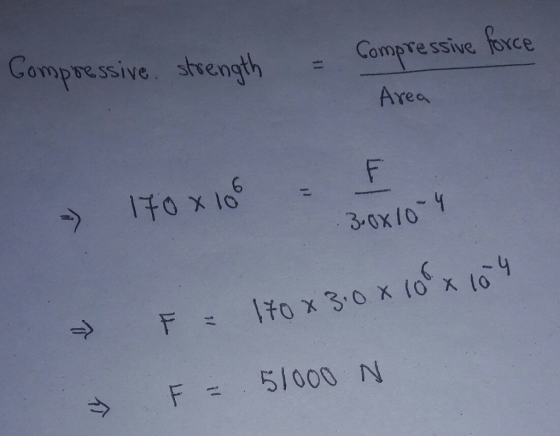
The femur bone in the human leg has a minimum effective cross section of about 3.0...
The femur bone in a human leg has a minimum effective cross section of 3.25 cm2.3.25...
The femur bone in a human leg has a minimum effective cross section of 3.25 cm2.3.25 cm2. How much compressive force can it withstand before breaking? Assume the ultimate strength of the bone to be 1.70×10⁸ N/m2.
The leg bone (femur) breaks under a compressive force of about 6.30 × 10⁴ N for...
The leg bone (femur) breaks under a compressive force of about 6.30 × 10⁴ N for a human and 12.7 × 10⁴ N for a horse. The human femur has a compressive strength of 160 MPa, whereas the horse femur has a compressive strength of 140 MPa. What is the effective cross-sectional area of the femur in a horse? (Note: Since the center of the femur contains bone marrow, which has essentially no compressive strength, the effective cross-sectional area is...
Please answer question 17: The femur (the largest leg bone) of a certain person has a...
Please answer question 17: The femur (the largest leg bone) of a certain person has a cross sectional area of 3.57×10⁻⁴m2 and a length of 39 cm. If the compressional strength of bone is 104 MN/m2, what is the force required to fracture this femur? Correct, computer gets: 3.71E+04 N 17. [2pt] In the previous problem, what is the elongation of the femur when it is on the verge of breaking? Use positive values if the bone is longer, and...
QUESTION 4 a) The human femur bone breaks if compressive stress greater than 1.50 * 10...
 QUESTION 4 a) The human femur bone breaks if compressive stress greater than 1.50 * 10 N/m2 is imposed on it. Assuming the Young's modulus for bone is 1.50 * 1010 N/m2, determine 1) the maximum force that can be exerted on the femur bone in the leg if it has a cross-sectional area of 4.90 x 10⁻⁴ m2 by how much does a 0.400 m long bone shorten if this maximum force is applied compressively to the bone. (6...
Assume that Young's Modulus for bone is 1.50 ✕ 1010 N/m2 and that the bone will...
Assume that Young's Modulus for bone is 1.50 ✕ 1010 N/m2 and that the bone will fracture if more than 1.50 ✕ 108 N/m2 is exerted. (a) What is the maximum force that can be exerted on the femur bone in the leg if it has a minimum effective diameter of 2.70 cm? (b) If a force of this magnitude is applied compressively, by how much does the 28.0 cm long bone shorten?
Bone has a young's modulus of about 18 times 10^9 pa. Under compression, it can withstand...
 Bone has a young's modulus of about 18 times 10^9 pa. Under compression, it can withstand a stress of about 163 times 10^6 pa before breaking. Assume that a femur (thigh bone) is 0048 m long, and calculate the amount of compression this bone can withstand before breaking.
By what amount does the 52-cm-long femur of an 73 kg runner compress at this moment? The cross-section area of the bone...
By what amount does the 52-cm-long femur of an 73 kg runner compress at this moment? The cross-section area of the bone of the femur can be taken as 5.2×10?4m2 and its Young's modulus is 1.6×10¹⁰N/m2.
While unrealistic, we will examine the forces on a leg when one falls from a height...
While unrealistic, we will examine the forces on a leg when one falls from a height by approximating the leg as a uniform cylinder of bone with a diameter of 2.3 cm and ignoring any shear forces. Human bone can be compressed with approximately 1.7 × 10⁸ N/m2 before breaking. A man with a mass of 70 kg falls from a height of 7 m. Assume his acceleration once he hits the ground is constant. For these calculations, g =...
Depending on how you fall, you can break a bone easily. The severity of the break depends on how much energy the bone a...
Depending on how you fall, you can break a bone easily. The severity of the break depends on how much energy the bone absorbs in the accident, and to evaluate this let us treat the bone as an ideal spring. The maximum applied force of compression that one man's thighbone can endure without breaking is 7.50 104 N. The minimum effective cross-sectional area of the bone is 3.90 10-4 m2, its length is 0.59 m, and Young's modulus is Y...
The shaft of the tibia is subjected to compressive forces. The length of the tibia shaft...
The shaft of the tibia is subjected to compressive forces. The length of the tibia shaft is 0.30 m and the cross-sectional area of cortical bone in the shaft is 0.0002 m2. If the ultimate strength of cortical bone is 200 x 10^6 N/m2 and if the elastic modulus of the shaft of the tibia is 2 x 10^10 N/m2, what is the maximum compressive force (in N) that can be applied to the tibia shaft before compressive failure? Now...
 QUESTION 4 a) The human femur bone breaks if compressive stress greater than 1.50 * 10 N/m2 is imposed on it. Assuming the Young's modulus for bone is 1.50 * 1010 N/m2, determine 1) the maximum force that can be exerted on the femur bone in the leg if it has a cross-sectional area of 4.90 x 10⁻⁴ m2 by how much does a 0.400 m long bone shorten if this maximum force is applied compressively to the bone. (6...
 Bone has a young's modulus of about 18 times 10^9 pa. Under compression, it can withstand a stress of about 163 times 10^6 pa before breaking. Assume that a femur (thigh bone) is 0048 m long, and calculate the amount of compression this bone can withstand before breaking.
Most questions answered within 3 hours.
-
Where is the error in this code sequence?
String s1 = "Hello";
String s2 = "ello";...
asked 11 months ago -
Financial data for Joel de Paris, Inc., for last year
follow:
Joel de Paris, Inc.
Balance...
asked 11 months ago -
Consider this reaction:
Al2(SO4)3 (aq)+ BaCl3
(aq) Al2Cl6 (aq)- +
3BaSO4(s) . What is the...
asked 11 months ago -
Suppose that Savneet is considering increasing her
recent random sample from 20 car rentals to 40...
asked 11 months ago -
Trucks arrive at an unloading terminal at an average rate of 120
per hour.
Trucks arrive...
asked 11 months ago -
Why are methanol and ethanol completely soluble in water while
octanol is not very little soluble....
asked 11 months ago -
A facilities manager at a university reads in a research report
that the mean amount of...
asked 11 months ago -
When the CuSO4 is rehydrated by adding water to the anhydrous
compound, is this an endothermic...
asked 11 months ago -
A ray of sunlight is passing from diamond into crown glass; the
angle of incidence is...
asked 11 months ago -
A block of mass 0.249 kg is placed on top of a light, vertical
spring of...
asked 11 months ago -
how do the kidneys compensate in the presences of acidosis
a) trigger hyperventilate
b) reserve acid...
asked 11 months ago -
Question 501 pts
The rental rate of capital to the firm increases. Which of the
following...
asked 11 months ago