The leg bone (femur) breaks under a compressive force of about 6.30 × 10⁴ N for...
The leg bone (femur) breaks under a compressive force of about 6.30 × 10⁴ N for a human and 12.7 × 10⁴ N for a horse. The human femur has a compressive strength of 160 MPa, whereas the horse femur has a compressive strength of 140 MPa.
What is the effective cross-sectional area of the femur in a horse? (Note: Since the center of the femur contains bone marrow, which has essentially no compressive strength, the effective cross-sectional area is about 80% of the total cross-sectional area.)
cm2
Homework Answers
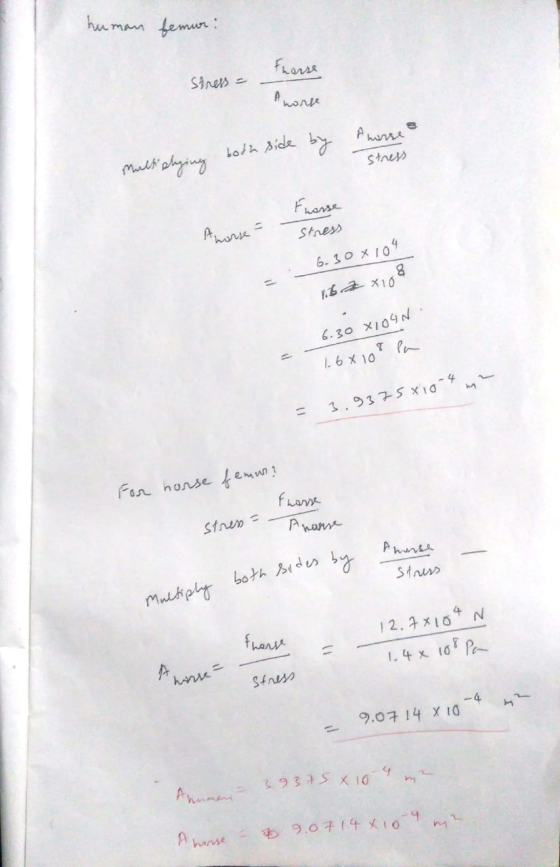
cross-sectional area of the femur in a horse = 9.0714 x 10⁻⁴ m2
Hope this will help you. Thanks. Please give a like.
Add Answer to:
The leg bone (femur) breaks under a compressive force of about
6.30 × 10⁴ N for...
The femur bone in a human leg has a minimum effective cross section of 3.25 cm2.3.25...
The femur bone in a human leg has a minimum effective cross section of 3.25 cm2.3.25 cm2. How much compressive force can it withstand before breaking? Assume the ultimate strength of the bone to be 1.70×10⁸ N/m2.
The femur bone in the human leg has a minimum effective cross section of about 3.0...
 The femur bone in the human leg has a minimum effective cross section of about 3.0 cm^2 (3.0 times 10^-4 m2). Compressive strength for bone is 170 times 10^6 N/m^2. Part A How much compressive force can it withstand before breaking?
Please answer question 17: The femur (the largest leg bone) of a certain person has a...
Please answer question 17: The femur (the largest leg bone) of a certain person has a cross sectional area of 3.57×10⁻⁴m2 and a length of 39 cm. If the compressional strength of bone is 104 MN/m2, what is the force required to fracture this femur? Correct, computer gets: 3.71E+04 N 17. [2pt] In the previous problem, what is the elongation of the femur when it is on the verge of breaking? Use positive values if the bone is longer, and...
QUESTION 4 a) The human femur bone breaks if compressive stress greater than 1.50 * 10...
 QUESTION 4 a) The human femur bone breaks if compressive stress greater than 1.50 * 10 N/m2 is imposed on it. Assuming the Young's modulus for bone is 1.50 * 1010 N/m2, determine 1) the maximum force that can be exerted on the femur bone in the leg if it has a cross-sectional area of 4.90 x 10⁻⁴ m2 by how much does a 0.400 m long bone shorten if this maximum force is applied compressively to the bone. (6...
Materials fracture when the force per unit area, called STRESS, exceeds a critical value. In general, the critical stress depends on the direction as well as the magnitude of the force. For example,...
 Materials fracture when the force per unit area, called STRESS, exceeds a critical value. In general, the critical stress depends on the direction as well as the magnitude of the force. For example, bones break differently when subjected to torsional (twisting) stress than when subjected to compressional (or squeezing) stress. Let us consider compressional stress. Wet human bone for 20-39 year olds has an ultimate compressive strength of 1.6x10⁴N/cm2 [8]. Consider a person who falls from a height to the...
i got 1.4 but it was incorrect and i am not sure why. Please help! READING 2 Materials fracture when the force per unit area, called STRESS, exceeds a critical value. In general, the critical stress...
 i got 1.4 but it was incorrect
and i am not sure why. Please help!
READING 2 Materials fracture when the force per unit area, called STRESS, exceeds a critical value. In general, the critical stress depends on the direction as well as the magnitude of the force. For example, bones break differently when subjected to torsional (twisting) stress than when subjected to compressional (or squeezing) stress. Let us consider compressional stress. Wet human bone for 20-39 year olds has...
i got 1.4 but it was incorrect
and i am not sure why. Please help!
READING 2 Materials fracture when the force per unit area, called STRESS, exceeds a critical value. In general, the critical stress depends on the direction as well as the magnitude of the force. For example, bones break differently when subjected to torsional (twisting) stress than when subjected to compressional (or squeezing) stress. Let us consider compressional stress. Wet human bone for 20-39 year olds has...
1. According to the paper, what does lactate dehydrogenase (LDH) do and what does it allow...
 1. According to the paper, what does lactate dehydrogenase
(LDH) do and what does it allow to happen within the myofiber? (5
points)
2. According to the paper, what is the major disadvantage of
relying on glycolysis during high-intensity exercise? (5
points)
3. Using Figure 1 in the paper, briefly describe the different
sources of ATP production at 50% versus 90% AND explain whether you
believe this depiction of ATP production applies to a Type IIX
myofiber in a human....
1. According to the paper, what does lactate dehydrogenase
(LDH) do and what does it allow to happen within the myofiber? (5
points)
2. According to the paper, what is the major disadvantage of
relying on glycolysis during high-intensity exercise? (5
points)
3. Using Figure 1 in the paper, briefly describe the different
sources of ATP production at 50% versus 90% AND explain whether you
believe this depiction of ATP production applies to a Type IIX
myofiber in a human....
explaim the mechanisms amd toxological effects if type 1 diabetes in this article Exposure to arsenic...
 explaim the mechanisms amd toxological effects if type 1
diabetes in this article
Exposure to arsenic in drinking water is associated with increased prevalence of diabetes. We previously reported an association of diabetes and urinary concentration of dimethylarsinite (DMAS"), a toxic product of arsenic methylation by arsenic (+ 3 oxidation state) methyltransferase (AS3MT). Here we examine associations between AS3MT polymorphism, arsenic metabolism and diabetes. Fasting blood glucose, oral glucose tolerance and self-reported diagnoses were used to identify diabetic individuals. Inorganic...
explaim the mechanisms amd toxological effects if type 1
diabetes in this article
Exposure to arsenic in drinking water is associated with increased prevalence of diabetes. We previously reported an association of diabetes and urinary concentration of dimethylarsinite (DMAS"), a toxic product of arsenic methylation by arsenic (+ 3 oxidation state) methyltransferase (AS3MT). Here we examine associations between AS3MT polymorphism, arsenic metabolism and diabetes. Fasting blood glucose, oral glucose tolerance and self-reported diagnoses were used to identify diabetic individuals. Inorganic...
 The femur bone in the human leg has a minimum effective cross section of about 3.0 cm^2 (3.0 times 10^-4 m2). Compressive strength for bone is 170 times 10^6 N/m^2. Part A How much compressive force can it withstand before breaking?
 QUESTION 4 a) The human femur bone breaks if compressive stress greater than 1.50 * 10 N/m2 is imposed on it. Assuming the Young's modulus for bone is 1.50 * 1010 N/m2, determine 1) the maximum force that can be exerted on the femur bone in the leg if it has a cross-sectional area of 4.90 x 10⁻⁴ m2 by how much does a 0.400 m long bone shorten if this maximum force is applied compressively to the bone. (6...
 Materials fracture when the force per unit area, called STRESS, exceeds a critical value. In general, the critical stress depends on the direction as well as the magnitude of the force. For example, bones break differently when subjected to torsional (twisting) stress than when subjected to compressional (or squeezing) stress. Let us consider compressional stress. Wet human bone for 20-39 year olds has an ultimate compressive strength of 1.6x10⁴N/cm2 [8]. Consider a person who falls from a height to the...
 i got 1.4 but it was incorrect
and i am not sure why. Please help!
READING 2 Materials fracture when the force per unit area, called STRESS, exceeds a critical value. In general, the critical stress depends on the direction as well as the magnitude of the force. For example, bones break differently when subjected to torsional (twisting) stress than when subjected to compressional (or squeezing) stress. Let us consider compressional stress. Wet human bone for 20-39 year olds has...
i got 1.4 but it was incorrect
and i am not sure why. Please help!
READING 2 Materials fracture when the force per unit area, called STRESS, exceeds a critical value. In general, the critical stress depends on the direction as well as the magnitude of the force. For example, bones break differently when subjected to torsional (twisting) stress than when subjected to compressional (or squeezing) stress. Let us consider compressional stress. Wet human bone for 20-39 year olds has...
 1. According to the paper, what does lactate dehydrogenase
(LDH) do and what does it allow to happen within the myofiber? (5
points)
2. According to the paper, what is the major disadvantage of
relying on glycolysis during high-intensity exercise? (5
points)
3. Using Figure 1 in the paper, briefly describe the different
sources of ATP production at 50% versus 90% AND explain whether you
believe this depiction of ATP production applies to a Type IIX
myofiber in a human....
1. According to the paper, what does lactate dehydrogenase
(LDH) do and what does it allow to happen within the myofiber? (5
points)
2. According to the paper, what is the major disadvantage of
relying on glycolysis during high-intensity exercise? (5
points)
3. Using Figure 1 in the paper, briefly describe the different
sources of ATP production at 50% versus 90% AND explain whether you
believe this depiction of ATP production applies to a Type IIX
myofiber in a human....
 explaim the mechanisms amd toxological effects if type 1
diabetes in this article
Exposure to arsenic in drinking water is associated with increased prevalence of diabetes. We previously reported an association of diabetes and urinary concentration of dimethylarsinite (DMAS"), a toxic product of arsenic methylation by arsenic (+ 3 oxidation state) methyltransferase (AS3MT). Here we examine associations between AS3MT polymorphism, arsenic metabolism and diabetes. Fasting blood glucose, oral glucose tolerance and self-reported diagnoses were used to identify diabetic individuals. Inorganic...
explaim the mechanisms amd toxological effects if type 1
diabetes in this article
Exposure to arsenic in drinking water is associated with increased prevalence of diabetes. We previously reported an association of diabetes and urinary concentration of dimethylarsinite (DMAS"), a toxic product of arsenic methylation by arsenic (+ 3 oxidation state) methyltransferase (AS3MT). Here we examine associations between AS3MT polymorphism, arsenic metabolism and diabetes. Fasting blood glucose, oral glucose tolerance and self-reported diagnoses were used to identify diabetic individuals. Inorganic...
Most questions answered within 3 hours.
-
Where is the error in this code sequence?
String s1 = "Hello";
String s2 = "ello";...
asked 11 months ago -
Financial data for Joel de Paris, Inc., for last year
follow:
Joel de Paris, Inc.
Balance...
asked 11 months ago -
Consider this reaction:
Al2(SO4)3 (aq)+ BaCl3
(aq) Al2Cl6 (aq)- +
3BaSO4(s) . What is the...
asked 11 months ago -
Suppose that Savneet is considering increasing her
recent random sample from 20 car rentals to 40...
asked 11 months ago -
Trucks arrive at an unloading terminal at an average rate of 120
per hour.
Trucks arrive...
asked 11 months ago -
Why are methanol and ethanol completely soluble in water while
octanol is not very little soluble....
asked 11 months ago -
A facilities manager at a university reads in a research report
that the mean amount of...
asked 11 months ago -
When the CuSO4 is rehydrated by adding water to the anhydrous
compound, is this an endothermic...
asked 11 months ago -
A ray of sunlight is passing from diamond into crown glass; the
angle of incidence is...
asked 11 months ago -
A block of mass 0.249 kg is placed on top of a light, vertical
spring of...
asked 11 months ago -
how do the kidneys compensate in the presences of acidosis
a) trigger hyperventilate
b) reserve acid...
asked 11 months ago -
Question 501 pts
The rental rate of capital to the firm increases. Which of the
following...
asked 11 months ago