Consider two toy cars. Car A starts from rest and speeds up with constant acceleration for...
Consider two toy cars. Car A starts from rest and speeds up with
constant acceleration for a time tA until it reaches a speed of vA
and then continues to travel at this speed. At the moment car A
reaches its maximum speed, car B, starting at rest from the same
point that car A started from, speeds up with constant acceleration
aB.
a) Make a freehand plot of the speed of each car as a function of
time. Label your plot with all relevant information, including any
given slope information.
c) Determine how much time, ∆t, elapses between the time car B
starts moving and the time car B passes car A. To do this, you will
need to solve a quadratic equation. Explain your choice of sign for
the radical.
2
b) Make a freehand plot of the position of each car as a func- tion
of time. Label your plot with all relevant information, including
any given slope information.
d) Determine the ratio vB/vA, where vB is the speed of car B at the
moment it passes car A. Simplify your answer as much as possible.
What is the limit of vB/vA as aB → 0? Will car B always eventually
overtake car A no matter how small we make aB (as long as aB is
nonzero)?
Homework Answers
a)
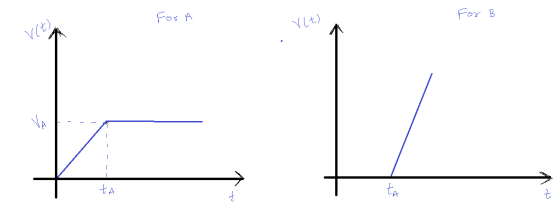
c)
let the car B catch car A after time  t
t
Consider the motion of car A :
VAo = initial velocity of car A = 0 m/s
tA = time during which the car accelerate
t = time during
which the car A moves at constant speed
Position of car A is given as
XA = VAo tA + (0.5)
aA tA2 + VAt
XA = (0) tA + (0.5) aA
tA2 + VAt
XA = VAt + (0.5)
aA
tA2
eq-1
Consider the motion of car B :
VBo = initial velocity of car B = 0 m/s
t = time during
which the car B accelerate
aB = acceleration of car B
Position of car B is given as
XB = VBot + (0.5)
aBt2
XB = (0) t + (0.5)
aBt2
XB = (0.5) aBt2
eq-2
Using eq-1 and eq-2, for the cars to catch each other
XA = XB
VAt + (0.5)
aA tA2 = (0.5)
aBt2
(0.5) aBt2 -
VAt - + (0.5)
aA tA2 = 0
t = (- (-
VA)  sqrt((-
VA)2 - 4 ((0.5) aB ) ((0.5)
aA tA2)) )/aB
sqrt((-
VA)2 - 4 ((0.5) aB ) ((0.5)
aA tA2)) )/aB
t = (
VA sqrt(
VA2 - aB aA
tA2 )/aB
the sign will be positive since time can not be negative
Add Answer to:
Consider two toy cars. Car A starts from rest and speeds up with
constant acceleration for...
Problem 1) A car starts from rest at x 0 and 0, travelling in a straight...
 Problem 1) A car starts from rest at x 0 and 0, travelling in a straight line. The car speeds up and then slows down until it comes back to rest at a distance of 0.900 km from where it started. For the first quarter of the distance, its acceleration is +2.25 m/s2, while for the last three quarters of the distance its acceleration is -0.750 m/s2. (a) Find the travel time for the entire trip. (b) Find the maximum...
A train has a length of 104 m and starts from rest with a constant acceleration...
A train has a length of 104 m and starts from rest with a constant acceleration at time t = 0 s. At this instant, a car just reaches the end of the train. The car is moving with a constant velocity. At a time t = 8.14 s, the car just reaches the front of the train. Ultimately, however, the train pulls ahead of the car, and at time t = 39.9 s, the car is again at the...
A train has a length of 107 m and starts from rest with a constant acceleration...
A train has a length of 107 m and starts from rest with a constant acceleration at time t = 0 s. At this instant, a car just reaches the end of the train. The car is moving with a constant velocity. At a time t = 11.3 s, the car just reaches the front of the train. Ultimately, however, the train pulls ahead of the car, and at time t = 37.3 s, the car is again at the...
2. A car starts from rest at a stop sign. It accelerates at 2.5 m/32 for...
 2. A car starts from rest at a stop sign. It accelerates at 2.5 m/32 for until it reaches a speed of 50 km/hr. (1 km/hr .278 m/s) (a) Draw a picture of this problem (not a motion diagram but a picture!) clearly indicate on your picture where you call x-0, t-0 i.e. establish a coordinate ystem. Label it with symbols representing initial positon, initial velocity, final position final time, final velocity and acceleration and include all the information you...
Review. As soon as a traffic light turns green, a car speeds up from rest to...
Review. As soon as a traffic light turns green, a car speeds up from rest to 22.35 m/s with constant acceleration 4.02 m/s2. In the adjoining bicycle lane, a cyclist speeds up from rest to 8.94 m/s with constant acceleration 5.81m/s2. Each vehicle maintains constant velocity after reaching its cruising speed. (a) For what time interval is the bicycle ahead of the car? (b) By what maximum distance does the bicycle lead the car? Give it with detailed explanation please.
Help 6. A 2370 kg airplane starts from rest and, with a constant acceleration of 5.0...
 Help
6. A 2370 kg airplane starts from rest and, with a constant acceleration of 5.0 m/s, reaches its takeoff speed in 9.00 s. a. What is the net force on the airplane during this time? b. What is the airplane's takeoff speed? c. How far down the runway does the airplane travel before taking off? 7. A train engine pulls a freight car that has a mass of 5.0 x 10 kg with a constant force. The freight car...
Help
6. A 2370 kg airplane starts from rest and, with a constant acceleration of 5.0 m/s, reaches its takeoff speed in 9.00 s. a. What is the net force on the airplane during this time? b. What is the airplane's takeoff speed? c. How far down the runway does the airplane travel before taking off? 7. A train engine pulls a freight car that has a mass of 5.0 x 10 kg with a constant force. The freight car...
Car 1 starts from rest along a straight highway with constant acceleration a = 1 m/s2. Car...
Car 1 starts from rest along a straight highway with constant acceleration a = 1 m/s2. Car 2 passes car 1 with constant velocity of 120 km/hr. Which car is acted on by a larger net force? a- The net force on both cars is zero. b- Car 2 c-Both cars are acted on by the same non-zero net force. d-Car 1
A low-flying crop-duster A is moving with a constant speed of 40 m/s in the horizontal circle of radius 300 m. As it passes the twelve-o'clock position shown at time t = 0, car B starts from rest from the position shown and accelerates along the straight
 A low-flying cropduster A is moving with a constant speed of 40 m/s in the horizontal circle of radius 300 m. As it passes the twelve-o'clock position shown at time t = 0 car B starts from rest from the position shown and accelerates along the straight road at the constant rate of 3m / (s ^ 2) until it reaches a speed of 30m / s after which it maintains that constant speed. Determine the velocity and acceleration
of...
A low-flying cropduster A is moving with a constant speed of 40 m/s in the horizontal circle of radius 300 m. As it passes the twelve-o'clock position shown at time t = 0 car B starts from rest from the position shown and accelerates along the straight road at the constant rate of 3m / (s ^ 2) until it reaches a speed of 30m / s after which it maintains that constant speed. Determine the velocity and acceleration
of...
A low-flying crop-duster A is moving with a constant speed of 40 m/s in the horizontal circle of radius 300 m. As it passes the twelve-o'clock position shown at time t = 0, car B starts from rest from the position shown and accelerates along the straight
A low-flying cropduster A is moving with a constant speed of 40 m/s in the horizontal circle of radius 300 m. As it passes the twelve-o'clock position shown at time t = 0 car B starts from rest from the position shown and accelerates along the straight road at the constant rate of 3m / (s ^ 2) until it reaches a speed of 30m / s after which it maintains that constant speed. Determine the velocity and acceleration
of...
2. The car starts from rest at s 0 and is subjected to an acceleration shown...
 2. The car starts from rest at s 0 and is subjected to an acceleration shown as Fig. 2 a-s plot. Please draw v-s curve and determine the time to travel 200 m. a (m/s) 수 12 300 450 s (m) Fig. 2 a-s plot for Problem 2
 Problem 1) A car starts from rest at x 0 and 0, travelling in a straight line. The car speeds up and then slows down until it comes back to rest at a distance of 0.900 km from where it started. For the first quarter of the distance, its acceleration is +2.25 m/s2, while for the last three quarters of the distance its acceleration is -0.750 m/s2. (a) Find the travel time for the entire trip. (b) Find the maximum...
 2. A car starts from rest at a stop sign. It accelerates at 2.5 m/32 for until it reaches a speed of 50 km/hr. (1 km/hr .278 m/s) (a) Draw a picture of this problem (not a motion diagram but a picture!) clearly indicate on your picture where you call x-0, t-0 i.e. establish a coordinate ystem. Label it with symbols representing initial positon, initial velocity, final position final time, final velocity and acceleration and include all the information you...
 Help
6. A 2370 kg airplane starts from rest and, with a constant acceleration of 5.0 m/s, reaches its takeoff speed in 9.00 s. a. What is the net force on the airplane during this time? b. What is the airplane's takeoff speed? c. How far down the runway does the airplane travel before taking off? 7. A train engine pulls a freight car that has a mass of 5.0 x 10 kg with a constant force. The freight car...
Help
6. A 2370 kg airplane starts from rest and, with a constant acceleration of 5.0 m/s, reaches its takeoff speed in 9.00 s. a. What is the net force on the airplane during this time? b. What is the airplane's takeoff speed? c. How far down the runway does the airplane travel before taking off? 7. A train engine pulls a freight car that has a mass of 5.0 x 10 kg with a constant force. The freight car...
 2. The car starts from rest at s 0 and is subjected to an acceleration shown as Fig. 2 a-s plot. Please draw v-s curve and determine the time to travel 200 m. a (m/s) 수 12 300 450 s (m) Fig. 2 a-s plot for Problem 2
Most questions answered within 3 hours.
-
Where is the error in this code sequence?
String s1 = "Hello";
String s2 = "ello";...
asked 11 months ago -
Financial data for Joel de Paris, Inc., for last year
follow:
Joel de Paris, Inc.
Balance...
asked 11 months ago -
Consider this reaction:
Al2(SO4)3 (aq)+ BaCl3
(aq) Al2Cl6 (aq)- +
3BaSO4(s) . What is the...
asked 11 months ago -
Suppose that Savneet is considering increasing her
recent random sample from 20 car rentals to 40...
asked 11 months ago -
Trucks arrive at an unloading terminal at an average rate of 120
per hour.
Trucks arrive...
asked 11 months ago -
Why are methanol and ethanol completely soluble in water while
octanol is not very little soluble....
asked 11 months ago -
A facilities manager at a university reads in a research report
that the mean amount of...
asked 11 months ago -
When the CuSO4 is rehydrated by adding water to the anhydrous
compound, is this an endothermic...
asked 11 months ago -
A ray of sunlight is passing from diamond into crown glass; the
angle of incidence is...
asked 11 months ago -
A block of mass 0.249 kg is placed on top of a light, vertical
spring of...
asked 11 months ago -
how do the kidneys compensate in the presences of acidosis
a) trigger hyperventilate
b) reserve acid...
asked 11 months ago -
Question 501 pts
The rental rate of capital to the firm increases. Which of the
following...
asked 11 months ago