Tony is a project leader at a company frequently subcontracted to produce code for various U.S....
Tony is a project leader at a company frequently subcontracted
to produce code for various U.S. government entities and
affiliates. Traditionally, code that was developed for one federal
department could be reused for another if approval was obtained by
the former.
One day, Tony’s company was contacted by a privately-owned
commercial corporation, FlyHigh, to create code for an
avionics-related image processing effort. Since the code requested
was almost identical to one used for a past project, Tony’s team
decided to, once approval had been obtained from the government,
reuse the code. After permission was granted through email,
however, Tony realized the approving party, a law agency that was
contracted by the government, lacked complete understanding of who
would benefit from the reused code. Tony wanted to contact the
government directly to ensure it had been informed of all vital
aspects of the contract, but realized doing so could mean having
the initial approval revoked, having to re-code the requested code,
and increasing the contract bid up to two million dollars.
Understanding the contract between his company and FlyHighwas on
the line, should Tony move forward with clarifying the situation to
the appropriate party?
Homework Answers
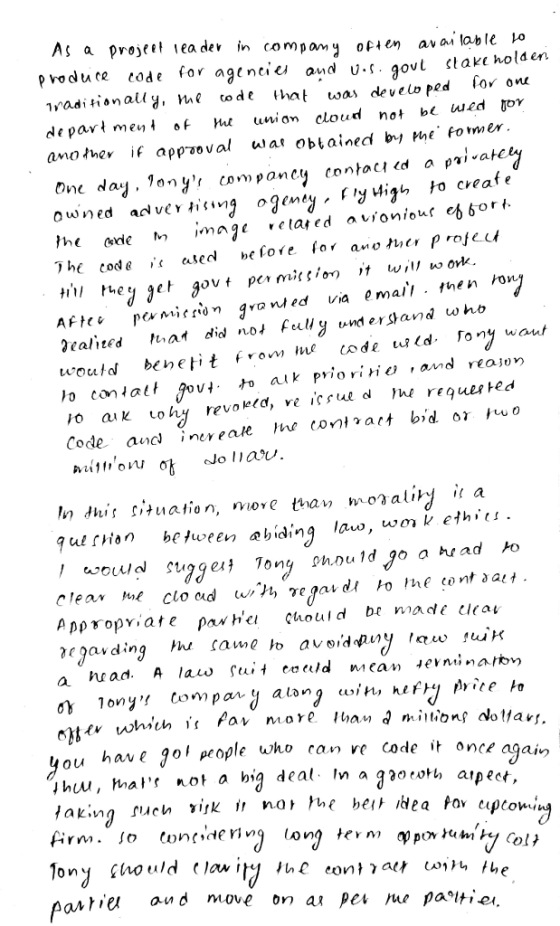
If you have any query comment down below i will surely help you as soon as possible.Please upvote my answer.Thanks in advance...!
Add Answer to:
Tony is a project leader at a company frequently subcontracted
to produce code for various U.S....
How can we assess whether a project is a success or a failure? This case presents...
 How can we assess whether a project is a success or a
failure?
This case presents two phases of a large business transformation project involving the implementation of an ERP system with the aim of creating an integrated company. The case illustrates some of the challenges associated with integration. It also presents the obstacles facing companies that undertake projects involving large information technology projects. Bombardier and Its Environment Joseph-Armand Bombardier was 15 years old when he built his first snowmobile...
How can we assess whether a project is a success or a
failure?
This case presents two phases of a large business transformation project involving the implementation of an ERP system with the aim of creating an integrated company. The case illustrates some of the challenges associated with integration. It also presents the obstacles facing companies that undertake projects involving large information technology projects. Bombardier and Its Environment Joseph-Armand Bombardier was 15 years old when he built his first snowmobile...
Case Study Analysis: Fred Stern & Company, Inc. (Knapp): In the business world of the Roaring...
Case Study Analysis: Fred Stern & Company, Inc. (Knapp): In the business world of the Roaring Twenties, the schemes and scams of flimflam artists and confidence men were legendary. The absence of a strong regulatory system at the federal level to police the securities markets—the Securities and Exchange Commission was not established until 1934—aided, if not encouraged, financial frauds of all types. In all likelihood, the majority of individuals involved in business during the 1920s were scrupulously honest. Nevertheless, the...
 How can we assess whether a project is a success or a
failure?
This case presents two phases of a large business transformation project involving the implementation of an ERP system with the aim of creating an integrated company. The case illustrates some of the challenges associated with integration. It also presents the obstacles facing companies that undertake projects involving large information technology projects. Bombardier and Its Environment Joseph-Armand Bombardier was 15 years old when he built his first snowmobile...
How can we assess whether a project is a success or a
failure?
This case presents two phases of a large business transformation project involving the implementation of an ERP system with the aim of creating an integrated company. The case illustrates some of the challenges associated with integration. It also presents the obstacles facing companies that undertake projects involving large information technology projects. Bombardier and Its Environment Joseph-Armand Bombardier was 15 years old when he built his first snowmobile...
Most questions answered within 3 hours.
-
Where is the error in this code sequence?
String s1 = "Hello";
String s2 = "ello";...
asked 11 months ago -
Financial data for Joel de Paris, Inc., for last year
follow:
Joel de Paris, Inc.
Balance...
asked 11 months ago -
Consider this reaction:
Al2(SO4)3 (aq)+ BaCl3
(aq) Al2Cl6 (aq)- +
3BaSO4(s) . What is the...
asked 11 months ago -
Suppose that Savneet is considering increasing her
recent random sample from 20 car rentals to 40...
asked 11 months ago -
Trucks arrive at an unloading terminal at an average rate of 120
per hour.
Trucks arrive...
asked 11 months ago -
Why are methanol and ethanol completely soluble in water while
octanol is not very little soluble....
asked 11 months ago -
A facilities manager at a university reads in a research report
that the mean amount of...
asked 11 months ago -
When the CuSO4 is rehydrated by adding water to the anhydrous
compound, is this an endothermic...
asked 11 months ago -
A ray of sunlight is passing from diamond into crown glass; the
angle of incidence is...
asked 11 months ago -
A block of mass 0.249 kg is placed on top of a light, vertical
spring of...
asked 11 months ago -
how do the kidneys compensate in the presences of acidosis
a) trigger hyperventilate
b) reserve acid...
asked 11 months ago -
Question 501 pts
The rental rate of capital to the firm increases. Which of the
following...
asked 11 months ago