
Homework Answers
Add Answer to:
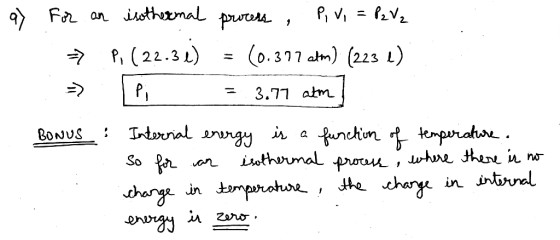
9. (5 points) 1.00 mole of an ideal gas undergoes an isothermal process. Its initial volume...
A diatomic gas describes a Carnot cycle in which, through an isothermal expansion process at 850...
A diatomic gas describes a Carnot cycle in which, through an isothermal expansion process at 850 K it passes from a pressure of 10 atm and a volume of 2 L at a pressure of 8 atm. Subsequently there is an adiabatic expansion and isothermal compression at a temperature of 310 K. Finally, in the adiabatic compression the initial point is reached at 10 atm of pressure and a volume of 2 L. Make a scheme of the process and...
(5 pts) 15.A quantity of 2.0 moles of an ideal gas undergoes a reversible isothermal process...
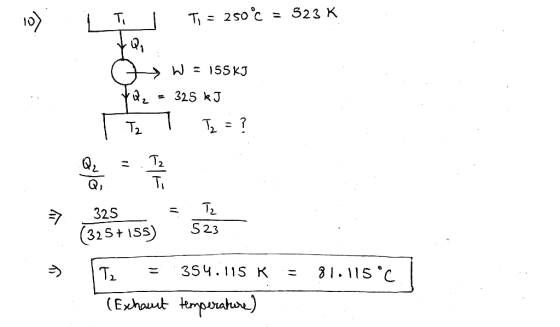
 (5 pts) 15.A quantity of 2.0 moles of an ideal gas undergoes a reversible isothermal process (AT -0) at 120 K. In the process 80.0 J of heat energy flows out of the gas. In this process the entropy of the gas a decreases (b) stays the same (c) increases (5 pts) 16. In each cycle a heat engine receives 80.0 J of heat energy from the high temperature reservoir and rejects 30.0 J of heat energy into the low...
12. 1 mole of an ideal gas undergoes an isothermal expansion from V1 = 1.4L followed...
 12. 1 mole of an ideal gas undergoes an isothermal expansion from V1 = 1.4L followed by isobaric compression, p = cst.if P1 = 4.4atm, p2 = 1.7atm → ?- m calculate the work done by gas during the expansion. Express work in J = N·m! • For isothermal processes, AT = 0 T = cst → w=faw=fr&v=/MRT AV 594 Show your work like: `x-int_0^5 v(t)dt rarr x-int_0^5(-4*t)dt=-50 m 13. 1 mole of an ideal gas undergoes an isothermal expansion...
An ideal gas undergoes isothermal compression from an initial volume of 5.28 m3 to a final...
An ideal gas undergoes isothermal compression from an initial volume of 5.28 m3 to a final volume of 2.89 m3. There is 6.41 mol of the gas, and its temperature is 11.4°C. (a) How much work is done by the gas? (b) How much energy is transferred as heat between the gas and its environment?
Consider a monatomic ideal gas operating through the Carnot cycle. The initial volume of the gas is V1 = 340x 10-3m3 .
 Consider a monatomic ideal gas operating through the Carnot cycle. The initial volume of the gas is V1 = 340x 10-3m3 .Part (a) What types of processes are going on for each step in this process? Part (b) During the isothermal compression step, the volume of gas is reduced by a factor of 4. In the adiabatic heating step, the temperature of the gas is doubled. What is the volume at point 3. in cubic meters? Part (c) What is the volume at...
An ideal gas is brought through an isothermal compression process. The 5.00 mol of gas goes...
 An ideal gas is brought through an isothermal compression process. The 5.00 mol of gas goes from an initial volume of 215.4 x 100m to a final volume of 126.2 x 10-m. If 7.40 x 10' J is released by the gas during this process, what are the temperature T and the final pressure p, of the gas?
A Carnot cycle is conducted using an ideal diatomic gas. Initially, the gas is at temperature...
A Carnot cycle is conducted using an ideal diatomic gas. Initially, the gas is at temperature 25C., pressure of 100KPa and volume of 0.01m3. The system is then compressed isothermally to a volume 0.002m3. From that point, the gas undergoes an adiabatic compression ( with gamma= 1.4), until the volume further reduces to 0.001m3. After that, the system goes an isothermal expansion process to a point where the pressure of the system is 263.8KPa. Then the system continues the cycle...
7.5) A 1.15 -mol quantity of monatomic ideal gas undergoes the following cyclic process. The gas...
 7.5) A 1.15 -mol quantity of monatomic ideal gas undergoes the
following cyclic process. The gas starts at point a at STP. It
expands isothermally to point b, where the volume is 2.2 times its
original volume. Next, heat is removed while keeping the volume
constant and reducing the pressure. Finally, the gas undergoes
adiabatic compression, returning to point a.
a. Calculate the pressures at b and c. (answers in Pa)
**Find the volumes at a and b first.
**Use...
7.5) A 1.15 -mol quantity of monatomic ideal gas undergoes the
following cyclic process. The gas starts at point a at STP. It
expands isothermally to point b, where the volume is 2.2 times its
original volume. Next, heat is removed while keeping the volume
constant and reducing the pressure. Finally, the gas undergoes
adiabatic compression, returning to point a.
a. Calculate the pressures at b and c. (answers in Pa)
**Find the volumes at a and b first.
**Use...
An ideal gas is brought through an isothermal compression process. The 5.00 mol of gas goes...
 An ideal gas is brought through an isothermal compression process. The 5.00 mol of gas goes from an initial volume of 269 3 10-6 rm3 to a final volume of 1 12.7 10 6 m, If 7730 J İs released by the gas during this process, what are the temperature T and the final pressure py of the gas? Pa
4. An ideal gas with constant specific heats undergoes a process from an initial pressure of...
4. An ideal gas with constant specific heats undergoes a process from an initial pressure of 50 kPa and initial specific volume of 4 m^3/kg to a final pressure of 80 kPa and final specific volume of 5 m^3/kg. The mass of the carbon monoxide is 3 kg. The gas has a molar mass of 44 kg/kmol and a specific heat at constant volume of 0.98 kJ/(kg∙K). Determine the entropy change of the gas during the process in kJ/K.
 (5 pts) 15.A quantity of 2.0 moles of an ideal gas undergoes a reversible isothermal process (AT -0) at 120 K. In the process 80.0 J of heat energy flows out of the gas. In this process the entropy of the gas a decreases (b) stays the same (c) increases (5 pts) 16. In each cycle a heat engine receives 80.0 J of heat energy from the high temperature reservoir and rejects 30.0 J of heat energy into the low...
 12. 1 mole of an ideal gas undergoes an isothermal expansion from V1 = 1.4L followed by isobaric compression, p = cst.if P1 = 4.4atm, p2 = 1.7atm → ?- m calculate the work done by gas during the expansion. Express work in J = N·m! • For isothermal processes, AT = 0 T = cst → w=faw=fr&v=/MRT AV 594 Show your work like: `x-int_0^5 v(t)dt rarr x-int_0^5(-4*t)dt=-50 m 13. 1 mole of an ideal gas undergoes an isothermal expansion...
 An ideal gas is brought through an isothermal compression process. The 5.00 mol of gas goes from an initial volume of 215.4 x 100m to a final volume of 126.2 x 10-m. If 7.40 x 10' J is released by the gas during this process, what are the temperature T and the final pressure p, of the gas?
 An ideal gas is brought through an isothermal compression process. The 5.00 mol of gas goes from an initial volume of 269 3 10-6 rm3 to a final volume of 1 12.7 10 6 m, If 7730 J İs released by the gas during this process, what are the temperature T and the final pressure py of the gas? Pa
Most questions answered within 3 hours.
-
Where is the error in this code sequence?
String s1 = "Hello";
String s2 = "ello";...
asked 11 months ago -
Financial data for Joel de Paris, Inc., for last year
follow:
Joel de Paris, Inc.
Balance...
asked 11 months ago -
Consider this reaction:
Al2(SO4)3 (aq)+ BaCl3
(aq) Al2Cl6 (aq)- +
3BaSO4(s) . What is the...
asked 11 months ago -
Suppose that Savneet is considering increasing her
recent random sample from 20 car rentals to 40...
asked 11 months ago -
Trucks arrive at an unloading terminal at an average rate of 120
per hour.
Trucks arrive...
asked 11 months ago -
Why are methanol and ethanol completely soluble in water while
octanol is not very little soluble....
asked 11 months ago -
A facilities manager at a university reads in a research report
that the mean amount of...
asked 11 months ago -
When the CuSO4 is rehydrated by adding water to the anhydrous
compound, is this an endothermic...
asked 11 months ago -
A ray of sunlight is passing from diamond into crown glass; the
angle of incidence is...
asked 11 months ago -
A block of mass 0.249 kg is placed on top of a light, vertical
spring of...
asked 11 months ago -
how do the kidneys compensate in the presences of acidosis
a) trigger hyperventilate
b) reserve acid...
asked 11 months ago -
Question 501 pts
The rental rate of capital to the firm increases. Which of the
following...
asked 11 months ago