
Homework Answers
 So reaction in AB is 233.35 KN
tension and reaction in BC is 178.75 KN compression.
So reaction in AB is 233.35 KN
tension and reaction in BC is 178.75 KN compression.
Add Answer to:
mail YouTube Maps Translate Fig.2 3- Determine the load in each member of the system shown...
For the beam shown in Fig. 9.5(a), determine the maximum positive and negative shears and the...
 For the beam shown in Fig. 9.5(a), determine the maximum positive and negative shears and the maximum positive and negative bending moments at point due to a concentrated live load of 90 kN, a uniformly distributed live load of 40 kN/m, and a uniformly distributed dead load of 20 kN/m. А B с 3 m - 3 m 6 m (a) cm | قمة | А с D B D A B -2 (e) Influence Line for Mc (kN-m/kN) (b)...
QUESTION 1 [25 marks A frame loaded with a uniformly distributed load at Member AB and...
 QUESTION 1 [25 marks A frame loaded with a uniformly distributed load at Member AB and point load at Member BC and joint B. It has pinned supports A and C, while joint B is fixed connected, as can be seen in Figure 1. Take E-200 GPa. a) Using the slope-deflection method, calculate the moments and illustrate the bending moment diagram. [15 marks) b) Then calculate the shear forces and sketch the shear force diagram. [10 marks) 22 KN 10...
The beam shown in Figure (2) is subjected to a uniform live load of 2.4 kN/m,...
 The beam shown in Figure (2) is subjected to a uniform live load of 2.4 kN/m, a dead load of 1.0 kN/m, and a single live load of 80 kN. Assume B is an internal hinge. Determine: (a) the maximum positive moment at E, (b) the maximum positive shear at E. created by these loads. Hinge A B С E D 2m 2m 2m 2m
Q5: Using force method, determine the reactions of the supports for the beam shown in Figure...
 Q5: Using force method, determine the reactions of the
supports for the beam shown in Figure (5). Then draw shear and
bending moment diagrams for the beam. EI is constant. Use conjugate
beam method to determine deflections.
I need it in 30min or 1 h
6 m 50 KN 200 kN.m 22 А В. С 9 m to 3m
Q5: Using force method, determine the reactions of the
supports for the beam shown in Figure (5). Then draw shear and
bending moment diagrams for the beam. EI is constant. Use conjugate
beam method to determine deflections.
I need it in 30min or 1 h
6 m 50 KN 200 kN.m 22 А В. С 9 m to 3m
2. a. An edge beam with sectional dimensions is shown in Fig.3. i. Determine the location...
 2. a. An edge beam with sectional dimensions is shown in Fig.3. i. Determine the location of its centriod from point 0. ii. Determine its moment of inertia in x-x direction about centriod. A y 150mm 40mm 35mm 300mm V --> X Fig. 3 2. b. Determine the mid-span deflection of a 3m long simply supported R.C. beam which is subject to a gravity UDL of 10 kN/m with a cross section as shown in Fig. 3 (E = 35kN/mm²).
4-34 Refer to Fig. P4-34. Determine the forces acting on each member of the frame due...
 4-34 Refer to Fig. P4-34. Determine the forces acting on each member of the frame due to the 4-kN load shown. Neglect the weights of all members srwoda bsol 10 m 0.5 m 0.5m 4 kN 0.7 m FIGURE P4-34
Determine the force in each member of the truss shown by the method of joint. 20...
 Determine the force in each member of the truss shown by the
method of joint.
20 kN 10 kN 3 m 20 kN 20 kN F С) E D 3 m 20 20 B A 3 m 3 m 3 m 3 m FIG. P4.27
Determine the force in each member of the truss shown by the
method of joint.
20 kN 10 kN 3 m 20 kN 20 kN F С) E D 3 m 20 20 B A 3 m 3 m 3 m 3 m FIG. P4.27
3. For the frame shown in Fig. 3, (a) (7%) determine the support reactions, (b) (6%) draw the fre...
 3. For the frame shown in Fig. 3, (a) (7%) determine the support reactions, (b) (6%) draw the free-body diagrams of member AB and member CBD; (c) (12%) replace the loading on the frame by a single resultant force, and specify where its line of action intersects member CD, measured from end C 150 N 500 N 3 m 3m 2 m 400 N -m 0.35 m 0.35 m 3 m 500 N 35° Fig. 3 Fig. 2 Fig. 1...
1- For the Pratt type bridge reinforcement and the load shown in the figure. 1. Determine...
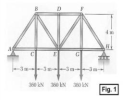 1- For the Pratt type bridge reinforcement and the load shown in
the figure. 1. Determine the average normal stress on the BE
element, knowing that the element's cross-sectional area is 350
mm2.
Make the free body diagram and explain step by step.
B D 4 m A C E --3---3-- -3m- -3 m 360 kN 360 KN 360 KN Fig. 1
1- For the Pratt type bridge reinforcement and the load shown in
the figure. 1. Determine the average normal stress on the BE
element, knowing that the element's cross-sectional area is 350
mm2.
Make the free body diagram and explain step by step.
B D 4 m A C E --3---3-- -3m- -3 m 360 kN 360 KN 360 KN Fig. 1
Determine the forces in each member of the truss shown in figure 11. Above. 120 KN...
 Determine the forces in each member of the truss shown in figure
11. Above.
120 KN 120 KN 4 m 120 KN H E F 60 KN 60 KN 4 m 40 KN 40 KN A B D 8 m +2 m|-3 m-3m|3m|3m|2m1 8 m Figure 11: A truss. GROUP 2B QUESTION 12: You have just graduated from CBU as a civil engineer. A water utility company employs you. During maintenance, in turning the water pump steadily, you exert a...
Determine the forces in each member of the truss shown in figure
11. Above.
120 KN 120 KN 4 m 120 KN H E F 60 KN 60 KN 4 m 40 KN 40 KN A B D 8 m +2 m|-3 m-3m|3m|3m|2m1 8 m Figure 11: A truss. GROUP 2B QUESTION 12: You have just graduated from CBU as a civil engineer. A water utility company employs you. During maintenance, in turning the water pump steadily, you exert a...
 For the beam shown in Fig. 9.5(a), determine the maximum positive and negative shears and the maximum positive and negative bending moments at point due to a concentrated live load of 90 kN, a uniformly distributed live load of 40 kN/m, and a uniformly distributed dead load of 20 kN/m. А B с 3 m - 3 m 6 m (a) cm | قمة | А с D B D A B -2 (e) Influence Line for Mc (kN-m/kN) (b)...
 QUESTION 1 [25 marks A frame loaded with a uniformly distributed load at Member AB and point load at Member BC and joint B. It has pinned supports A and C, while joint B is fixed connected, as can be seen in Figure 1. Take E-200 GPa. a) Using the slope-deflection method, calculate the moments and illustrate the bending moment diagram. [15 marks) b) Then calculate the shear forces and sketch the shear force diagram. [10 marks) 22 KN 10...
 The beam shown in Figure (2) is subjected to a uniform live load of 2.4 kN/m, a dead load of 1.0 kN/m, and a single live load of 80 kN. Assume B is an internal hinge. Determine: (a) the maximum positive moment at E, (b) the maximum positive shear at E. created by these loads. Hinge A B С E D 2m 2m 2m 2m
 Q5: Using force method, determine the reactions of the
supports for the beam shown in Figure (5). Then draw shear and
bending moment diagrams for the beam. EI is constant. Use conjugate
beam method to determine deflections.
I need it in 30min or 1 h
6 m 50 KN 200 kN.m 22 А В. С 9 m to 3m
Q5: Using force method, determine the reactions of the
supports for the beam shown in Figure (5). Then draw shear and
bending moment diagrams for the beam. EI is constant. Use conjugate
beam method to determine deflections.
I need it in 30min or 1 h
6 m 50 KN 200 kN.m 22 А В. С 9 m to 3m
 2. a. An edge beam with sectional dimensions is shown in Fig.3. i. Determine the location of its centriod from point 0. ii. Determine its moment of inertia in x-x direction about centriod. A y 150mm 40mm 35mm 300mm V --> X Fig. 3 2. b. Determine the mid-span deflection of a 3m long simply supported R.C. beam which is subject to a gravity UDL of 10 kN/m with a cross section as shown in Fig. 3 (E = 35kN/mm²).
 4-34 Refer to Fig. P4-34. Determine the forces acting on each member of the frame due to the 4-kN load shown. Neglect the weights of all members srwoda bsol 10 m 0.5 m 0.5m 4 kN 0.7 m FIGURE P4-34
 Determine the force in each member of the truss shown by the
method of joint.
20 kN 10 kN 3 m 20 kN 20 kN F С) E D 3 m 20 20 B A 3 m 3 m 3 m 3 m FIG. P4.27
Determine the force in each member of the truss shown by the
method of joint.
20 kN 10 kN 3 m 20 kN 20 kN F С) E D 3 m 20 20 B A 3 m 3 m 3 m 3 m FIG. P4.27
 3. For the frame shown in Fig. 3, (a) (7%) determine the support reactions, (b) (6%) draw the free-body diagrams of member AB and member CBD; (c) (12%) replace the loading on the frame by a single resultant force, and specify where its line of action intersects member CD, measured from end C 150 N 500 N 3 m 3m 2 m 400 N -m 0.35 m 0.35 m 3 m 500 N 35° Fig. 3 Fig. 2 Fig. 1...
 1- For the Pratt type bridge reinforcement and the load shown in
the figure. 1. Determine the average normal stress on the BE
element, knowing that the element's cross-sectional area is 350
mm2.
Make the free body diagram and explain step by step.
B D 4 m A C E --3---3-- -3m- -3 m 360 kN 360 KN 360 KN Fig. 1
1- For the Pratt type bridge reinforcement and the load shown in
the figure. 1. Determine the average normal stress on the BE
element, knowing that the element's cross-sectional area is 350
mm2.
Make the free body diagram and explain step by step.
B D 4 m A C E --3---3-- -3m- -3 m 360 kN 360 KN 360 KN Fig. 1
 Determine the forces in each member of the truss shown in figure
11. Above.
120 KN 120 KN 4 m 120 KN H E F 60 KN 60 KN 4 m 40 KN 40 KN A B D 8 m +2 m|-3 m-3m|3m|3m|2m1 8 m Figure 11: A truss. GROUP 2B QUESTION 12: You have just graduated from CBU as a civil engineer. A water utility company employs you. During maintenance, in turning the water pump steadily, you exert a...
Determine the forces in each member of the truss shown in figure
11. Above.
120 KN 120 KN 4 m 120 KN H E F 60 KN 60 KN 4 m 40 KN 40 KN A B D 8 m +2 m|-3 m-3m|3m|3m|2m1 8 m Figure 11: A truss. GROUP 2B QUESTION 12: You have just graduated from CBU as a civil engineer. A water utility company employs you. During maintenance, in turning the water pump steadily, you exert a...
Most questions answered within 3 hours.
-
Where is the error in this code sequence?
String s1 = "Hello";
String s2 = "ello";...
asked 10 months ago -
Financial data for Joel de Paris, Inc., for last year
follow:
Joel de Paris, Inc.
Balance...
asked 10 months ago -
Consider this reaction:
Al2(SO4)3 (aq)+ BaCl3
(aq) Al2Cl6 (aq)- +
3BaSO4(s) . What is the...
asked 10 months ago -
Suppose that Savneet is considering increasing her
recent random sample from 20 car rentals to 40...
asked 10 months ago -
Trucks arrive at an unloading terminal at an average rate of 120
per hour.
Trucks arrive...
asked 10 months ago -
Why are methanol and ethanol completely soluble in water while
octanol is not very little soluble....
asked 10 months ago -
A facilities manager at a university reads in a research report
that the mean amount of...
asked 10 months ago -
When the CuSO4 is rehydrated by adding water to the anhydrous
compound, is this an endothermic...
asked 10 months ago -
A ray of sunlight is passing from diamond into crown glass; the
angle of incidence is...
asked 10 months ago -
A block of mass 0.249 kg is placed on top of a light, vertical
spring of...
asked 10 months ago -
how do the kidneys compensate in the presences of acidosis
a) trigger hyperventilate
b) reserve acid...
asked 10 months ago -
Question 501 pts
The rental rate of capital to the firm increases. Which of the
following...
asked 10 months ago