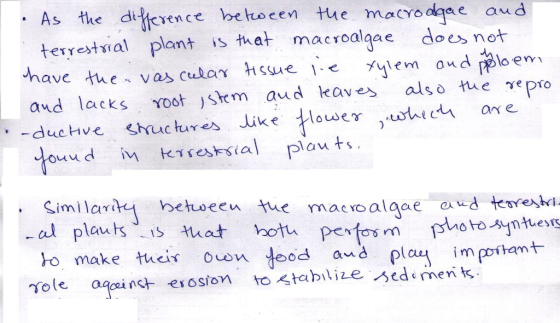
Describe the characteristics that distinguish macro algae from terrestrial plants. How are the two groups similar?
Describe the characteristics that distinguish macro algae from terrestrial plants. How are the two groups similar?
Homework Answers
Add Answer to:
Describe the characteristics that distinguish macro algae from
terrestrial plants. How are the two groups similar?
In two to three paragraphs, describe the characteristics and numbers of plants in a terrestrial ecosystem....
In two to three paragraphs, describe the characteristics and numbers of plants in a terrestrial ecosystem. Describe where they get their energy. Be clear, thorough, and scientifically accurate.
4. List the characteristics characteristics that distinguish the four major groups of plants: then provide an...
 4. List the characteristics characteristics that distinguish the four major groups of plants: then provide an example of a plant within each groun et ta eynlanations for the observation that b..
Explain how land plants adapted on terrestrial environment: mention general adaptation characteristics, as well as reproductive...
Explain how land plants adapted on terrestrial environment: mention general adaptation characteristics, as well as reproductive ones.
Algae and protozoans are loosely grouped together as protozoans and are different from plants because they...
Algae and protozoans are loosely grouped together as protozoans and are different from plants because they lack certain characteristics of plants. Explain what differentiates algae from plants and two ways they are different from protozoans. Talk about algae being part of our environment and how algae may positively or negatively impact our health or the environment. (Words to use in your answer: cell wall, cell membrane, chloroplast, plankton, single-cell, multicellular, red tide, toxins, agar, phytoplankton, reproduction, motility, nutrition, feeding strategies)
Bryophytes & Seedless vascular plants: Be able to define a true “plant” Know how plants differ...
Bryophytes & Seedless vascular plants: Be able to define a true “plant” Know how plants differ from other photosynthetic organisms (green algae, cyanobacteria) Understand that land plants share a common ancestor with green algae Be familiar with the four stages in land plant evolution, and know that both bryophytes and seedless vascular plants arose in the first stage seedless vascular plants diversified and dominated the Earth in the second stage, during the Carboniferous Period (~350-300 MYA), when coal deposits were...
Macro algae, or seaweeds are classified in 3 large groups based on their photosynthetic pigment colors....
Macro algae, or seaweeds are classified in 3 large groups based on their photosynthetic pigment colors. Which two groups are more closely related to each other and to land plants? green algae and brown algae green algae and red algae red algae and brown algae 2.The simplest and most evolutionarily ancient primary producers are: diatoms cyanobacteria (AKA bluegreen algae) unicellular algae plants dinoflagellates Ocean water is salty because there are ions (salts) dissolved in the water. What are the 2...
The ancestors of plants were probably algae. True/False 2) What do plants and the green algae...
The ancestors of plants were probably algae. True/False 2) What do plants and the green algae charophytes have in common? 3) What advantages did life in land provide for plants? 4) What were the disadvantages for life on land for plants? 5) What are some differences between plants and algae? 6) How do land plants maintain moisture in their cells? 7) What structures do land plants use to obtain resources such as water, minerals, and CO2? 8) List the two...
A category of people distinguished by identifiable inherited physical characteristics that distinguish them from other groups...
A category of people distinguished by identifiable inherited physical characteristics that distinguish them from other groups is
LAB: Phylum Chlorophyta: Green Algae The Chlorophyta are a diverse group of microalgae and macroalgae, that...
LAB: Phylum Chlorophyta: Green Algae The Chlorophyta are a diverse group of microalgae and macroalgae, that are most common in freshwater with a significant number of marine representatives. The green algae show a wide range of sexual reproduction and range from unicellular to truly multicellular varieties. They share most of their characteristics with members of the kingdom Plantae and are considered the primary ancestors of terrestrial plants. Observe prepared slides and living specimens of Chlamydomonas, Volvox, Oedogonium and Spirogyra. Chlamydomonas....
How does duckweed plant reproduction differ from typical terrestrial flowering plants? Explain.
How does duckweed plant reproduction differ from typical terrestrial flowering plants? Explain.
 4. List the characteristics characteristics that distinguish the four major groups of plants: then provide an example of a plant within each groun et ta eynlanations for the observation that b..
Most questions answered within 3 hours.
-
Where is the error in this code sequence?
String s1 = "Hello";
String s2 = "ello";...
asked 10 months ago -
Financial data for Joel de Paris, Inc., for last year
follow:
Joel de Paris, Inc.
Balance...
asked 10 months ago -
Consider this reaction:
Al2(SO4)3 (aq)+ BaCl3
(aq) Al2Cl6 (aq)- +
3BaSO4(s) . What is the...
asked 10 months ago -
Suppose that Savneet is considering increasing her
recent random sample from 20 car rentals to 40...
asked 10 months ago -
Trucks arrive at an unloading terminal at an average rate of 120
per hour.
Trucks arrive...
asked 10 months ago -
Why are methanol and ethanol completely soluble in water while
octanol is not very little soluble....
asked 10 months ago -
A facilities manager at a university reads in a research report
that the mean amount of...
asked 10 months ago -
When the CuSO4 is rehydrated by adding water to the anhydrous
compound, is this an endothermic...
asked 10 months ago -
A ray of sunlight is passing from diamond into crown glass; the
angle of incidence is...
asked 10 months ago -
A block of mass 0.249 kg is placed on top of a light, vertical
spring of...
asked 10 months ago -
how do the kidneys compensate in the presences of acidosis
a) trigger hyperventilate
b) reserve acid...
asked 10 months ago -
Question 501 pts
The rental rate of capital to the firm increases. Which of the
following...
asked 10 months ago