
Homework Answers
In this question we have to find the minimum coefficient of
static friction between block and the ground such that block does
not slide when a force of 500N is applied on it.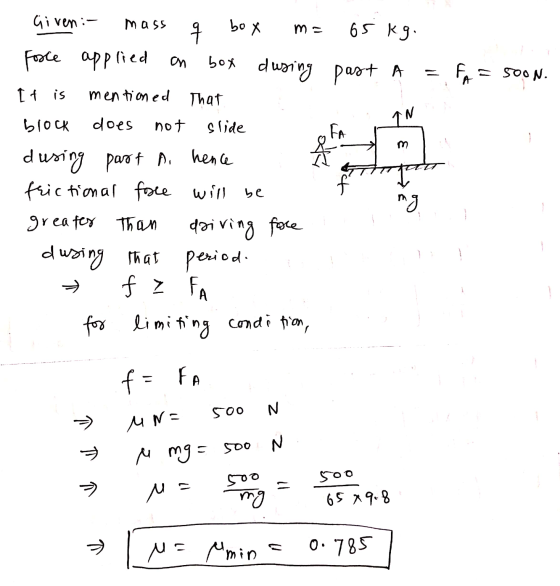
Add Answer to:
Question 26 (2.5 points) A 65.0 kg box is at rest on a rough horizontal surface....
A 100 N box is initially at rest on a rough horizontal surface. The coefficient of...
 A 100 N box is initially at rest on a rough horizontal surface. The coefficient of static friction between the block and the surface is 0.6 and the coefficient of kinetic friction is 0.4. A man decides to move the box so he applies a steadily increasing horizontal force F_Applied on the box to the right as shown. The graph on the left below shows the horizontal force F_Applied on the box as it goes from 0 to 80 N...
machines изть ртор 1. A box of mass 10 kg on a horizontal rough surface 19...
 machines изть ртор 1. A box of mass 10 kg on a horizontal rough surface 19 being pushed horizontally with P = 50 N, if the coefficient of static and kinetic friction are us = 0.5 and uk = 0.33 respectively, what is the state of motion of the box? A. Not moving, impending motion B. Not moving C. Moving D. Cannot be determined
A crate of toys (25 kg) is at rest on a rough horizontal surface. The coefficients...
A crate of toys (25 kg) is at rest on a rough horizontal surface. The coefficients of static and kinetic friction (respectively) are 0.5 and 0.2. What minimum force is required to cause the crate to move? Assuming this force is maintained once the crate begins moving, with what acceleration does the crate move?
A 28.0-kg block is initially at rest on a horizontal surface. A horizontal force of 73.0...
A 28.0-kg block is initially at rest on a horizontal surface. A horizontal force of 73.0 N is required to set the block in motion, after which a horizontal force of 55.0 N is required to keep the block moving with constant speed. (a) Find the coefficient of static friction between the block and the surface. (b) Find the coefficient of kinetic friction between the block and the surface.
a 55-Kg box rests on a horizontal surface. The coefficient of static friction between the box...
a 55-Kg box rests on a horizontal surface. The coefficient of static friction between the box and the surface is 0.30. A horizontal 42 N force is applied to the box. what is the static friction force on the box? (I know that the answer is 42 N because my teacher told me but I need the 4 questions below answered regarding this question) 1) what is the minimum static friction force? 2) how do you calculate the maximum friction...
Side 7. A 10.0 kg block is at rest on a rough horizontal surface. A force...
 Side 7. A 10.0 kg block is at rest on a rough horizontal surface. A force of F - 50.0N @ 35° is applied to the vie block, as shown below. The coefficients of static and kinetic friction between the block and the horizontal surface are: Hs = 0.55 and thk = 0.35. Will the block move? If not, explain why not. If so, determine its acceleration. Your answer must include a free-body diagram. (Hint: compare the horizontal component of...
Question 6 1 pts A box of bananas weighing 40.ON rests on a horizontal surface. The...
 Question 6 1 pts A box of bananas weighing 40.ON rests on a horizontal surface. The coefficient of static friction (us) between the box and the surface is 0.40 while the coefficient of kinetic friction (uk) is 0.20. If a monkey applies a constant horizontal force of 6.0 N, and the box is initially at rest, what is the magnitude of the friction force 1 minutes after the monkey starts pushing? 16.0N 8.0 N Unable to determine O 0.ON 18.0N...
A) A massless rope is tied to a 1.82 kg box sitting on a rough, horizontal...
A) A massless rope is tied to a 1.82 kg box sitting on a rough, horizontal surface. The rope is pulled with constant force F acting upward at an angle 15.8o to the horizontal. The coefficient of kinetic friction between the box and the surface is 0.217, and the box slides at constant speed along the table for a distance of 84.4 m. Find the total work done by F, in J. B)Josh, mass 143 kg, is racing against his...
2. A crate is pushed horizontally at an angle of 20° across a rough surface as...
 2. A crate is pushed horizontally at an angle of 20° across a rough surface as shown. The mass of the crate is 55 kg and the coefficient of kinetic friction M = 0.35. a) What applied force is required to keep the box moving at a constant acceleration of 3m/s2 ? b) What applied force is needed to keep the box moving at a constant speed, that is, no acceleration? (2 pts.) 3. A 60-kg skier starts from rest...
A stockroom worker pushes a box with mass 11.5 kg on a horizontal surface with a...
A stockroom worker pushes a box with mass 11.5 kg on a horizontal surface with a constant speed of 3.50 m/s . The coefficient of kinetic friction between the box and the surface is 0.19. What horizontal force must the worker apply to maintain the motion? If the force calculated in the previous part is removed, how far does the box slide before coming to rest?
 A 100 N box is initially at rest on a rough horizontal surface. The coefficient of static friction between the block and the surface is 0.6 and the coefficient of kinetic friction is 0.4. A man decides to move the box so he applies a steadily increasing horizontal force F_Applied on the box to the right as shown. The graph on the left below shows the horizontal force F_Applied on the box as it goes from 0 to 80 N...
 machines изть ртор 1. A box of mass 10 kg on a horizontal rough surface 19 being pushed horizontally with P = 50 N, if the coefficient of static and kinetic friction are us = 0.5 and uk = 0.33 respectively, what is the state of motion of the box? A. Not moving, impending motion B. Not moving C. Moving D. Cannot be determined
 Side 7. A 10.0 kg block is at rest on a rough horizontal surface. A force of F - 50.0N @ 35° is applied to the vie block, as shown below. The coefficients of static and kinetic friction between the block and the horizontal surface are: Hs = 0.55 and thk = 0.35. Will the block move? If not, explain why not. If so, determine its acceleration. Your answer must include a free-body diagram. (Hint: compare the horizontal component of...
 Question 6 1 pts A box of bananas weighing 40.ON rests on a horizontal surface. The coefficient of static friction (us) between the box and the surface is 0.40 while the coefficient of kinetic friction (uk) is 0.20. If a monkey applies a constant horizontal force of 6.0 N, and the box is initially at rest, what is the magnitude of the friction force 1 minutes after the monkey starts pushing? 16.0N 8.0 N Unable to determine O 0.ON 18.0N...
 2. A crate is pushed horizontally at an angle of 20° across a rough surface as shown. The mass of the crate is 55 kg and the coefficient of kinetic friction M = 0.35. a) What applied force is required to keep the box moving at a constant acceleration of 3m/s2 ? b) What applied force is needed to keep the box moving at a constant speed, that is, no acceleration? (2 pts.) 3. A 60-kg skier starts from rest...
Most questions answered within 3 hours.
-
Where is the error in this code sequence?
String s1 = "Hello";
String s2 = "ello";...
asked 10 months ago -
Financial data for Joel de Paris, Inc., for last year
follow:
Joel de Paris, Inc.
Balance...
asked 10 months ago -
Consider this reaction:
Al2(SO4)3 (aq)+ BaCl3
(aq) Al2Cl6 (aq)- +
3BaSO4(s) . What is the...
asked 10 months ago -
Suppose that Savneet is considering increasing her
recent random sample from 20 car rentals to 40...
asked 10 months ago -
Trucks arrive at an unloading terminal at an average rate of 120
per hour.
Trucks arrive...
asked 10 months ago -
Why are methanol and ethanol completely soluble in water while
octanol is not very little soluble....
asked 10 months ago -
A facilities manager at a university reads in a research report
that the mean amount of...
asked 10 months ago -
When the CuSO4 is rehydrated by adding water to the anhydrous
compound, is this an endothermic...
asked 10 months ago -
A ray of sunlight is passing from diamond into crown glass; the
angle of incidence is...
asked 10 months ago -
A block of mass 0.249 kg is placed on top of a light, vertical
spring of...
asked 10 months ago -
how do the kidneys compensate in the presences of acidosis
a) trigger hyperventilate
b) reserve acid...
asked 10 months ago -
Question 501 pts
The rental rate of capital to the firm increases. Which of the
following...
asked 10 months ago