
Homework Answers
Add Answer to:
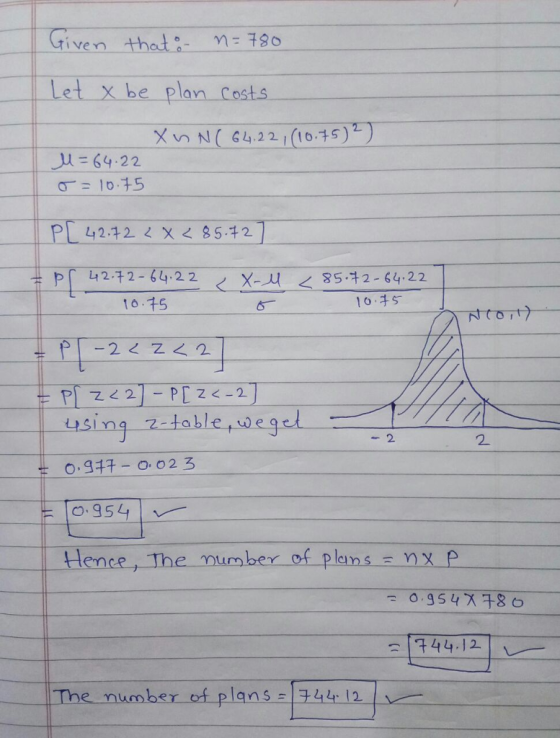
Internet providers: In a survey of 780 homeowners with high-speed Internet, the average monthly cost of...
Internet providers: In a survey of 686 homeowners with high-speed Internet, the average monthly cost of...
Internet providers: In a survey of 686 homeowners with high-speed Internet, the average monthly cost of a high-speed Internet plan was $54.86 with standard deviation $12.1. Assume the plan costs to be approximately bell-shaped. Estimate the number of plans that cost between $42.76 and $66.96. Round to the nearest whole number. The number of plans that cost between $42.76 and $66.96 is
Lunch break: In a recent survey of 621working Americans ages 25-34, the average weekly amount spent...
Lunch break: In a recent survey of 621working Americans ages 25-34, the average weekly amount spent on lunch as $45.92 with standard deviation $2.68. The weekly amounts are approximately bell-shaped. (b) Estimate the percentage of amounts that were greater than $48.60. Round the answer to one decimal place.
In a large sample of customer accounts, a utility company determined that the average number of...
In a large sample of customer accounts, a utility company determined that the average number of days between when a bill was sent out and when the payment was made is 26 with a standard deviation of 7 days. Assume the data to be approximately bell-shaped. Estimate the percentage of customer accounts for which the number of days is greater than 26.
The GMAC Insurance company reported that the mean score on the National Drivers Test was 72.0...
 The GMAC Insurance company reported that the mean score on the National Drivers Test was 72.0 with a standard deviation of 3.3 points. The test scores are approximately bell-shaped. Approximately 68% of all test scores were between two values A and B. What is the value of A? Write only a number as your answer. Round to one decimal place. Your Answer: Answer Question 10 (1.2 points) In a large sample of customer accounts, a utility company determined that the...
The results of a national survey showed that on average, adults sleep 6.3 hours per night....
The results of a national survey showed that on average, adults sleep 6.3 hours per night. Suppose that the standard deviation is 1.4 hours. (a) Use Chebyshev's theorem to calculate the minimum percentage of individuals who sleep between 3.5 and 9.1 hours. (b) Use Chebyshev's theorem to calculate the minimum percentage of individuals who sleep between 2.8 and 9.8 hours. (c) Assume that the number of hours of sleep follows a bell-shaped distribution. Use the empirical rule to calculate the...
In a large sample of customer accounts, a utility company determined that the average number of...
 In a large sample of customer accounts, a utility company determined that the average number of days between when a bill was sent out and when the payment was made is 20 with a standard deviation of 18 days. Assume the data to be approximately bell-shaped. Approximately 95% of all customer accounts have the average number of days between two values A and B. What is the value of B? Write only a number as your answer. Your Answer:
In a large sample of customer accounts, a utility company determined that the average number of...
 In a large sample of customer accounts, a utility company determined that the average number of days between when a bill was sent out and when the payment was made is 10 with a standard deviation of 9 days. Assume the data to be approximately bell-shaped. Approximately 95% of all customer accounts have the average number of days between two values A and B. What is the value of B? Write only a number as your answer Your Answer:
Use the Empirical Rule. The mean speed of a sample of vehicles along a stretch of...
 Use the Empirical Rule. The mean speed of a sample of vehicles along a stretch of highway is 64 miles per hour, with a standard deviation of 5 miles per hour. Estimate the percent of vehicles whose speeds are between 59 miles per hour and 69 miles per hour. (Assume the data set has a bell-shaped distribution.) Approximately % of vehicles travel between 59 miles per hour and 69 miles per hour.
Pay your bills: In a large sample of customer accounts, a utility company determined that the average number of days...
 Pay your bills: In a large sample of customer accounts, a utility company determined that the average number of days between when a bill was sent out and when the payment was made is 26 with a standard deviation of 5 days. Assume the data to be approximately bell-shaped. Part: 0/3 Part 1 of 3 (a) Between what two values will approximately 95% of the numbers of days be? and Approximately 95% of the customer accounts have payment made between...
please show steps. thank you. Use the Empirical Rule. The mean speed of a sample of...
please show steps. thank you. Use the Empirical Rule. The mean speed of a sample of vehicles along a stretch of highway is 64 miles per hour, with a standard deviation of 5 miles per hour. Estimate the percent of vehicles whose speeds are between 49 miles per hour and 79 miles per hour. (Assume the data set has a bell-shaped distribution.) Approximately nothing ___% of vehicles travel between 49 miles per hour and 79 miles per hour.
 The GMAC Insurance company reported that the mean score on the National Drivers Test was 72.0 with a standard deviation of 3.3 points. The test scores are approximately bell-shaped. Approximately 68% of all test scores were between two values A and B. What is the value of A? Write only a number as your answer. Round to one decimal place. Your Answer: Answer Question 10 (1.2 points) In a large sample of customer accounts, a utility company determined that the...
 In a large sample of customer accounts, a utility company determined that the average number of days between when a bill was sent out and when the payment was made is 20 with a standard deviation of 18 days. Assume the data to be approximately bell-shaped. Approximately 95% of all customer accounts have the average number of days between two values A and B. What is the value of B? Write only a number as your answer. Your Answer:
 In a large sample of customer accounts, a utility company determined that the average number of days between when a bill was sent out and when the payment was made is 10 with a standard deviation of 9 days. Assume the data to be approximately bell-shaped. Approximately 95% of all customer accounts have the average number of days between two values A and B. What is the value of B? Write only a number as your answer Your Answer:
 Use the Empirical Rule. The mean speed of a sample of vehicles along a stretch of highway is 64 miles per hour, with a standard deviation of 5 miles per hour. Estimate the percent of vehicles whose speeds are between 59 miles per hour and 69 miles per hour. (Assume the data set has a bell-shaped distribution.) Approximately % of vehicles travel between 59 miles per hour and 69 miles per hour.
 Pay your bills: In a large sample of customer accounts, a utility company determined that the average number of days between when a bill was sent out and when the payment was made is 26 with a standard deviation of 5 days. Assume the data to be approximately bell-shaped. Part: 0/3 Part 1 of 3 (a) Between what two values will approximately 95% of the numbers of days be? and Approximately 95% of the customer accounts have payment made between...
Most questions answered within 3 hours.
-
Where is the error in this code sequence?
String s1 = "Hello";
String s2 = "ello";...
asked 11 months ago -
Financial data for Joel de Paris, Inc., for last year
follow:
Joel de Paris, Inc.
Balance...
asked 11 months ago -
Consider this reaction:
Al2(SO4)3 (aq)+ BaCl3
(aq) Al2Cl6 (aq)- +
3BaSO4(s) . What is the...
asked 11 months ago -
Suppose that Savneet is considering increasing her
recent random sample from 20 car rentals to 40...
asked 11 months ago -
Trucks arrive at an unloading terminal at an average rate of 120
per hour.
Trucks arrive...
asked 11 months ago -
Why are methanol and ethanol completely soluble in water while
octanol is not very little soluble....
asked 11 months ago -
A facilities manager at a university reads in a research report
that the mean amount of...
asked 11 months ago -
When the CuSO4 is rehydrated by adding water to the anhydrous
compound, is this an endothermic...
asked 11 months ago -
A ray of sunlight is passing from diamond into crown glass; the
angle of incidence is...
asked 11 months ago -
A block of mass 0.249 kg is placed on top of a light, vertical
spring of...
asked 11 months ago -
how do the kidneys compensate in the presences of acidosis
a) trigger hyperventilate
b) reserve acid...
asked 11 months ago -
Question 501 pts
The rental rate of capital to the firm increases. Which of the
following...
asked 11 months ago