
Homework Answers
Add Answer to:
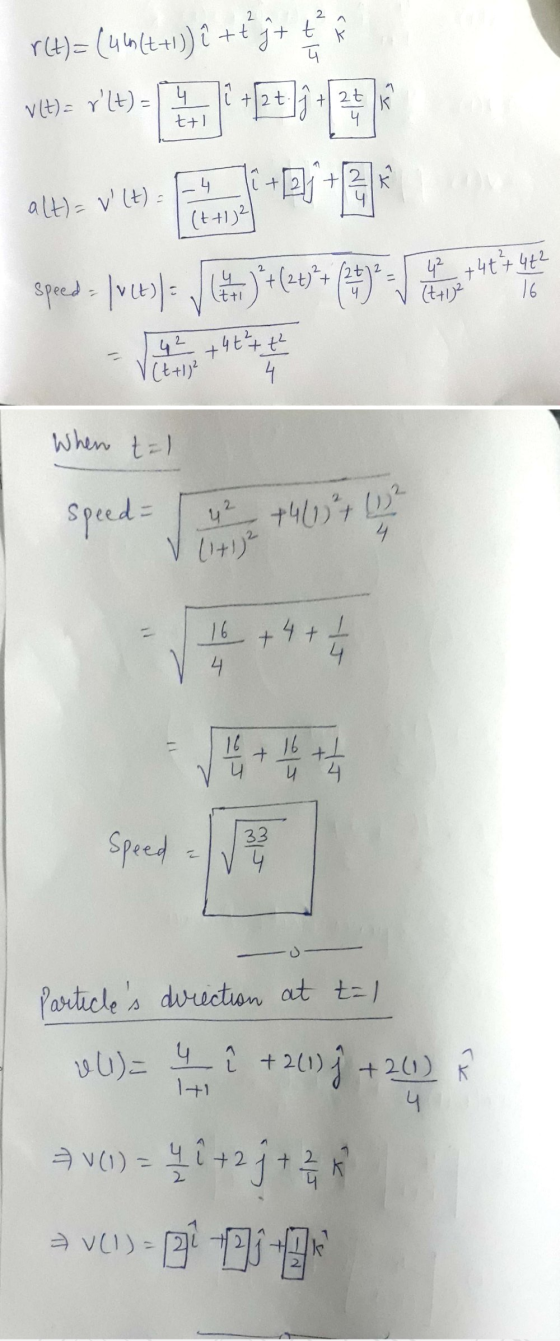
The position of a particle in space at time is r(t) as shown below. Find the...
r(t) is the position of a particle in space at time t. Find the angle between...
 r(t) is the position of a particle in space at time t. Find the angle between the velocity and acceleration vectors at time t = 0. r(t) = (ln(t? + 1))i + (tan-At)j + V +2 + 1k
The vector r(t) is the position vector of a particle at time t. Find the angle...
 The vector r(t) is the position vector of a particle at time t. Find the angle between the velocity and the acceleration vectors at time t = 0. r(t) = sin (3t) i + In(31 2 + 1)j + V32.1k os Oo 4 Moving to the next question prevents changes to this answer.
The vector position of a particle varies in time according to the expression r = 8.20...
 The vector position of a particle varies in time according to the expression r = 8.20 i-5.60p j where r is in meters and t is in seconds. (a) Find an expression for the velocity of the particle as a function of time. (Use any variable or symbol stated above as necessary.) x m/s Determine the acceleration of the particle as a function of time. (Use any variable or symbol stated above as necessary.) X m/s2 (c) Calculate the particle's...
Learning Goal: To find the velocity and acceleration vectors for uniform circular motion and to recognize...
Learning Goal: To find the velocity and acceleration vectors for uniform circular motion and to recognize that this acceleration is the centripetal acceleration. Suppose that a particle's position is given by the following expression: r⃗ (t)=R[cos(ωt)i^+sin(ωt)j^] =Rcos(ωt)i^+Rsin(ωt)j^. Part C Find the particle's velocity as a function of time. Express your answer using unit vectors (e.g., A i^+ B j^, where A and B are functions of ω, R, t, and π). Part D Find the speed of the particle at...
Find the position vector for a particle with acceleration, initial velocity, and initial position given below. a(t...
 Find the position vector for a particle with acceleration, initial velocity, and initial position given below. a(t) (4t, 2 sin(t), cos(2t)) 5(0) (0, 5,5) r(t) Preview Preview Preview The position of an object at time t is given by the parametric equations Find the horizontal velocity, the vertical velocity, and the speed at the moment wheret - 4. Do not worry about units in this problem. Horizontal Velocity - Preview Vertical Velocity- Preview Preview peed-
Find the position vector for...
Find the position vector for a particle with acceleration, initial velocity, and initial position given below. a(t) (4t, 2 sin(t), cos(2t)) 5(0) (0, 5,5) r(t) Preview Preview Preview The position of an object at time t is given by the parametric equations Find the horizontal velocity, the vertical velocity, and the speed at the moment wheret - 4. Do not worry about units in this problem. Horizontal Velocity - Preview Vertical Velocity- Preview Preview peed-
Find the position vector for...
(1 point) Find the velocity and position vectors of a particle with acceleration a(t) = (0,0,2),...
 (1 point) Find the velocity and position vectors of a particle with acceleration a(t) = (0,0,2), and initial conditions (0) - (-4,-4, 2) and r(0) = (2,1,1) v(t)- ) (1) - 1
A particle moves along a space curve,r=r(t) is the time measured from some initial time. if...
A particle moves along a space curve,r=r(t) is the time measured from some initial time. if v=/dr/dt/=ds/dt is the magnitude of the velocity of the particle (s is the arc length along space curve measured from the initial position),prove that the acceleration a of particle is given by a=dv/dtT+v^2/pN where T and N are unit tangent and normal vectors to the space curve and p=|d^2r/ds^2|^-1={(d^2/ds^2)^2+. (d^2y/ds^2)^2 + (d^2z/ds^2)^2}^-1/2
Find the position and velocity of a particle at t = 2.10 s if the particle...
Find the position and velocity of a particle at t = 2.10 s if the particle is initially moving east at a speed of 19.8 m/s and experiences an acceleration of magnitude 4.20 m/s2, directed west. Magnitude and direction of the position. magnitude? direction? Magnitude and direction of the velocity. magnitude? direction?
(1 point) Suppose the position of a particle in motion at time t is given by...
 (1 point) Suppose the position of a particle in motion at time t is given by the vector parametric equation r(t) = (3/t - 2), 7, 2+3 – 6t). (a) Find the velocity of the particle at time t. v(t) = (b) Find the speed of the particle at time t. Speed = (c) Find the time(s) when the particle is stationary. If there is more than one correct answer, enter your answers as a comma separated list. t =
Find the position and velocity of a particle at t = 1.98 s if the particle...
 Find the position and velocity of a particle at t = 1.98 s if the particle is initially moving east at a speed of 18.8 m/s and experiences an acceleration of magnitude 3.64 m/s2, directed west. Magnitude and direction of the position magnitude directionSelect Magnitude and direction of the velocity magnitude directionSelect
 r(t) is the position of a particle in space at time t. Find the angle between the velocity and acceleration vectors at time t = 0. r(t) = (ln(t? + 1))i + (tan-At)j + V +2 + 1k
 The vector r(t) is the position vector of a particle at time t. Find the angle between the velocity and the acceleration vectors at time t = 0. r(t) = sin (3t) i + In(31 2 + 1)j + V32.1k os Oo 4 Moving to the next question prevents changes to this answer.
 The vector position of a particle varies in time according to the expression r = 8.20 i-5.60p j where r is in meters and t is in seconds. (a) Find an expression for the velocity of the particle as a function of time. (Use any variable or symbol stated above as necessary.) x m/s Determine the acceleration of the particle as a function of time. (Use any variable or symbol stated above as necessary.) X m/s2 (c) Calculate the particle's...
 Find the position vector for a particle with acceleration, initial velocity, and initial position given below. a(t) (4t, 2 sin(t), cos(2t)) 5(0) (0, 5,5) r(t) Preview Preview Preview The position of an object at time t is given by the parametric equations Find the horizontal velocity, the vertical velocity, and the speed at the moment wheret - 4. Do not worry about units in this problem. Horizontal Velocity - Preview Vertical Velocity- Preview Preview peed-
Find the position vector for...
Find the position vector for a particle with acceleration, initial velocity, and initial position given below. a(t) (4t, 2 sin(t), cos(2t)) 5(0) (0, 5,5) r(t) Preview Preview Preview The position of an object at time t is given by the parametric equations Find the horizontal velocity, the vertical velocity, and the speed at the moment wheret - 4. Do not worry about units in this problem. Horizontal Velocity - Preview Vertical Velocity- Preview Preview peed-
Find the position vector for...
 (1 point) Find the velocity and position vectors of a particle with acceleration a(t) = (0,0,2), and initial conditions (0) - (-4,-4, 2) and r(0) = (2,1,1) v(t)- ) (1) - 1
 (1 point) Suppose the position of a particle in motion at time t is given by the vector parametric equation r(t) = (3/t - 2), 7, 2+3 – 6t). (a) Find the velocity of the particle at time t. v(t) = (b) Find the speed of the particle at time t. Speed = (c) Find the time(s) when the particle is stationary. If there is more than one correct answer, enter your answers as a comma separated list. t =
 Find the position and velocity of a particle at t = 1.98 s if the particle is initially moving east at a speed of 18.8 m/s and experiences an acceleration of magnitude 3.64 m/s2, directed west. Magnitude and direction of the position magnitude directionSelect Magnitude and direction of the velocity magnitude directionSelect
Most questions answered within 3 hours.
-
Where is the error in this code sequence?
String s1 = "Hello";
String s2 = "ello";...
asked 11 months ago -
Financial data for Joel de Paris, Inc., for last year
follow:
Joel de Paris, Inc.
Balance...
asked 11 months ago -
Consider this reaction:
Al2(SO4)3 (aq)+ BaCl3
(aq) Al2Cl6 (aq)- +
3BaSO4(s) . What is the...
asked 11 months ago -
Suppose that Savneet is considering increasing her
recent random sample from 20 car rentals to 40...
asked 11 months ago -
Trucks arrive at an unloading terminal at an average rate of 120
per hour.
Trucks arrive...
asked 11 months ago -
Why are methanol and ethanol completely soluble in water while
octanol is not very little soluble....
asked 11 months ago -
A facilities manager at a university reads in a research report
that the mean amount of...
asked 11 months ago -
When the CuSO4 is rehydrated by adding water to the anhydrous
compound, is this an endothermic...
asked 11 months ago -
A ray of sunlight is passing from diamond into crown glass; the
angle of incidence is...
asked 11 months ago -
A block of mass 0.249 kg is placed on top of a light, vertical
spring of...
asked 11 months ago -
how do the kidneys compensate in the presences of acidosis
a) trigger hyperventilate
b) reserve acid...
asked 11 months ago -
Question 501 pts
The rental rate of capital to the firm increases. Which of the
following...
asked 11 months ago