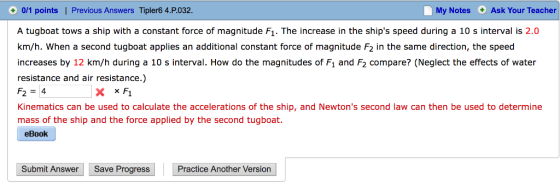
A tugboat tows a ship with a constant force of magnitude
F1. The increase in the ship's speed during a
10 s interval is 2.0km/h. When a second tugboat applies an
additional constant force of magnitude F2 in
the same direction, the speed increases by 12 km/h during a 10 s
interval. How do the magnitudes of F1 and
F2 compare? (Neglect the effects of water
resistance and air resistance.)
Homework Answers

Add Answer to:
A tugboat tows a ship with a constant force of magnitude
F1. The increase in the...
A tugboat tows a ship at a constant velocity. The tow harness consists of a single...
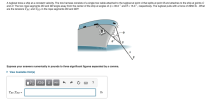 A tugboat tows a ship at a constant velocity. The tow harness consists of a single tow cable attached to the tugboat at point A that splits at point B and attaches to the ship at points C and . The two rope segments BC and BD angle away from the center of the ship at angles o 350 and -5 respective The boat pulls with a re o 295 0 What are the tensions Tec and TBD in the...
cruise ship
A large cruise ship of mass 6.60 107 kg has a speed of 12.6 m/s at some instant.(a) What is the ship's kinetic energy at this time?(b) How much work is required to stop it? (Include the sign of this value.)(c) What is the magnitude of the constant force required to stop it as it undergoes a displacement of 2.60 km?
A large cruise ship of mass 6.40 ✕ 107 kg has a speed of 11.4 m/s...
A large cruise ship of mass 6.40 ✕ 107 kg has a speed of 11.4 m/s at some instant. (a) What is the ship's kinetic energy at this time? (b) How much work is required to stop it? (Give the work done on the ship. Include the sign of the value in your answer.) (c) What is the magnitude of the constant force required to stop it as it undergoes a displacement of 2.70 km? N
A large cruise ship of mass 6.20 ✕ 107 kg has a speed of 11.4 m/s...
A large cruise ship of mass 6.20 ✕ 107 kg has a speed of 11.4 m/s at some instant. (a) What is the ship's kinetic energy at this time? J (b) How much work is required to stop it? (Give the work done on the ship. Include the sign of the value in your answer.) J (c) What is the magnitude of the constant force required to stop it as it undergoes a displacement of 2.70 km? N
A large cruise ship of mass 6.10 ✕ 107 kg has a speed of 10.4 m/s...
A large cruise ship of mass 6.10 ✕ 107 kg has a speed of 10.4 m/s at some instant. (a) What is the ship's kinetic energy at this time? J (b) How much work is required to stop it? (Give the work done on the ship. Include the sign of the value in your answer.) J (c) What is the magnitude of the constant force required to stop it as it undergoes a displacement of 3.00 km? N
Please show work l A force F1 of magnitude 7.20 units acts on an object at...
 Please show work
l
A force F1 of magnitude 7.20 units acts on an object at the origin in a direction θ = 31.0° above the positive x-axis. (See the figure below.) A second force F2 of magnitude 5.00 units acts on the object in the direction of the positive y-axis. Find graphically the magnitude and direction of the resultant force F1 F2 magnitude 10.67 22.65X direction Your response differs from the correct answer by more than 10%. Double check...
Please show work
l
A force F1 of magnitude 7.20 units acts on an object at the origin in a direction θ = 31.0° above the positive x-axis. (See the figure below.) A second force F2 of magnitude 5.00 units acts on the object in the direction of the positive y-axis. Find graphically the magnitude and direction of the resultant force F1 F2 magnitude 10.67 22.65X direction Your response differs from the correct answer by more than 10%. Double check...
1) what is the magnitude of the torque exerted by the force F4 on the gate....
 1) what is the magnitude of the torque exerted by the
force F4 on the gate.
2) what is the magnitude of the torque exerted by the
force F1 on the gate.
3) what is the magnetude of the torque exerted by the
force F2 on the gate.
(1,2,3 using the first photo. )
4) A 4.0 radius grinding stone initially rotates with
an angular velocity of 8.0 rad/s. The angular velocity is then
increased to 12 rad/s for the...
1) what is the magnitude of the torque exerted by the
force F4 on the gate.
2) what is the magnitude of the torque exerted by the
force F1 on the gate.
3) what is the magnetude of the torque exerted by the
force F2 on the gate.
(1,2,3 using the first photo. )
4) A 4.0 radius grinding stone initially rotates with
an angular velocity of 8.0 rad/s. The angular velocity is then
increased to 12 rad/s for the...
Two forces are acting on an object. The first force has magnitude F1=30.3 N and is...
Two forces are acting on an object. The first force has magnitude F1=30.3 N and is pointing at an angle of θ1=22.8 clockwise from the positive y axis. The second force has magnitude F2=23.6 N and is pointing at an angle of θ2=27.8 counterclockwise from the negative x axis. 1. What is the x component of the net force acting on the object? Tries 0/10 2. What is the y component of the net force acting on the object? Tries...
Fluid Mechanics QUESTION 3 State 2 applications of dimensional analysis. (a) (2 marks) (b) The drag force, Fo acting...
 Fluid Mechanics
QUESTION 3 State 2 applications of dimensional analysis. (a) (2 marks) (b) The drag force, Fo acting on a ship is considered to be a function of the fluid density (p) viscosity (H). exavitlg). ship velocity (V), and characteristic length (). Using Buckingham П theorem, determine a set ofsuitable dimensionless numbers to describe the relationship.Fo f(p.H.g.V (4 marks) A 1:60 scale model of a ship is used in a water tank to simulate a ship speed of 10...
Fluid Mechanics
QUESTION 3 State 2 applications of dimensional analysis. (a) (2 marks) (b) The drag force, Fo acting on a ship is considered to be a function of the fluid density (p) viscosity (H). exavitlg). ship velocity (V), and characteristic length (). Using Buckingham П theorem, determine a set ofsuitable dimensionless numbers to describe the relationship.Fo f(p.H.g.V (4 marks) A 1:60 scale model of a ship is used in a water tank to simulate a ship speed of 10...
The engine of a locomotive exerts a constant force of magnitude 7.1 105 N to accelerate...
The engine of a locomotive exerts a constant force of magnitude 7.1 105 N to accelerate a train to 64 km/h. Determine the time taken for the train of mass 1.2 107 kg to reach this speed from rest.
 A tugboat tows a ship at a constant velocity. The tow harness consists of a single tow cable attached to the tugboat at point A that splits at point B and attaches to the ship at points C and . The two rope segments BC and BD angle away from the center of the ship at angles o 350 and -5 respective The boat pulls with a re o 295 0 What are the tensions Tec and TBD in the...
 Please show work
l
A force F1 of magnitude 7.20 units acts on an object at the origin in a direction θ = 31.0° above the positive x-axis. (See the figure below.) A second force F2 of magnitude 5.00 units acts on the object in the direction of the positive y-axis. Find graphically the magnitude and direction of the resultant force F1 F2 magnitude 10.67 22.65X direction Your response differs from the correct answer by more than 10%. Double check...
Please show work
l
A force F1 of magnitude 7.20 units acts on an object at the origin in a direction θ = 31.0° above the positive x-axis. (See the figure below.) A second force F2 of magnitude 5.00 units acts on the object in the direction of the positive y-axis. Find graphically the magnitude and direction of the resultant force F1 F2 magnitude 10.67 22.65X direction Your response differs from the correct answer by more than 10%. Double check...
 1) what is the magnitude of the torque exerted by the
force F4 on the gate.
2) what is the magnitude of the torque exerted by the
force F1 on the gate.
3) what is the magnetude of the torque exerted by the
force F2 on the gate.
(1,2,3 using the first photo. )
4) A 4.0 radius grinding stone initially rotates with
an angular velocity of 8.0 rad/s. The angular velocity is then
increased to 12 rad/s for the...
1) what is the magnitude of the torque exerted by the
force F4 on the gate.
2) what is the magnitude of the torque exerted by the
force F1 on the gate.
3) what is the magnetude of the torque exerted by the
force F2 on the gate.
(1,2,3 using the first photo. )
4) A 4.0 radius grinding stone initially rotates with
an angular velocity of 8.0 rad/s. The angular velocity is then
increased to 12 rad/s for the...
 Fluid Mechanics
QUESTION 3 State 2 applications of dimensional analysis. (a) (2 marks) (b) The drag force, Fo acting on a ship is considered to be a function of the fluid density (p) viscosity (H). exavitlg). ship velocity (V), and characteristic length (). Using Buckingham П theorem, determine a set ofsuitable dimensionless numbers to describe the relationship.Fo f(p.H.g.V (4 marks) A 1:60 scale model of a ship is used in a water tank to simulate a ship speed of 10...
Fluid Mechanics
QUESTION 3 State 2 applications of dimensional analysis. (a) (2 marks) (b) The drag force, Fo acting on a ship is considered to be a function of the fluid density (p) viscosity (H). exavitlg). ship velocity (V), and characteristic length (). Using Buckingham П theorem, determine a set ofsuitable dimensionless numbers to describe the relationship.Fo f(p.H.g.V (4 marks) A 1:60 scale model of a ship is used in a water tank to simulate a ship speed of 10...
Most questions answered within 3 hours.
-
Where is the error in this code sequence?
String s1 = "Hello";
String s2 = "ello";...
asked 10 months ago -
Financial data for Joel de Paris, Inc., for last year
follow:
Joel de Paris, Inc.
Balance...
asked 10 months ago -
Consider this reaction:
Al2(SO4)3 (aq)+ BaCl3
(aq) Al2Cl6 (aq)- +
3BaSO4(s) . What is the...
asked 10 months ago -
Suppose that Savneet is considering increasing her
recent random sample from 20 car rentals to 40...
asked 10 months ago -
Trucks arrive at an unloading terminal at an average rate of 120
per hour.
Trucks arrive...
asked 10 months ago -
Why are methanol and ethanol completely soluble in water while
octanol is not very little soluble....
asked 10 months ago -
A facilities manager at a university reads in a research report
that the mean amount of...
asked 10 months ago -
When the CuSO4 is rehydrated by adding water to the anhydrous
compound, is this an endothermic...
asked 10 months ago -
A ray of sunlight is passing from diamond into crown glass; the
angle of incidence is...
asked 10 months ago -
A block of mass 0.249 kg is placed on top of a light, vertical
spring of...
asked 10 months ago -
how do the kidneys compensate in the presences of acidosis
a) trigger hyperventilate
b) reserve acid...
asked 10 months ago -
Question 501 pts
The rental rate of capital to the firm increases. Which of the
following...
asked 10 months ago