A) how many mL of 0.5000 m aqueous potassium hydroxide are needed to neutralized (turn oink...
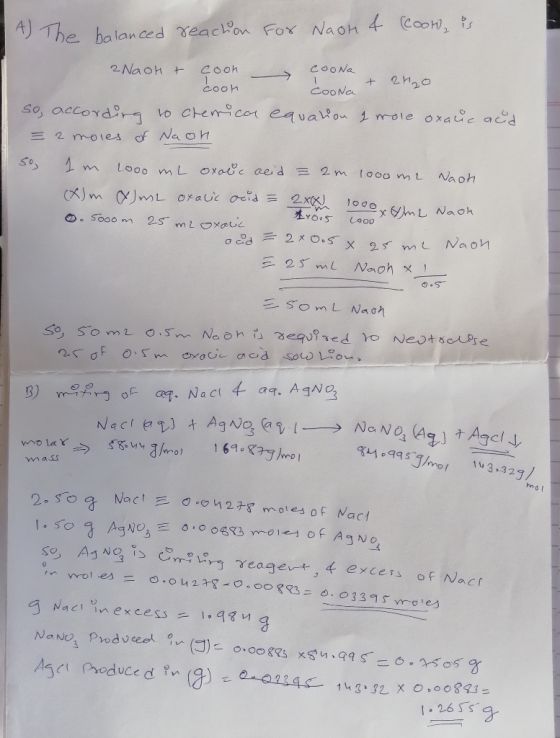
A) how many mL of 0.5000 m aqueous potassium hydroxide are needed to neutralized (turn oink due to indicator phenolphthalein) 25.00 ml of 0.5000 m aqueous oxalic acid. please write balanced equation, note mole to mole ratio of acid to base and use stoichiometry to solve.
B) write a balanced reaction for the mixing of aqueous sodium chloride and aqueous silver nitrate which produces solid silver chloride and aqueous sodium chloride. Calculate the grams of the solid product and grams of excess reagent when 2.50 grams of sodium chloride is mixed with 1.50 grams of silver nitrate.
Homework Answers
Add Answer to:
A) how many mL of 0.5000 m aqueous potassium hydroxide
are needed to neutralized (turn oink...
Consider an aqueous solution of calcium nitrate added to an aqueous solution of sodium phosphate. What...
Consider an aqueous solution of calcium nitrate added to an aqueous solution of sodium phosphate. What is the formula of the solid formed in the reaction? You mix 55 mL of 1.00 M silver nitrate with 25 mL of 0.55 M sodium chloride. What mass of silver chloride should you form? 2.0 g 2.2 g 4.3 3.9 g None of these choices are correct. In the balanced molecular equation for the neutralization of sodium hydroxide with sulfuric acid, the products...
A student is asked to standardize a solution of potassium hydroxide. He weighs out 0.907 g potass...
 titrations and limiting reactants
A student is asked to standardize a solution of potassium hydroxide. He weighs out 0.907 g potassium hydrogen phthalate (KHCgH404 treat this as a monoprotic acid) It requires 28.6 mL of potassium hydroxide to reach the endpoint. A. What is the molarity of the potassium hydroxide solution?M This potassium hydroxide solution is then used to titrate an unknown solution of hydrobromic acid B. If 178 ml of the potassium hydroxide solution is required to neutralize 19.0...
titrations and limiting reactants
A student is asked to standardize a solution of potassium hydroxide. He weighs out 0.907 g potassium hydrogen phthalate (KHCgH404 treat this as a monoprotic acid) It requires 28.6 mL of potassium hydroxide to reach the endpoint. A. What is the molarity of the potassium hydroxide solution?M This potassium hydroxide solution is then used to titrate an unknown solution of hydrobromic acid B. If 178 ml of the potassium hydroxide solution is required to neutralize 19.0...
Aqueous solutions of lead(II) nitrate and sodium chloride react to form solid lead(II) chloride and aqueous...
Aqueous solutions of lead(II) nitrate and sodium chloride react to form solid lead(II) chloride and aqueous sodium nitrate according to the reaction below. Pb(NO3)2 (aq) + 2 NaCl (aq) → 2 NaNO3 (aq) + PbCl2 (s) What is the molarity of the sodium chloride solution if 85.0 mL of it will produce 5.97 g of the lead(II) chloride? Question 16 (1 point) Aqueous solutions of copper (II) bromide and silver (I) acetate react to form solid silver (I) bromide and...
Reactants Observation(s) Type of Reaction Balanced Molecular Equation aqueous barium chloride + aqueous sodium sulfate A...
 Reactants Observation(s) Type of Reaction Balanced Molecular Equation aqueous barium chloride + aqueous sodium sulfate A white solid forms after the solutions are mixed together. Precipitation Reaction BaCl(aq) + Na SO.(aq) - BaSO (s) + 2 NaCl(aq) zinc metal + hydrochloric acid Bubbles are observed after the solutions are mixed together. The zinc appears to be smaller in size. aqueous sodium phosphate + aqueous copper(II) sulfate A solid forms after the solutions are mixed together. copper metal + aqueous silver...
Which of the following aqueous solutions are good buffer systems? 0.11 M potassium hydroxide +0.20 M...
 Which of the following aqueous solutions are good buffer systems? 0.11 M potassium hydroxide +0.20 M potassium chloride 0.28 M ammonia + 0.36 M ammonium bromide 0.39 M barium nitrate + 0.25 M sodium nitrate 0.28 M hydrochloric acid + 0.21 M sodium chloride 0.12 M hydrofluoric acid + 0.21 M perchloric acid
1) Calculate AH (250°C) for the formation of ammonia gas from nitrogen gas and hydrogen gas...
 1) Calculate AH (250°C) for the formation of ammonia gas from nitrogen gas and hydrogen gas Substance Enthalpy value (kJ/mole) Entropy value K-mole) 1925 1306 191.5 Ammonia gas Hydrogen gas Nitrogen gas (write rxn with phase labels) 1) Calculate the standard Enthalpy change at 25.0°C Gaseous water (-241.8 kJ/mole) plus Carbon graphitel( 0.0 kJ/mole) yields hydrogen gas (0.0kJ/mole) plus carbon dioxide gas(-393.5 kJ/mole) Calcium carbonate (marble chips) reacts with hydrochloric acid to produce carbon dioxide gas, water and calcium chloride....
6. A 50.0 mL sample of 0.528 M NHaNO, is diluted with water to a total...
 6. A 50.0 mL sample of 0.528 M NHaNO, is diluted with water to a total volume of 250.0 mL What is the ammonium nitrate concentration in the resulting solution? 7. 75.0 ml. of a 0.250M NaCI solution is added to 35.8 ml. of 0.1150M NaCOs. What is the concentration of sodium ion in the final solution? 8, 34.62 mL. of 0.1510 M NaOH was needed to neutralize 50.0 mL of an H2SO4 solution. What is the concentration of the...
Reaction 14: Aqueous iron(II) chloride + aqueous ammonium hydroxide Balanced Molecular Equation (from page 8): Complete...
 Reaction 14: Aqueous iron(II) chloride + aqueous ammonium hydroxide Balanced Molecular Equation (from page 8): Complete lonic Equation: Net Ionic Equation: 2. Predict the products for the followine single and double displacement reactions, and wing single and double displacement reactions, and write balanced molecular squations including physical states) for each of them. If you predict that no reaction will occur, w na reaction will occur, write "NR", " followed by a brief explanation. a. Aluminum metal + aqueous silver acetate...
CHM 1210 Final practice Name: Know electrolyte table, 5 solubility rules; 26 polyatomics (name/formula) Write 7...
 CHM 1210 Final practice Name: Know electrolyte table, 5 solubility rules; 26 polyatomics (name/formula) Write 7 naturally occurring diatomic molecules (name; formula, phase , charge) Write rite out strong acids and weak acids by name; formula, phase ,charge Write out the molecular, complete, and net-ionic equations for the following reactions The mixing of Cobalt(IlI) chloride and silver nitrate The mixing of acetic acid and sodium hydroxide The mixing of hydrochloric acid and cakcium hydroxide The mixing of barium chloride and...
9 b) the reaction between aqueous solutions of cobalt(III) nitrate and sodium hydroxide to form aqueous sodium nitra...
 9
b) the reaction between aqueous solutions of cobalt(III) nitrate and sodium hydroxide to form aqueous sodium nitrate and solid cobalt(III) hydroxide. c) the reaction between solid zinc and aqueous hydrochloric acid in a single replacement reaction. d) classify the reactions in (a) and (b). 9. Hydrogen sulfide, given off by decaying organic matter, is converted to sulfur dioxide in the atmosphere by the reaction: 2 H S(g) + 30 (g) 2 SO (g) + 2 H2O() a) How many...
9
b) the reaction between aqueous solutions of cobalt(III) nitrate and sodium hydroxide to form aqueous sodium nitrate and solid cobalt(III) hydroxide. c) the reaction between solid zinc and aqueous hydrochloric acid in a single replacement reaction. d) classify the reactions in (a) and (b). 9. Hydrogen sulfide, given off by decaying organic matter, is converted to sulfur dioxide in the atmosphere by the reaction: 2 H S(g) + 30 (g) 2 SO (g) + 2 H2O() a) How many...
 titrations and limiting reactants
A student is asked to standardize a solution of potassium hydroxide. He weighs out 0.907 g potassium hydrogen phthalate (KHCgH404 treat this as a monoprotic acid) It requires 28.6 mL of potassium hydroxide to reach the endpoint. A. What is the molarity of the potassium hydroxide solution?M This potassium hydroxide solution is then used to titrate an unknown solution of hydrobromic acid B. If 178 ml of the potassium hydroxide solution is required to neutralize 19.0...
titrations and limiting reactants
A student is asked to standardize a solution of potassium hydroxide. He weighs out 0.907 g potassium hydrogen phthalate (KHCgH404 treat this as a monoprotic acid) It requires 28.6 mL of potassium hydroxide to reach the endpoint. A. What is the molarity of the potassium hydroxide solution?M This potassium hydroxide solution is then used to titrate an unknown solution of hydrobromic acid B. If 178 ml of the potassium hydroxide solution is required to neutralize 19.0...
 Reactants Observation(s) Type of Reaction Balanced Molecular Equation aqueous barium chloride + aqueous sodium sulfate A white solid forms after the solutions are mixed together. Precipitation Reaction BaCl(aq) + Na SO.(aq) - BaSO (s) + 2 NaCl(aq) zinc metal + hydrochloric acid Bubbles are observed after the solutions are mixed together. The zinc appears to be smaller in size. aqueous sodium phosphate + aqueous copper(II) sulfate A solid forms after the solutions are mixed together. copper metal + aqueous silver...
 Which of the following aqueous solutions are good buffer systems? 0.11 M potassium hydroxide +0.20 M potassium chloride 0.28 M ammonia + 0.36 M ammonium bromide 0.39 M barium nitrate + 0.25 M sodium nitrate 0.28 M hydrochloric acid + 0.21 M sodium chloride 0.12 M hydrofluoric acid + 0.21 M perchloric acid
 1) Calculate AH (250°C) for the formation of ammonia gas from nitrogen gas and hydrogen gas Substance Enthalpy value (kJ/mole) Entropy value K-mole) 1925 1306 191.5 Ammonia gas Hydrogen gas Nitrogen gas (write rxn with phase labels) 1) Calculate the standard Enthalpy change at 25.0°C Gaseous water (-241.8 kJ/mole) plus Carbon graphitel( 0.0 kJ/mole) yields hydrogen gas (0.0kJ/mole) plus carbon dioxide gas(-393.5 kJ/mole) Calcium carbonate (marble chips) reacts with hydrochloric acid to produce carbon dioxide gas, water and calcium chloride....
 6. A 50.0 mL sample of 0.528 M NHaNO, is diluted with water to a total volume of 250.0 mL What is the ammonium nitrate concentration in the resulting solution? 7. 75.0 ml. of a 0.250M NaCI solution is added to 35.8 ml. of 0.1150M NaCOs. What is the concentration of sodium ion in the final solution? 8, 34.62 mL. of 0.1510 M NaOH was needed to neutralize 50.0 mL of an H2SO4 solution. What is the concentration of the...
 Reaction 14: Aqueous iron(II) chloride + aqueous ammonium hydroxide Balanced Molecular Equation (from page 8): Complete lonic Equation: Net Ionic Equation: 2. Predict the products for the followine single and double displacement reactions, and wing single and double displacement reactions, and write balanced molecular squations including physical states) for each of them. If you predict that no reaction will occur, w na reaction will occur, write "NR", " followed by a brief explanation. a. Aluminum metal + aqueous silver acetate...
 CHM 1210 Final practice Name: Know electrolyte table, 5 solubility rules; 26 polyatomics (name/formula) Write 7 naturally occurring diatomic molecules (name; formula, phase , charge) Write rite out strong acids and weak acids by name; formula, phase ,charge Write out the molecular, complete, and net-ionic equations for the following reactions The mixing of Cobalt(IlI) chloride and silver nitrate The mixing of acetic acid and sodium hydroxide The mixing of hydrochloric acid and cakcium hydroxide The mixing of barium chloride and...
 9
b) the reaction between aqueous solutions of cobalt(III) nitrate and sodium hydroxide to form aqueous sodium nitrate and solid cobalt(III) hydroxide. c) the reaction between solid zinc and aqueous hydrochloric acid in a single replacement reaction. d) classify the reactions in (a) and (b). 9. Hydrogen sulfide, given off by decaying organic matter, is converted to sulfur dioxide in the atmosphere by the reaction: 2 H S(g) + 30 (g) 2 SO (g) + 2 H2O() a) How many...
9
b) the reaction between aqueous solutions of cobalt(III) nitrate and sodium hydroxide to form aqueous sodium nitrate and solid cobalt(III) hydroxide. c) the reaction between solid zinc and aqueous hydrochloric acid in a single replacement reaction. d) classify the reactions in (a) and (b). 9. Hydrogen sulfide, given off by decaying organic matter, is converted to sulfur dioxide in the atmosphere by the reaction: 2 H S(g) + 30 (g) 2 SO (g) + 2 H2O() a) How many...
Most questions answered within 3 hours.
-
Where is the error in this code sequence?
String s1 = "Hello";
String s2 = "ello";...
asked 11 months ago -
Financial data for Joel de Paris, Inc., for last year
follow:
Joel de Paris, Inc.
Balance...
asked 11 months ago -
Consider this reaction:
Al2(SO4)3 (aq)+ BaCl3
(aq) Al2Cl6 (aq)- +
3BaSO4(s) . What is the...
asked 11 months ago -
Suppose that Savneet is considering increasing her
recent random sample from 20 car rentals to 40...
asked 11 months ago -
Trucks arrive at an unloading terminal at an average rate of 120
per hour.
Trucks arrive...
asked 11 months ago -
Why are methanol and ethanol completely soluble in water while
octanol is not very little soluble....
asked 11 months ago -
A facilities manager at a university reads in a research report
that the mean amount of...
asked 11 months ago -
When the CuSO4 is rehydrated by adding water to the anhydrous
compound, is this an endothermic...
asked 11 months ago -
A ray of sunlight is passing from diamond into crown glass; the
angle of incidence is...
asked 11 months ago -
A block of mass 0.249 kg is placed on top of a light, vertical
spring of...
asked 11 months ago -
how do the kidneys compensate in the presences of acidosis
a) trigger hyperventilate
b) reserve acid...
asked 11 months ago -
Question 501 pts
The rental rate of capital to the firm increases. Which of the
following...
asked 11 months ago