Consider an aqueous solution of calcium nitrate added to an aqueous solution of sodium phosphate. What...
Consider an aqueous solution of calcium nitrate added to an aqueous solution of sodium phosphate. What is the formula of the solid formed in the reaction?
You mix 55 mL of 1.00 M silver nitrate with 25 mL of 0.55 M sodium chloride. What mass of silver chloride should you form?
2.0 g
2.2 g
4.3
3.9 g
None of these choices are correct.
In the balanced molecular equation for the neutralization of sodium hydroxide with sulfuric acid, the products are:
Na2S + 2H2O
NaSO4 + H2O
NaSO3 + 2H2O
Na2SO4 + 2H2O
2NaSO4 + H2O
Homework Answers
1) calcium nitrate on reaction with sodium phosphate produced sodium nitrate along with a precipitate of calcium phosphate with a formula Ca3(PO4)2
2)We first calculate the number of moles of silver nitrate and sodium chloride provided:
AgNO3 :(55/1000) * 1 = 0.055 moles
NaCl : (25/1000) * 0.55 = 0.01375 moles
The reaction proceeds as follows :
AgNO3 + NaCl -> AgCl + NaNO3
1 mole AgNO3 requires 1 moles NaCl to produce 1 mole of silver chloride.
Therefore NaCl acts as the limiting reagent since we only have 0.01375 miles of nacl for 0.055 moles of agno3
Therefore , moles of AgCl formed for 0.01375 moles of NaCl : 0.01375 moles
Weight of one mole of AgCl = 143 g
Weight of 0.01375 moles of AgCl : 0.01375 * 143 = 1.96 g
Nearest answer : 2.0 g
3)given reaction :
2NaOH + H2SO4 -> Na2SO4 + 2H2O
Add Answer to:
Consider an aqueous solution of calcium nitrate added to an
aqueous solution of sodium phosphate. What...
silver nitrate + sodium phosphate + sodium nitrate yields silver phosphate + sodium phosphate Ib. Silver nitrate...
 silver nitrate + sodium phosphate
+ sodium nitrate yields silver phosphate + sodium phosphate Ib. Silver nitrate Balanced: Complete lonic: Net Ionic: + sodium carbonate yields zine carbonate+ sodium nitrate 2a. Zinc nitrate (ag) (ag) Balanced: Complete lonic: Net lonic: 2b. Zinc nitrate (aq) + sodium phosphate yields zinc phosphate+ sodium nitrate (ag) () (a) Balanced: Complete Ionic: Net Ionic: Report Form - Chemical Reactions 50 yields aluminum iodide (ag) 3a. Aluminum nitrate +potassium iodide (ag) Balanced: Complete lonic: Net...
silver nitrate + sodium phosphate
+ sodium nitrate yields silver phosphate + sodium phosphate Ib. Silver nitrate Balanced: Complete lonic: Net Ionic: + sodium carbonate yields zine carbonate+ sodium nitrate 2a. Zinc nitrate (ag) (ag) Balanced: Complete lonic: Net lonic: 2b. Zinc nitrate (aq) + sodium phosphate yields zinc phosphate+ sodium nitrate (ag) () (a) Balanced: Complete Ionic: Net Ionic: Report Form - Chemical Reactions 50 yields aluminum iodide (ag) 3a. Aluminum nitrate +potassium iodide (ag) Balanced: Complete lonic: Net...
an aqueous solution contain 14.0 g of silver nitrate was added to an aqueous solution contain...
an aqueous solution contain 14.0 g of silver nitrate was added to an aqueous solution contain 4.83 g of calcium chloride. Assuming all of the silver nitrate is consumed, how many grams of calcium chloride would required to react with the silver nitrate? is there enough calcium chloride to consume all of the silver nitrate?
Silver nitrate solution is mixed with sodium sulfide solutionproducing a black solid and sodium nitrate solution...
Silver nitrate solution is mixed with sodium sulfide solutionproducing a black solid and sodium nitrate solution according tothe balanced chemical equation: 2 AgNO3(aq) + Na2S(aq) --> Ag2S(s) +2NaNO3(aq) a) What volume (mL) of .200 M silver nitrate solution is required to completely react with 50.00 mL of 0.100 M sodium sulfidesolution? b) What is the theoretical yield of Ag2S based on the complete rxn of .200 M AgNO3 (aq) and 50.00 mL of 0.100 M Na2S solution?
An aqueous solution of sodium sulfate is reacted with an aqueous solution of lead(II) nitrate. a....
 An aqueous solution of sodium sulfate is reacted with an aqueous solution of lead(II) nitrate. a. Write out the balanced reaction when sodium sulfate is reacted with lead(II) nitrate. Include ph. b. What is the precipitate in the above reaction? 2. A forensic scientist wishes to identify an unknown salt powder discovered at a crime scene. She has reas to believe the sample is either cesium chloride, lithium acetate or aluminum perchlorate. She chooses to identify it by reacting with...
Aqueous sulfuric acid (H2SO4) reacts with solid sodium hydroxide (NaOH) to produce aqueous sodium sulfate (Na2SO4)...
Aqueous sulfuric acid (H2SO4) reacts with solid sodium hydroxide (NaOH) to produce aqueous sodium sulfate (Na2SO4) and liquid water (H2O). what is the theoretical yield of water formed from the reaction of 3.9 g of sulfuric acid and 0.86 g of sodium hydroxide?
Aqueous solutions of lead(II) nitrate and sodium chloride react to form solid lead(II) chloride and aqueous...
Aqueous solutions of lead(II) nitrate and sodium chloride react to form solid lead(II) chloride and aqueous sodium nitrate according to the reaction below. Pb(NO3)2 (aq) + 2 NaCl (aq) → 2 NaNO3 (aq) + PbCl2 (s) What is the molarity of the sodium chloride solution if 85.0 mL of it will produce 5.97 g of the lead(II) chloride? Question 16 (1 point) Aqueous solutions of copper (II) bromide and silver (I) acetate react to form solid silver (I) bromide and...
4. An aqueous solution of sodium sulfate is mixed with an aqueous solution of calcium nitrate....
 4. An aqueous solution of sodium sulfate is mixed with an aqueous solution of calcium nitrate. Identify the solid formed in the reaction. a. CaSO4 b. Na2SO4 c. Ca(NO3)2 d. NaNO3 e. There is no solid formed when the two solutions are mixed.
4, Question Details Solid sodium phosphate is added to an aqueous solution of manganese(II) nitra...
 4, Question Details Solid sodium phosphate is added to an aqueous solution of manganese(II) nitrate in a series of experiments. The salts react to form a precipitate according to the chemical equation 2 Na3PO4(aq) 3 Mn(NO3)2(aq)Mn3(PO4)2(s) 6 NaNO3(aq) In each experiment, the precipitate was collected, dried, and weighed Exp 1 Exp 2 Exp 3 Exp 4 Exp 5 Exp 6 Volume of manganese) 487.6 m nitrate Mass of sodium phosphate g Mass of precipitate 377.6 ml 323.7 mL 232.4 mL...
The video shows the addition of aqueous sodium chloride to a solution of aqueous silver nitrate....
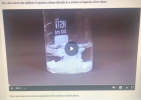 The video shows the addition of aqueous sodium chloride to a solution of aqueous silver nitrate. Im 02 ► 0:00 Write the balanced molecular equation for the reaction. Include phases
Considering the titration of sulfuric acid with sodium hydroxide, what is the balanced neutralization equation? O...
 Considering the titration of sulfuric acid with sodium hydroxide, what is the balanced neutralization equation? O NaOH + 2H2SO4 -> H2O + 2Na2504 O 2NaOH + H2SO4 -> 2H2O + Na2504 O NaOH + H2SO4 --> H2O + Na2SO4 O 2NaOH + H2504 --> H2O + Nas04
 silver nitrate + sodium phosphate
+ sodium nitrate yields silver phosphate + sodium phosphate Ib. Silver nitrate Balanced: Complete lonic: Net Ionic: + sodium carbonate yields zine carbonate+ sodium nitrate 2a. Zinc nitrate (ag) (ag) Balanced: Complete lonic: Net lonic: 2b. Zinc nitrate (aq) + sodium phosphate yields zinc phosphate+ sodium nitrate (ag) () (a) Balanced: Complete Ionic: Net Ionic: Report Form - Chemical Reactions 50 yields aluminum iodide (ag) 3a. Aluminum nitrate +potassium iodide (ag) Balanced: Complete lonic: Net...
silver nitrate + sodium phosphate
+ sodium nitrate yields silver phosphate + sodium phosphate Ib. Silver nitrate Balanced: Complete lonic: Net Ionic: + sodium carbonate yields zine carbonate+ sodium nitrate 2a. Zinc nitrate (ag) (ag) Balanced: Complete lonic: Net lonic: 2b. Zinc nitrate (aq) + sodium phosphate yields zinc phosphate+ sodium nitrate (ag) () (a) Balanced: Complete Ionic: Net Ionic: Report Form - Chemical Reactions 50 yields aluminum iodide (ag) 3a. Aluminum nitrate +potassium iodide (ag) Balanced: Complete lonic: Net...
 An aqueous solution of sodium sulfate is reacted with an aqueous solution of lead(II) nitrate. a. Write out the balanced reaction when sodium sulfate is reacted with lead(II) nitrate. Include ph. b. What is the precipitate in the above reaction? 2. A forensic scientist wishes to identify an unknown salt powder discovered at a crime scene. She has reas to believe the sample is either cesium chloride, lithium acetate or aluminum perchlorate. She chooses to identify it by reacting with...
 4. An aqueous solution of sodium sulfate is mixed with an aqueous solution of calcium nitrate. Identify the solid formed in the reaction. a. CaSO4 b. Na2SO4 c. Ca(NO3)2 d. NaNO3 e. There is no solid formed when the two solutions are mixed.
 4, Question Details Solid sodium phosphate is added to an aqueous solution of manganese(II) nitrate in a series of experiments. The salts react to form a precipitate according to the chemical equation 2 Na3PO4(aq) 3 Mn(NO3)2(aq)Mn3(PO4)2(s) 6 NaNO3(aq) In each experiment, the precipitate was collected, dried, and weighed Exp 1 Exp 2 Exp 3 Exp 4 Exp 5 Exp 6 Volume of manganese) 487.6 m nitrate Mass of sodium phosphate g Mass of precipitate 377.6 ml 323.7 mL 232.4 mL...
 The video shows the addition of aqueous sodium chloride to a solution of aqueous silver nitrate. Im 02 ► 0:00 Write the balanced molecular equation for the reaction. Include phases
 Considering the titration of sulfuric acid with sodium hydroxide, what is the balanced neutralization equation? O NaOH + 2H2SO4 -> H2O + 2Na2504 O 2NaOH + H2SO4 -> 2H2O + Na2504 O NaOH + H2SO4 --> H2O + Na2SO4 O 2NaOH + H2504 --> H2O + Nas04
Most questions answered within 3 hours.
-
Where is the error in this code sequence?
String s1 = "Hello";
String s2 = "ello";...
asked 10 months ago -
Financial data for Joel de Paris, Inc., for last year
follow:
Joel de Paris, Inc.
Balance...
asked 10 months ago -
Consider this reaction:
Al2(SO4)3 (aq)+ BaCl3
(aq) Al2Cl6 (aq)- +
3BaSO4(s) . What is the...
asked 10 months ago -
Suppose that Savneet is considering increasing her
recent random sample from 20 car rentals to 40...
asked 10 months ago -
Trucks arrive at an unloading terminal at an average rate of 120
per hour.
Trucks arrive...
asked 10 months ago -
Why are methanol and ethanol completely soluble in water while
octanol is not very little soluble....
asked 10 months ago -
A facilities manager at a university reads in a research report
that the mean amount of...
asked 10 months ago -
When the CuSO4 is rehydrated by adding water to the anhydrous
compound, is this an endothermic...
asked 10 months ago -
A ray of sunlight is passing from diamond into crown glass; the
angle of incidence is...
asked 10 months ago -
A block of mass 0.249 kg is placed on top of a light, vertical
spring of...
asked 10 months ago -
how do the kidneys compensate in the presences of acidosis
a) trigger hyperventilate
b) reserve acid...
asked 10 months ago -
Question 501 pts
The rental rate of capital to the firm increases. Which of the
following...
asked 10 months ago