A) It was found that a specific galvanic cell was able to power the red LED...
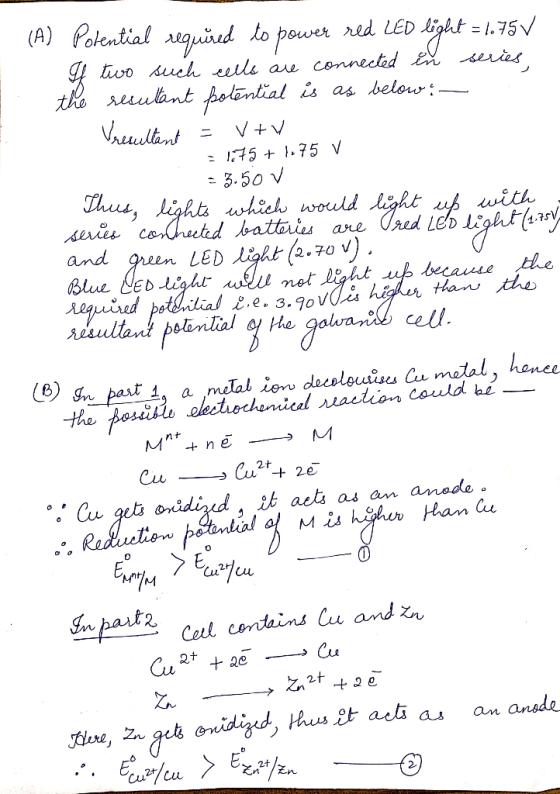
A) It was found that a specific galvanic cell was able to power the red LED light. We then linked 2 of these galvanic cells together in series. Assuming that the red LED light needed 1.75 V to power, and a green LED needed 2.70 V to power, and a blue LED light needed 3.90 V to power. Which lights would light up with your series-connected batteries? (select all that apply) (red LED, green LED, blue LED or no LED)
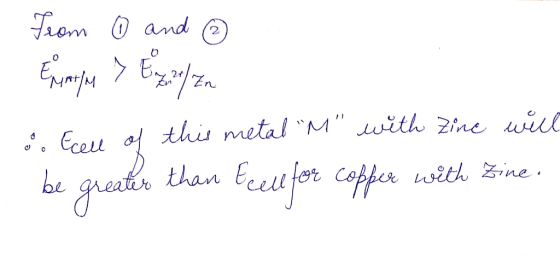
B) Suppose in part I of the lab, you were given a metal ion that discolored copper metal. In part two, how would the Ecell of this metal with zinc compare to the Ecell of copper with zinc? (The Ecell would be larger than the Ecell for copper with zinc, the Ecell would be smaller than the Ecell for copper with zinc)
Homework Answers
Add Answer to:
A) It was found that a specific galvanic cell was able to power
the red LED...
Calculate the theoretical cell potential (E°) of a galvanic cell under standard conditions made up of...
 Calculate the theoretical cell potential (E°) of a galvanic cell
under standard conditions made up of copper and magnesium (see Part
II and Table 1 for more information).
PARTIL Creating and Testing Voltaic Cells Introduction and Background for the Voltaic Cells A galvanic cell (sometimes more appropriately called a voltaic cell) consists of two half-cells joined by a salt bridge that allow ions to pass between the two sides in order to maintain electroneutrality. Each half-cell contains the Components of...
Calculate the theoretical cell potential (E°) of a galvanic cell
under standard conditions made up of copper and magnesium (see Part
II and Table 1 for more information).
PARTIL Creating and Testing Voltaic Cells Introduction and Background for the Voltaic Cells A galvanic cell (sometimes more appropriately called a voltaic cell) consists of two half-cells joined by a salt bridge that allow ions to pass between the two sides in order to maintain electroneutrality. Each half-cell contains the Components of...
need help with the rest of the table EXPERIMENT 10 DETERMINATION OF THE ELECTROCHEMICAL SERIES PURPOSE...
 need help with the rest of the table
EXPERIMENT 10 DETERMINATION OF THE ELECTROCHEMICAL SERIES PURPOSE To determine the standard cell potential values of several electrochemical coll INTRODUCTION The basis for an electrochemical cell is an oxidation reduction Corredor be divided into two half reactions reaction. This reaction can Oxidation half reaction Gloss of electrons) takes place at the anode, which is the positive electrode that the anions migrate to Chence the name anode) Reduction half reaction (gain of electrons)...
need help with the rest of the table
EXPERIMENT 10 DETERMINATION OF THE ELECTROCHEMICAL SERIES PURPOSE To determine the standard cell potential values of several electrochemical coll INTRODUCTION The basis for an electrochemical cell is an oxidation reduction Corredor be divided into two half reactions reaction. This reaction can Oxidation half reaction Gloss of electrons) takes place at the anode, which is the positive electrode that the anions migrate to Chence the name anode) Reduction half reaction (gain of electrons)...
6. LED Alarm Circuit One day, you come back to your dorm to find that your...
 6. LED Alarm Circuit One day, you come back to your dorm to find that your favorite candy has been stolen. Determined to catch the perpetrator red-handed, you decide to put the candy inside a kitchen drawer. Using the following circuit design, you would like to turn on a light-emitting diode (LED) "alarm" if the kitchen drawer is opened. Rli LED 2.5V LED Note Rphoto is a photoresistor, which acts like a typical resistor but changes resistance based on the...
Please just complete the questions that don’t require any more supplemental information 1. Write out the...
 Please just complete the questions that don’t require any more
supplemental information
1. Write out the net ionic equation for the reaction you performed in Formula Weight of a Copper Compound. Assume that you start with a Cu?- salt. Based on the reactions we have discussed, what type(s) of reaction does this represent? __( ) + ( ) → _ C + ( ) reaction type: 2. In a separate experiment, you determine that the percent-by-mass of Ag in a...
Please just complete the questions that don’t require any more
supplemental information
1. Write out the net ionic equation for the reaction you performed in Formula Weight of a Copper Compound. Assume that you start with a Cu?- salt. Based on the reactions we have discussed, what type(s) of reaction does this represent? __( ) + ( ) → _ C + ( ) reaction type: 2. In a separate experiment, you determine that the percent-by-mass of Ag in a...
1 Reaction C: Copper(II) Hydroxide to Copper(IT) Oxide Observations: The solntich goes from a light blue...
 1 Reaction C: Copper(II) Hydroxide to Copper(IT) Oxide Observations: The solntich goes from a light blue to a dark blue. when heated the solution turns to a green/black color. Balanced Molecular Equation: Balanced Net lonie Equation: Reaction D: Copper(IT) Oxide to Copper(II) Sulfate Observations: "The back sond is dissolved in the acid. This creates a light blue / Clear solurich Balanced Molecular Equation: Balanced Net Ionic Equation: Reaction E: Copper(II) Sulfate to Copper Metal (and Dissolution of excess Mg) Observations:...
5. What was the purpose of the NaNO3 solution in this experiment? 6. Could a solution...
 5. What was the purpose of the NaNO3 solution in this experiment? 6. Could a solution of NaCl be used instead of NaNO3? 7. What was the purpose of FeSO4 solution in this experiment? 8. Could a solution of FeCl, be used instead of FeSO4? 9. Could a solution of NaSO4 be used instead of FeSO4? 10. Calculate the standard cell potential for the spontaneous redox reaction between a Pb(s)/Pb(NO3)2(aq) half-cell and a Ag(s)/AgNO3(aq) half-cell. Which metal would be oxidized?...
69. THE ENDOSPORE itself is might to stain_?_ color in an ACID FAST stain. (a) HOT...
69. THE ENDOSPORE itself is might to stain_?_ color in an ACID FAST stain. (a) HOT pink (c) purple (d) green (e) baby-blue 70. All STAINS begin with a properly prepared _?_ . (a) dye (b) slide (c) smear (d) dog (e) cat 71. Which of the following is an ENDOTOXIN found in some microbes? This is results in fever, blood vessel dilation and possibly SHOCK when it is released into the human blood stream? (a) the plasma membrane (b)...
Chose the correct answer(s) from the multiple choice lists below 1. Exergy of a system is a) b) always increasing e) guided by the first and second laws of thermodynamics for reversible proce...
 Chose the correct answer(s) from the multiple choice lists below 1. Exergy of a system is a) b) always increasing e) guided by the first and second laws of thermodynamics for reversible processes only Un d) limited by the second law of thermodynamics for all processes. processes, it is destroyed partly or completely). e) equal to the Gibs free energy of the system. 211two electrodes, one made of u (E.-3.06 V) and another made of Cu ΟΕ.+034V placed in an...
Pease answer questions 4 and 5! Thank you so much! 4. Connect the 2nd resistor in...
 Pease answer questions 4 and 5! Thank you so much!
4. Connect the 2nd resistor in parallel with the 1st
resistor and connect that combination to the battery.
Measure
the following:
The
current passing through the R1, I1 = ___0.0058____ A
The
current passing through the R2, I2 = ___0.0031____ A
The
current supplied by the battery, I = ___0.0092____ A
Calculate I1 + I2 = ____________ A
Is the following statement true? I = I1 +...
Pease answer questions 4 and 5! Thank you so much!
4. Connect the 2nd resistor in parallel with the 1st
resistor and connect that combination to the battery.
Measure
the following:
The
current passing through the R1, I1 = ___0.0058____ A
The
current passing through the R2, I2 = ___0.0031____ A
The
current supplied by the battery, I = ___0.0092____ A
Calculate I1 + I2 = ____________ A
Is the following statement true? I = I1 +...
1. Why can the DSO only measure node voltages when the Function Generator is the power supply in ...
 1. Why can the DSO only measure node voltages when the Function Generator is the power supply in a circuit (unless it is using a current probe)? 2. Consider Figure 1. According to the calculations in the lab handout, if Z-1kΩ +/6914, then the phase difference (фи-фі) between u(t) and i (t) is 34.6". a. If this v(t) and i(t) were displayed on a DSO (v(t) being a node voltage and using a current probe for i(t) as shown in...
 Calculate the theoretical cell potential (E°) of a galvanic cell
under standard conditions made up of copper and magnesium (see Part
II and Table 1 for more information).
PARTIL Creating and Testing Voltaic Cells Introduction and Background for the Voltaic Cells A galvanic cell (sometimes more appropriately called a voltaic cell) consists of two half-cells joined by a salt bridge that allow ions to pass between the two sides in order to maintain electroneutrality. Each half-cell contains the Components of...
Calculate the theoretical cell potential (E°) of a galvanic cell
under standard conditions made up of copper and magnesium (see Part
II and Table 1 for more information).
PARTIL Creating and Testing Voltaic Cells Introduction and Background for the Voltaic Cells A galvanic cell (sometimes more appropriately called a voltaic cell) consists of two half-cells joined by a salt bridge that allow ions to pass between the two sides in order to maintain electroneutrality. Each half-cell contains the Components of...
 need help with the rest of the table
EXPERIMENT 10 DETERMINATION OF THE ELECTROCHEMICAL SERIES PURPOSE To determine the standard cell potential values of several electrochemical coll INTRODUCTION The basis for an electrochemical cell is an oxidation reduction Corredor be divided into two half reactions reaction. This reaction can Oxidation half reaction Gloss of electrons) takes place at the anode, which is the positive electrode that the anions migrate to Chence the name anode) Reduction half reaction (gain of electrons)...
need help with the rest of the table
EXPERIMENT 10 DETERMINATION OF THE ELECTROCHEMICAL SERIES PURPOSE To determine the standard cell potential values of several electrochemical coll INTRODUCTION The basis for an electrochemical cell is an oxidation reduction Corredor be divided into two half reactions reaction. This reaction can Oxidation half reaction Gloss of electrons) takes place at the anode, which is the positive electrode that the anions migrate to Chence the name anode) Reduction half reaction (gain of electrons)...
 6. LED Alarm Circuit One day, you come back to your dorm to find that your favorite candy has been stolen. Determined to catch the perpetrator red-handed, you decide to put the candy inside a kitchen drawer. Using the following circuit design, you would like to turn on a light-emitting diode (LED) "alarm" if the kitchen drawer is opened. Rli LED 2.5V LED Note Rphoto is a photoresistor, which acts like a typical resistor but changes resistance based on the...
 Please just complete the questions that don’t require any more
supplemental information
1. Write out the net ionic equation for the reaction you performed in Formula Weight of a Copper Compound. Assume that you start with a Cu?- salt. Based on the reactions we have discussed, what type(s) of reaction does this represent? __( ) + ( ) → _ C + ( ) reaction type: 2. In a separate experiment, you determine that the percent-by-mass of Ag in a...
Please just complete the questions that don’t require any more
supplemental information
1. Write out the net ionic equation for the reaction you performed in Formula Weight of a Copper Compound. Assume that you start with a Cu?- salt. Based on the reactions we have discussed, what type(s) of reaction does this represent? __( ) + ( ) → _ C + ( ) reaction type: 2. In a separate experiment, you determine that the percent-by-mass of Ag in a...
 1 Reaction C: Copper(II) Hydroxide to Copper(IT) Oxide Observations: The solntich goes from a light blue to a dark blue. when heated the solution turns to a green/black color. Balanced Molecular Equation: Balanced Net lonie Equation: Reaction D: Copper(IT) Oxide to Copper(II) Sulfate Observations: "The back sond is dissolved in the acid. This creates a light blue / Clear solurich Balanced Molecular Equation: Balanced Net Ionic Equation: Reaction E: Copper(II) Sulfate to Copper Metal (and Dissolution of excess Mg) Observations:...
 5. What was the purpose of the NaNO3 solution in this experiment? 6. Could a solution of NaCl be used instead of NaNO3? 7. What was the purpose of FeSO4 solution in this experiment? 8. Could a solution of FeCl, be used instead of FeSO4? 9. Could a solution of NaSO4 be used instead of FeSO4? 10. Calculate the standard cell potential for the spontaneous redox reaction between a Pb(s)/Pb(NO3)2(aq) half-cell and a Ag(s)/AgNO3(aq) half-cell. Which metal would be oxidized?...
 Chose the correct answer(s) from the multiple choice lists below 1. Exergy of a system is a) b) always increasing e) guided by the first and second laws of thermodynamics for reversible processes only Un d) limited by the second law of thermodynamics for all processes. processes, it is destroyed partly or completely). e) equal to the Gibs free energy of the system. 211two electrodes, one made of u (E.-3.06 V) and another made of Cu ΟΕ.+034V placed in an...
 Pease answer questions 4 and 5! Thank you so much!
4. Connect the 2nd resistor in parallel with the 1st
resistor and connect that combination to the battery.
Measure
the following:
The
current passing through the R1, I1 = ___0.0058____ A
The
current passing through the R2, I2 = ___0.0031____ A
The
current supplied by the battery, I = ___0.0092____ A
Calculate I1 + I2 = ____________ A
Is the following statement true? I = I1 +...
Pease answer questions 4 and 5! Thank you so much!
4. Connect the 2nd resistor in parallel with the 1st
resistor and connect that combination to the battery.
Measure
the following:
The
current passing through the R1, I1 = ___0.0058____ A
The
current passing through the R2, I2 = ___0.0031____ A
The
current supplied by the battery, I = ___0.0092____ A
Calculate I1 + I2 = ____________ A
Is the following statement true? I = I1 +...
 1. Why can the DSO only measure node voltages when the Function Generator is the power supply in a circuit (unless it is using a current probe)? 2. Consider Figure 1. According to the calculations in the lab handout, if Z-1kΩ +/6914, then the phase difference (фи-фі) between u(t) and i (t) is 34.6". a. If this v(t) and i(t) were displayed on a DSO (v(t) being a node voltage and using a current probe for i(t) as shown in...
Most questions answered within 3 hours.
-
Where is the error in this code sequence?
String s1 = "Hello";
String s2 = "ello";...
asked 10 months ago -
Financial data for Joel de Paris, Inc., for last year
follow:
Joel de Paris, Inc.
Balance...
asked 10 months ago -
Consider this reaction:
Al2(SO4)3 (aq)+ BaCl3
(aq) Al2Cl6 (aq)- +
3BaSO4(s) . What is the...
asked 10 months ago -
Suppose that Savneet is considering increasing her
recent random sample from 20 car rentals to 40...
asked 10 months ago -
Trucks arrive at an unloading terminal at an average rate of 120
per hour.
Trucks arrive...
asked 10 months ago -
Why are methanol and ethanol completely soluble in water while
octanol is not very little soluble....
asked 10 months ago -
A facilities manager at a university reads in a research report
that the mean amount of...
asked 10 months ago -
When the CuSO4 is rehydrated by adding water to the anhydrous
compound, is this an endothermic...
asked 10 months ago -
A ray of sunlight is passing from diamond into crown glass; the
angle of incidence is...
asked 10 months ago -
A block of mass 0.249 kg is placed on top of a light, vertical
spring of...
asked 10 months ago -
how do the kidneys compensate in the presences of acidosis
a) trigger hyperventilate
b) reserve acid...
asked 10 months ago -
Question 501 pts
The rental rate of capital to the firm increases. Which of the
following...
asked 10 months ago