
Homework Answers
Add Answer to:
please answer with detail, I will rate!
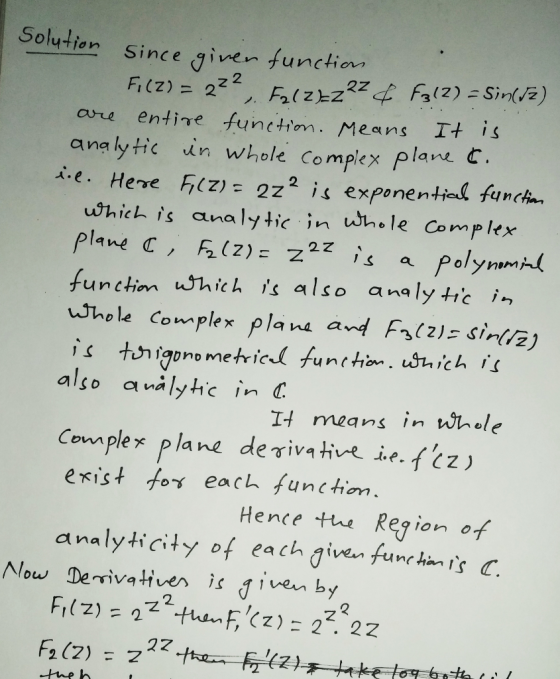
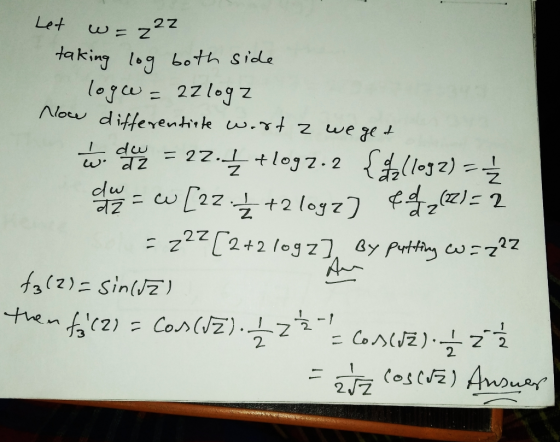
1. Find the region of analyticity of functions F...
What is the domain of analyticity of f PV.2', where P.V. denotes principal value? What is the derivative of f on th...
 What is the domain of analyticity of f PV.2', where P.V. denotes principal value? What is the derivative of f on the domain where it is analytic? What is the contour integral of f(z) over the unit circle with positive orientation? Find the Taylor series for f()around the point o-i the point 20 In what region are we guaranteed that the Taylor series converges to f?
What is the domain of analyticity of f PV.2', where P.V. denotes principal value?...
What is the domain of analyticity of f PV.2', where P.V. denotes principal value? What is the derivative of f on the domain where it is analytic? What is the contour integral of f(z) over the unit circle with positive orientation? Find the Taylor series for f()around the point o-i the point 20 In what region are we guaranteed that the Taylor series converges to f?
What is the domain of analyticity of f PV.2', where P.V. denotes principal value?...
Hw2 Q1 Show that the function f(z) = z2 + z is analytic. Also find its...
 Hw2 Q1 Show that the function f(z) = z2 + z is analytic. Also find its derivative. (Hint: check CR Equations for Analyticity, and then proceed finding the derivative as shown in video 8 by any of the two rules shown in video 7] Q2 Verify that the following functions are harmonic i. u = x2 - y2 + 2x - y. ii. v=e* cos y. Q3 Verify that the given function is harmonic, and find the harmonic conjugate function...
Can i have this as soon as possible please? I will give a rate!! or f(x, y, z) x2y + y2 + xz , compute a) the directional derivative at ( 1, 2, 4) in the direction of 12,2,1) , b) the maximum valu...
 Can
i have this as soon as possible please? I will give a rate!!
or f(x, y, z) x2y + y2 + xz , compute a) the directional derivative at ( 1, 2, 4) in the direction of 12,2,1) , b) the maximum value of the directional derivative of fat (1.2,4), and c) the direction of the minimum directional derivative of fat (1,2,4). (10 pts)
or f(x, y, z) x2y + y2 + xz , compute a) the directional derivative...
Can
i have this as soon as possible please? I will give a rate!!
or f(x, y, z) x2y + y2 + xz , compute a) the directional derivative at ( 1, 2, 4) in the direction of 12,2,1) , b) the maximum value of the directional derivative of fat (1.2,4), and c) the direction of the minimum directional derivative of fat (1,2,4). (10 pts)
or f(x, y, z) x2y + y2 + xz , compute a) the directional derivative...
Consider the complex functions given below: a) f(z) z,(z # 0) b) f(z)1, (0) c) f()22...
 Consider the complex functions given below: a) f(z) z,(z # 0) b) f(z)1, (0) c) f()22 d)f(2)1/(z+1), (z ) Verify that the Cauchy-Riemann equations are satisfied, and evaluate f (z) expression using the basic definition of derivative operation based on the limiting case as lim Az-0
Consider the complex functions given below: a) f(z) z,(z # 0) b) f(z)1, (0) c) f()22 d)f(2)1/(z+1), (z ) Verify that the Cauchy-Riemann equations are satisfied, and evaluate f (z) expression using the basic...
Consider the complex functions given below: a) f(z) z,(z # 0) b) f(z)1, (0) c) f()22 d)f(2)1/(z+1), (z ) Verify that the Cauchy-Riemann equations are satisfied, and evaluate f (z) expression using the basic definition of derivative operation based on the limiting case as lim Az-0
Consider the complex functions given below: a) f(z) z,(z # 0) b) f(z)1, (0) c) f()22 d)f(2)1/(z+1), (z ) Verify that the Cauchy-Riemann equations are satisfied, and evaluate f (z) expression using the basic...
need help with these problems. im stuck. please solve in detail and provide your answer. i...
 need help with these problems. im stuck. please solve in detail and
provide your answer. i will rate fast and high
#1
#2
1.-(50) Find: Vas Im I and the region of Ro RG 15V NW 414 geration 60 mA/ 4:2V PG IMA R = 200.2 2-(50) Find Ib, Ic , Yce and the region of operation 200.12 IM 2 B= 20 200
need help with these problems. im stuck. please solve in detail and
provide your answer. i will rate fast and high
#1
#2
1.-(50) Find: Vas Im I and the region of Ro RG 15V NW 414 geration 60 mA/ 4:2V PG IMA R = 200.2 2-(50) Find Ib, Ic , Yce and the region of operation 200.12 IM 2 B= 20 200
Please complete b & c 4.8. Compute f for the following functions f and paths y:...
 Please complete b & c
4.8. Compute f for the following functions f and paths y: (a) f(2)=z2 and y(*) = i + i2,0 s 1. (b) f(z) z and y is the semicircle from 1 through i to -1 (c) f(z) exp(z) and y is the line segment from 0 to a point zo
4.8. Compute f for the following functions f and paths y: (a) f(2)=z2 and y(*) = i + i2,0 s 1. (b) f(z) z and...
Please complete b & c
4.8. Compute f for the following functions f and paths y: (a) f(2)=z2 and y(*) = i + i2,0 s 1. (b) f(z) z and y is the semicircle from 1 through i to -1 (c) f(z) exp(z) and y is the line segment from 0 to a point zo
4.8. Compute f for the following functions f and paths y: (a) f(2)=z2 and y(*) = i + i2,0 s 1. (b) f(z) z and...
Please answer all questions with math detail 3. (21 points) Laplace Transform (a) (15 points) Find...
 Please answer all questions with math detail
3. (21 points) Laplace Transform (a) (15 points) Find the Laplace transforms of the following signals and determine their region of convergence sinwot)-iu i. f(t) -i, e-2(t-3 2<t otherwise (b) (6 points) The Laplace transform of a causal signal x(t) is given by X (s) = s2 , ROC: Re{s) > -1 Which of the following Fourier transforms can be obtained from X(s) without actu- ally determining the signal x(t)? In each case,...
Please answer all questions with math detail
3. (21 points) Laplace Transform (a) (15 points) Find the Laplace transforms of the following signals and determine their region of convergence sinwot)-iu i. f(t) -i, e-2(t-3 2<t otherwise (b) (6 points) The Laplace transform of a causal signal x(t) is given by X (s) = s2 , ROC: Re{s) > -1 Which of the following Fourier transforms can be obtained from X(s) without actu- ally determining the signal x(t)? In each case,...
Compute the first three non-zero terms of the Taylor series for the functions: Q.1 [10 Marks] Compute the first three non-zero terms of the Taylor series for the functions: (a) (i) f(x)-In( 1 ) about...
 Compute the first three non-zero terms of the Taylor series for
the functions:
Q.1 [10 Marks] Compute the first three non-zero terms of the Taylor series for the functions: (a) (i) f(x)-In( 1 ) about a-0 where Ir < 1 (Hint: In(it)-In(1+z)-In(1-r)) (ii) From your result in (i) find ËIn(쁩) dt Page: 1 of3 MAT1841 Assignment 2 2019 Continuous Mathematics for Computer Science 3 +3+4-10 (c) h(z) = exp (sin r) about a = 픔
Q.1 [10 Marks] Compute the...
Compute the first three non-zero terms of the Taylor series for
the functions:
Q.1 [10 Marks] Compute the first three non-zero terms of the Taylor series for the functions: (a) (i) f(x)-In( 1 ) about a-0 where Ir < 1 (Hint: In(it)-In(1+z)-In(1-r)) (ii) From your result in (i) find ËIn(쁩) dt Page: 1 of3 MAT1841 Assignment 2 2019 Continuous Mathematics for Computer Science 3 +3+4-10 (c) h(z) = exp (sin r) about a = 픔
Q.1 [10 Marks] Compute the...
2. (4pts each) Find the derivative of the following functions: You do not need to simplify...
 2. (4pts each) Find the derivative of the following functions: You do not need to simplify the answer. CIRCLE FINAL ANSWER. a. f(x) = 2x2e-1 + 7e2x-1 + 3e2e cos (36) b. g(t) = 1+sin(3) c. h(x) = ln(x2). arctan(kx) (k E R) d. f(x) = sin(x) sin(x)
5. Find the derivative matrices of the following composition of functions. (а) fog where f (x,...
 5. Find the derivative matrices of the following composition of functions. (а) fog where f (x, у) — 2х — 3у, g(u, v) - (usin u, U sin u) (Ъ) f.g where f(х, у, 2) %3D (x? + у? +2?,х— у+2:), g() %3 (2, 13, 2/4) (с) fog wherе f (x, у, z) 3D (хуz, ху + xz — yz) where g(u, v, w) %3D (uu, uw, vw)
5. Find the derivative matrices of the following composition of functions. (а)...
5. Find the derivative matrices of the following composition of functions. (а) fog where f (x, у) — 2х — 3у, g(u, v) - (usin u, U sin u) (Ъ) f.g where f(х, у, 2) %3D (x? + у? +2?,х— у+2:), g() %3 (2, 13, 2/4) (с) fog wherе f (x, у, z) 3D (хуz, ху + xz — yz) where g(u, v, w) %3D (uu, uw, vw)
5. Find the derivative matrices of the following composition of functions. (а)...
 What is the domain of analyticity of f PV.2', where P.V. denotes principal value? What is the derivative of f on the domain where it is analytic? What is the contour integral of f(z) over the unit circle with positive orientation? Find the Taylor series for f()around the point o-i the point 20 In what region are we guaranteed that the Taylor series converges to f?
What is the domain of analyticity of f PV.2', where P.V. denotes principal value?...
What is the domain of analyticity of f PV.2', where P.V. denotes principal value? What is the derivative of f on the domain where it is analytic? What is the contour integral of f(z) over the unit circle with positive orientation? Find the Taylor series for f()around the point o-i the point 20 In what region are we guaranteed that the Taylor series converges to f?
What is the domain of analyticity of f PV.2', where P.V. denotes principal value?...
 Hw2 Q1 Show that the function f(z) = z2 + z is analytic. Also find its derivative. (Hint: check CR Equations for Analyticity, and then proceed finding the derivative as shown in video 8 by any of the two rules shown in video 7] Q2 Verify that the following functions are harmonic i. u = x2 - y2 + 2x - y. ii. v=e* cos y. Q3 Verify that the given function is harmonic, and find the harmonic conjugate function...
 Can
i have this as soon as possible please? I will give a rate!!
or f(x, y, z) x2y + y2 + xz , compute a) the directional derivative at ( 1, 2, 4) in the direction of 12,2,1) , b) the maximum value of the directional derivative of fat (1.2,4), and c) the direction of the minimum directional derivative of fat (1,2,4). (10 pts)
or f(x, y, z) x2y + y2 + xz , compute a) the directional derivative...
Can
i have this as soon as possible please? I will give a rate!!
or f(x, y, z) x2y + y2 + xz , compute a) the directional derivative at ( 1, 2, 4) in the direction of 12,2,1) , b) the maximum value of the directional derivative of fat (1.2,4), and c) the direction of the minimum directional derivative of fat (1,2,4). (10 pts)
or f(x, y, z) x2y + y2 + xz , compute a) the directional derivative...
 Consider the complex functions given below: a) f(z) z,(z # 0) b) f(z)1, (0) c) f()22 d)f(2)1/(z+1), (z ) Verify that the Cauchy-Riemann equations are satisfied, and evaluate f (z) expression using the basic definition of derivative operation based on the limiting case as lim Az-0
Consider the complex functions given below: a) f(z) z,(z # 0) b) f(z)1, (0) c) f()22 d)f(2)1/(z+1), (z ) Verify that the Cauchy-Riemann equations are satisfied, and evaluate f (z) expression using the basic...
Consider the complex functions given below: a) f(z) z,(z # 0) b) f(z)1, (0) c) f()22 d)f(2)1/(z+1), (z ) Verify that the Cauchy-Riemann equations are satisfied, and evaluate f (z) expression using the basic definition of derivative operation based on the limiting case as lim Az-0
Consider the complex functions given below: a) f(z) z,(z # 0) b) f(z)1, (0) c) f()22 d)f(2)1/(z+1), (z ) Verify that the Cauchy-Riemann equations are satisfied, and evaluate f (z) expression using the basic...
 need help with these problems. im stuck. please solve in detail and
provide your answer. i will rate fast and high
#1
#2
1.-(50) Find: Vas Im I and the region of Ro RG 15V NW 414 geration 60 mA/ 4:2V PG IMA R = 200.2 2-(50) Find Ib, Ic , Yce and the region of operation 200.12 IM 2 B= 20 200
need help with these problems. im stuck. please solve in detail and
provide your answer. i will rate fast and high
#1
#2
1.-(50) Find: Vas Im I and the region of Ro RG 15V NW 414 geration 60 mA/ 4:2V PG IMA R = 200.2 2-(50) Find Ib, Ic , Yce and the region of operation 200.12 IM 2 B= 20 200
 Please complete b & c
4.8. Compute f for the following functions f and paths y: (a) f(2)=z2 and y(*) = i + i2,0 s 1. (b) f(z) z and y is the semicircle from 1 through i to -1 (c) f(z) exp(z) and y is the line segment from 0 to a point zo
4.8. Compute f for the following functions f and paths y: (a) f(2)=z2 and y(*) = i + i2,0 s 1. (b) f(z) z and...
Please complete b & c
4.8. Compute f for the following functions f and paths y: (a) f(2)=z2 and y(*) = i + i2,0 s 1. (b) f(z) z and y is the semicircle from 1 through i to -1 (c) f(z) exp(z) and y is the line segment from 0 to a point zo
4.8. Compute f for the following functions f and paths y: (a) f(2)=z2 and y(*) = i + i2,0 s 1. (b) f(z) z and...
 Please answer all questions with math detail
3. (21 points) Laplace Transform (a) (15 points) Find the Laplace transforms of the following signals and determine their region of convergence sinwot)-iu i. f(t) -i, e-2(t-3 2<t otherwise (b) (6 points) The Laplace transform of a causal signal x(t) is given by X (s) = s2 , ROC: Re{s) > -1 Which of the following Fourier transforms can be obtained from X(s) without actu- ally determining the signal x(t)? In each case,...
Please answer all questions with math detail
3. (21 points) Laplace Transform (a) (15 points) Find the Laplace transforms of the following signals and determine their region of convergence sinwot)-iu i. f(t) -i, e-2(t-3 2<t otherwise (b) (6 points) The Laplace transform of a causal signal x(t) is given by X (s) = s2 , ROC: Re{s) > -1 Which of the following Fourier transforms can be obtained from X(s) without actu- ally determining the signal x(t)? In each case,...
 Compute the first three non-zero terms of the Taylor series for
the functions:
Q.1 [10 Marks] Compute the first three non-zero terms of the Taylor series for the functions: (a) (i) f(x)-In( 1 ) about a-0 where Ir < 1 (Hint: In(it)-In(1+z)-In(1-r)) (ii) From your result in (i) find ËIn(쁩) dt Page: 1 of3 MAT1841 Assignment 2 2019 Continuous Mathematics for Computer Science 3 +3+4-10 (c) h(z) = exp (sin r) about a = 픔
Q.1 [10 Marks] Compute the...
Compute the first three non-zero terms of the Taylor series for
the functions:
Q.1 [10 Marks] Compute the first three non-zero terms of the Taylor series for the functions: (a) (i) f(x)-In( 1 ) about a-0 where Ir < 1 (Hint: In(it)-In(1+z)-In(1-r)) (ii) From your result in (i) find ËIn(쁩) dt Page: 1 of3 MAT1841 Assignment 2 2019 Continuous Mathematics for Computer Science 3 +3+4-10 (c) h(z) = exp (sin r) about a = 픔
Q.1 [10 Marks] Compute the...
 2. (4pts each) Find the derivative of the following functions: You do not need to simplify the answer. CIRCLE FINAL ANSWER. a. f(x) = 2x2e-1 + 7e2x-1 + 3e2e cos (36) b. g(t) = 1+sin(3) c. h(x) = ln(x2). arctan(kx) (k E R) d. f(x) = sin(x) sin(x)
 5. Find the derivative matrices of the following composition of functions. (а) fog where f (x, у) — 2х — 3у, g(u, v) - (usin u, U sin u) (Ъ) f.g where f(х, у, 2) %3D (x? + у? +2?,х— у+2:), g() %3 (2, 13, 2/4) (с) fog wherе f (x, у, z) 3D (хуz, ху + xz — yz) where g(u, v, w) %3D (uu, uw, vw)
5. Find the derivative matrices of the following composition of functions. (а)...
5. Find the derivative matrices of the following composition of functions. (а) fog where f (x, у) — 2х — 3у, g(u, v) - (usin u, U sin u) (Ъ) f.g where f(х, у, 2) %3D (x? + у? +2?,х— у+2:), g() %3 (2, 13, 2/4) (с) fog wherе f (x, у, z) 3D (хуz, ху + xz — yz) where g(u, v, w) %3D (uu, uw, vw)
5. Find the derivative matrices of the following composition of functions. (а)...
Most questions answered within 3 hours.
-
Where is the error in this code sequence?
String s1 = "Hello";
String s2 = "ello";...
asked 10 months ago -
Financial data for Joel de Paris, Inc., for last year
follow:
Joel de Paris, Inc.
Balance...
asked 10 months ago -
Consider this reaction:
Al2(SO4)3 (aq)+ BaCl3
(aq) Al2Cl6 (aq)- +
3BaSO4(s) . What is the...
asked 10 months ago -
Suppose that Savneet is considering increasing her
recent random sample from 20 car rentals to 40...
asked 10 months ago -
Trucks arrive at an unloading terminal at an average rate of 120
per hour.
Trucks arrive...
asked 10 months ago -
Why are methanol and ethanol completely soluble in water while
octanol is not very little soluble....
asked 10 months ago -
A facilities manager at a university reads in a research report
that the mean amount of...
asked 10 months ago -
When the CuSO4 is rehydrated by adding water to the anhydrous
compound, is this an endothermic...
asked 10 months ago -
A ray of sunlight is passing from diamond into crown glass; the
angle of incidence is...
asked 10 months ago -
A block of mass 0.249 kg is placed on top of a light, vertical
spring of...
asked 10 months ago -
how do the kidneys compensate in the presences of acidosis
a) trigger hyperventilate
b) reserve acid...
asked 10 months ago -
Question 501 pts
The rental rate of capital to the firm increases. Which of the
following...
asked 10 months ago