Exercise 5. Construct a Maple procedure for decoding a message which was encoded with a Huffman...
Exercise 5. Construct a Maple procedure for decoding a message which was encoded with a
Huffman code. That is, given a Huffman coding tree produced by the HuffmanCode procedure
and a message encoded by the EncodeString procedure, the algorithm should return the original
string.
Homework Answers
Let me start with the introduction,
Huffman Code :
The application is to methods for representing data as sequences of ones and zeros (bits). For example, the ASCII standard code used to represent text in computers encodes each character as a sequence of seven bits. Using seven bits allows us to distinguish 27, or 128, possible different characters. In general, if we want to distinguish n different symbols, we will need to use bits per symbol. If all our messages are made up of the eight symbols A, B, C, D, E, F, G, and H, we can choose a code with three bits per character, for example
|
A 000 |
C 010 |
E 100 |
G 110 |
|
B 001 |
D 011 |
F 101 |
H 111 |
With this code, the message
BACADAEAFABBAAAGAH
is encoded as the string of 54 bits
001000010000011000100000101000001001000000000110000111
Codes such as ASCII and the A-through-H code above are known as fixed-length codes, because they represent each symbol in the message with the same number of bits. It is sometimes advantageous to usevariable-length codes, in which different symbols may be represented by different numbers of bits. For example, Morse code does not use the same number of dots and dashes for each letter of the alphabet. In particular, E, the most frequent letter, is represented by a single dot. In general, if our messages are such that some symbols appear very frequently and some very rarely, we can encode data more efficiently (i.e., using fewer bits per message) if we assign shorter codes to the frequent symbols. Consider the following alternative code for the letters A through H:
|
A 0 |
C 1010 |
E 1100 |
G 1110 |
|
B 100 |
D 1011 |
F 1101 |
H 1111 |
With this code, the same message as above is encoded as the string
100010100101101100011010100100000111001111
This string contains 42 bits, so it saves more than 20% in space in comparison with the fixed-length code shown above.
One of the difficulties of using a variable-length code is knowing when you have reached the end of a symbol in reading a sequence of zeros and ones. Morse code solves this problem by using a specialseparator code (in this case, a pause) after the sequence of dots and dashes for each letter. Another solution is to design the code in such a way that no complete code for any symbol is the beginning (orprefix) of the code for another symbol. Such a code is called a prefix code. In the example above, A is encoded by 0 and B is encoded by 100, so no other symbol can have a code that begins with 0 or with 100.
In general, we can attain significant savings if we use variable-length prefix codes that take advantage of the relative frequencies of the symbols in the messages to be encoded. One particular scheme for doing this is called the Huffman encoding method, after its discoverer, David Huffman. A Huffman code can be represented as a binary tree whose leaves are the symbols that are encoded. At each non-leaf node of the tree there is a set containing all the symbols in the leaves that lie below the node. In addition, each symbol at a leaf is assigned a weight (which is its relative frequency), and each non-leaf node contains a weight that is the sum of all the weights of the leaves lying below it. The weights are not used in the encoding or the decoding process. We will see below how they are used to help construct the tree.
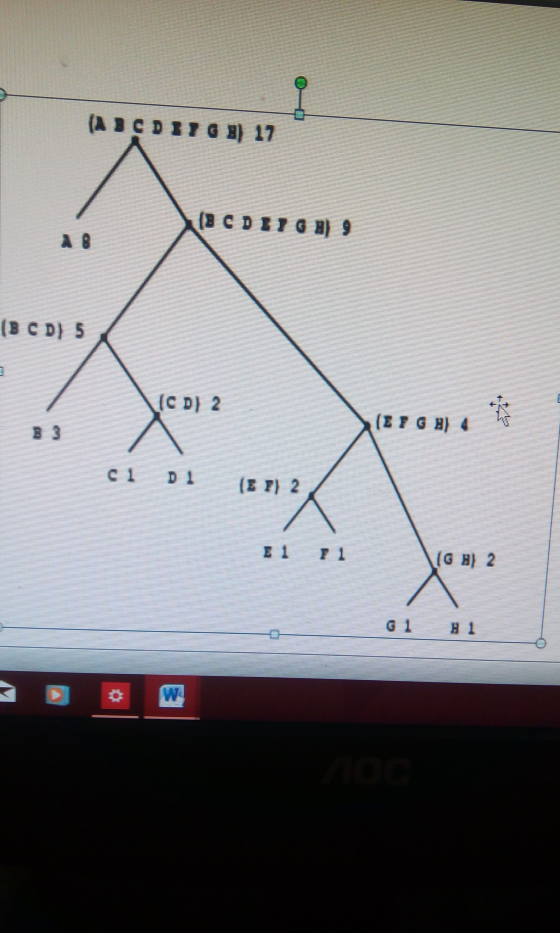
The above figure shows the Huffman tree for the A-through-H code given above. The weights at the leaves indicate that the tree was designed for messages in which A appears with relative frequency 8, B with relative frequency 3, and the other letters each with relative frequency 1.
Given a Huffman tree, we can find the encoding of any symbol by starting at the root and moving down until we reach the leaf that holds the symbol. Each time we move down a left branch we add a 0 to the code, and each time we move down a right branch we add a 1. (We decide which branch to follow by testing to see which branch either is the leaf node for the symbol or contains the symbol in its set.) For example, starting from the root of the tree in figure , we arrive at the leaf for D by following a right branch, then a left branch, then a right branch, then a right branch; hence, the code for D is 1011.
To decode a bit sequence using a Huffman tree, we begin at the root and use the successive zeros and ones of the bit sequence to determine whether to move down the left or the right branch. Each time we come to a leaf, we have generated a new symbol in the message, at which point we start over from the root of the tree to find the next symbol. For example, suppose we are given the tree above and the sequence 10001010. Starting at the root, we move down the right branch, (since the first bit of the string is 1), then down the left branch (since the second bit is 0), then down the left branch (since the third bit is also 0). This brings us to the leaf for B, so the first symbol of the decoded message is B. Now we start again at the root, and we make a left move because the next bit in the string is 0. This brings us to the leaf for A. Then we start again at the root with the rest of the string 1010, so we move right, left, right, left and reach C. Thus, the entire message is BAC.
Generating Huffman trees
Given an ``alphabet'' of symbols and their relative frequencies, how do we construct the ``best'' code? (In other words, which tree will encode messages with the fewest bits?) Huffman gave an algorithm for doing this and showed that the resulting code is indeed the best variable-length code for messages where the relative frequency of the symbols matches the frequencies with which the code was constructed. We will not prove this optimality of Huffman codes here, but we will show how Huffman trees are constructed.
The algorithm for generating a Huffman tree is very simple. The idea is to arrange the tree so that the symbols with the lowest frequency appear farthest away from the root. Begin with the set of leaf nodes, containing symbols and their frequencies, as determined by the initial data from which the code is to be constructed. Now find two leaves with the lowest weights and merge them to produce a node that has these two nodes as its left and right branches. The weight of the new node is the sum of the two weights. Remove the two leaves from the original set and replace them by this new node. Now continue this process. At each step, merge two nodes with the smallest weights, removing them from the set and replacing them with a node that has these two as its left and right branches. The process stops when there is only one node left, which is the root of the entire tree. Here is how the Huffman tree of figure was generated:
|
Initial leaves |
{(A 8) (B 3) (C 1) (D 1) (E 1) (F 1) (G 1) (H 1)} |
|
Merge |
{(A 8) (B 3) ({C D} 2) (E 1) (F 1) (G 1) (H 1)} |
|
Merge |
{(A 8) (B 3) ({C D} 2) ({E F} 2) (G 1) (H 1)} |
|
Merge |
{(A 8) (B 3) ({C D} 2) ({E F} 2) ({G H} 2)} |
|
Merge |
{(A 8) (B 3) ({C D} 2) ({E F G H} 4)} |
|
Merge |
{(A 8) ({B C D} 5) ({E F G H} 4)} |
|
Merge |
{(A 8) ({B C D E F G H} 9)} |
|
Final merge |
{({A B C D E F G H} 17)} |
The algorithm does not always specify a unique tree, because there may not be unique smallest-weight nodes at each step. Also, the choice of the order in which the two nodes are merged (i.e., which will be the right branch and which will be the left branch) is arbitrary.
Representing Huffman trees
In the exercises below we will work with a system that uses Huffman trees to encode and decode messages and generates Huffman trees according to the algorithm outlined above. We will begin by discussing how trees are represented.
Leaves of the tree are represented by a list consisting of the symbol leaf, the symbol at the leaf, and the weight:
(define (make-leaf symbol weight)
(list 'leaf symbol weight))
(define (leaf? object)
(eq? (car object) 'leaf))
(define (symbol-leaf x) (cadr x))
(define (weight-leaf x) (caddr x))
A general tree will be a list of a left branch, a right branch, a set of symbols, and a weight. The set of symbols will be simply a list of the symbols, rather than some more sophisticated set representation. When we make a tree by merging two nodes, we obtain the weight of the tree as the sum of the weights of the nodes, and the set of symbols as the union of the sets of symbols for the nodes. Since our symbol sets are represented as lists, we can form the union by using the append procedure we defined in section :
(define (make-code-tree left right)
(list left
right
(append (symbols left) (symbols right))
(+ (weight left) (weight right))))
If we make a tree in this way, we have the following selectors:
(define (left-branch tree) (car tree))
(define (right-branch tree) (cadr tree))
(define (symbols tree)
(if (leaf? tree)
(list (symbol-leaf tree))
(caddr tree)))
(define (weight tree)
(if (leaf? tree)
(weight-leaf tree)
(cadddr tree)))
The procedures symbols and weight must do something slightly different depending on whether they are called with a leaf or a general tree. These are simple examples of generic procedures (procedures that can handle more than one kind of data), which we will have much more to say about in sections .
The decoding procedure
The following procedure implements the decoding algorithm. It takes as arguments a list of zeros and ones, together with a Huffman tree.
(define (decode bits tree)
(define (decode-1 bits current-branch)
(if (null? bits)
'()
(let ((next-branch
(choose-branch (car bits) current-branch)))
(if (leaf? next-branch)
(cons (symbol-leaf next-branch)
(decode-1 (cdr bits) tree))
(decode-1 (cdr bits) next-branch)))))
(decode-1 bits tree))
(define (choose-branch bit branch)
(cond ((= bit 0) (left-branch branch))
((= bit 1) (right-branch branch))
(else (error "bad bit - CHOOSE-BRANCH" bit))))
The procedure decode-1 takes two arguments: the list of remaining bits and the current position in the tree. It keeps moving ``down'' the tree, choosing a left or a right branch according to whether the next bit in the list is a zero or a one. (This is done with the procedure choose-branch.) When it reaches a leaf, it returns the symbol at that leaf as the next symbol in the message by consing it onto the result of decoding the rest of the message, starting at the root of the tree. Note the error check in the final clause of choose-branch, which complains if the procedure finds something other than a zero or a one in the input data.
Sets of weighted elements In our representation of trees, each non-leaf node contains a set of symbols, which we have represented as a simple list. However, the tree-generating algorithm discussed above requires that we also work with sets of leaves and trees, successively merging the two smallest items. Since we will be required to repeatedly find the smallest item in a set, it is convenient to use an ordered representation for this kind of set.
We will represent a set of leaves and trees as a list of elements, arranged in increasing order of weight. The following adjoin-set procedure for constructing sets is similar to the one described in exercise ; however, items are compared by their weights, and the element being added to the set is never already in it.
(define (adjoin-set x set)
(cond ((null? set) (list x))
((< (weight x) (weight (car set))) (cons x set))
(else (cons (car set)
(adjoin-set x (cdr set))))))
The following procedure takes a list of symbol-frequency pairs such as ((A 4) (B 2) (C 1) (D 1)) and constructs an initial ordered set of leaves, ready to be merged according to the Huffman algorithm:
(define (make-leaf-set pairs)
(if (null? pairs)
'()
(let ((pair (car pairs)))
(adjoin-set (make-leaf (car pair) ; symbol
(cadr pair)) ; frequency
(make-leaf-set (cdr pairs))))))
Exercise. Define an encoding tree and a sample message:
(define sample-tree
(make-code-tree (make-leaf 'A 4)
(make-code-tree
(make-leaf 'B 2)
(make-code-tree (make-leaf 'D 1)
(make-leaf 'C 1)))))
(define sample-message '(0 1 1 0 0 1 0 1 0 1 1 1 0))
Use the decode procedure to decode the message, and give the result.
Exercise. The encode procedure takes as arguments a message and a tree and produces the list of bits that gives the encoded message.
(define (encode message tree)
(if (null? message)
'()
(append (encode-symbol (car message) tree)
(encode (cdr message) tree))))
Encode-symbol is a procedure, which you must write, that returns the list of bits that encodes a given symbol according to a given tree. You should design encode-symbol so that it signals an error if the symbol is not in the tree at all. Test your procedure by encoding the result you obtained in exercise with the sample tree and seeing whether it is the same as the original sample message.
Exercise. The following procedure takes as its argument a list of symbol-frequency pairs (where no symbol appears in more than one pair) and generates a Huffman encoding tree according to the Huffman algorithm.
(define (generate-huffman-tree pairs)
(successive-merge (make-leaf-set pairs)))
Make-leaf-set is the procedure given above that transforms the list of pairs into an ordered set of leaves. Successive-merge is the procedure you must write, using make-code-tree to successively merge the smallest-weight elements of the set until there is only one element left, which is the desired Huffman tree. (This procedure is slightly tricky, but not really complicated. If you find yourself designing a complex procedure, then you are almost certainly doing something wrong. You can take significant advantage of the fact that we are using an ordered set representation.)
Exercise. The following eight-symbol alphabet with associated relative frequencies was designed to efficiently encode the lyrics of 1950s rock songs. (Note that the ``symbols'' of an ``alphabet'' need not be individual letters.)
|
A |
2 |
NA |
16 |
|
BOOM |
1 |
SHA |
3 |
|
GET |
2 |
YIP |
9 |
|
JOB |
2 |
WAH |
1 |
Use generate-huffman-tree (exercise ) to generate a corresponding Huffman tree, and use encode (exercise ) to encode the following message:
Get a job
Sha na na na na na na na na
Get a job
Sha na na na na na na na na
Wah yip yip yip yip yip yip yip yip yip
Sha boom
Add Answer to:
Exercise 5. Construct a Maple procedure for decoding a message
which was encoded with a
Huffman...
(b.) Huffman code is a way to encode information using variable-length binary strings to represent symbols depending on the frequency of each individual letter. Specifically, letters that appear more...
 (b.) Huffman code is a way to encode information using variable-length binary strings to represent symbols depending on the frequency of each individual letter. Specifically, letters that appear more frequently can be encoded into strings of shorter lengths, while rarer letters can be turned into longer binary strings. On average, Huffman code is a more efficient way to encode a message as the number of bits in the output string will be shorter than if a fixed-length code was used....
. Huffman Encoding (a.) (6 points) Suppose a certain file contains only the following letters with the corresponding frequencies 1 AİB 73 9 30 44 130 28 16 In a fixed-length encoding scheme, cach...
 . Huffman Encoding (a.) (6 points) Suppose a certain file contains only the following letters with the corresponding frequencies 1 AİB 73 9 30 44 130 28 16 In a fixed-length encoding scheme, cach character is given a binary representation with the same number of bits. What is the minimum number of bits required to represent each letter of this file under fixed-length encoding scheme? Describe how to encode all seven letters in this file using the number of bits...
Problem (3): Huffman Coding A message contains n = 5 symbols (A, B, C, D, E)...
Problem (3): Huffman Coding A message contains n = 5 symbols (A, B, C, D, E) with probabilities P = (1/2, 1/4, 1/8, 1/16, 1/16), respectively. • Find a variable length Huffman coding for the 5 symbols • Find the average code length < L > for the obtained codes • Show that < L > can also be obtained by summing the probabilities of the internal nodes in the Huffman tree. • Find the coding efficiency for the obtained...
For this assignment, you will write a program to work with Huffman encoding. Huffman code is...
For this assignment, you will write a program to work with Huffman encoding. Huffman code is an optimal prefix code, which means no code is the prefix of another code. Most of the code is included. You will need to extend the code to complete three additional methods. In particular, code to actually build the Huffman tree is provided. It uses a data file containing the frequency of occurrence of characters. You will write the following three methods in the...
Problem (A1) (20 points): Huffman Coding Consider a message having the 5 symbols (A,B,C,D,E) with probabilities...
 Problem (A1) (20 points): Huffman Coding Consider a message having the 5 symbols (A,B,C,D,E) with probabilities (0.1,0.1,0.2 ,0.2, 0.4), respectively. For such data, two different sets of Huffman codes can result from a different tie breaking during the construction of the Huffman trees. • Construct the two Huffman trees. (8 points) Construct the Huffman codes for the given symbols for each tree. (4 points) Show that both trees will produce the same average code length. (4 points) For data transmission...
You will construct a Huffman tree based on the given frequencies of 26 English alphabets in...
You will construct a Huffman tree based on the given frequencies of 26 English alphabets in upper case plus the space character. An internal tree node class in HuffmanTree with necessary information is required. • You will not randomly switch left and right children when merger two trees. Instead, you will build a right-heavy tree according to the following strategies to select the right child. (1) The tree that is taller will be the right child, i.e., the height is...
C language huffman This exercise will familiarize you with linked lists, which you will need for...
 C language huffman
This exercise will familiarize you with linked lists, which you will need for a subsequent programming Getting Started assignment Overview Requirements Getting Started Submit Start by getting the files. Type 264get hw13 and then cd hw13 from bash. Pre-tester You will get the following files: Q&A Updates 1. huffman.h: An empty header file, you have to define your own functions in this homework. 2. huffman.c: An empty c file, you have to define your own functions in...
C language huffman
This exercise will familiarize you with linked lists, which you will need for a subsequent programming Getting Started assignment Overview Requirements Getting Started Submit Start by getting the files. Type 264get hw13 and then cd hw13 from bash. Pre-tester You will get the following files: Q&A Updates 1. huffman.h: An empty header file, you have to define your own functions in this homework. 2. huffman.c: An empty c file, you have to define your own functions in...
*Java* You will write a program to do the following: 1. Read an input file with...
 *Java*
You will write a program to do the following: 1. Read an input file with a single line of text. Create a method named load_data. 2. Determine the frequency distribution of every symbol in the line of text. Create a method named 3. Construct the Huffman tree. 4. Create a mapping between every symbol and its corresponding Huffman code. 5. Encode the line of text using the corresponding code for every symbol. 6. Display the results on the screen....
*Java*
You will write a program to do the following: 1. Read an input file with a single line of text. Create a method named load_data. 2. Determine the frequency distribution of every symbol in the line of text. Create a method named 3. Construct the Huffman tree. 4. Create a mapping between every symbol and its corresponding Huffman code. 5. Encode the line of text using the corresponding code for every symbol. 6. Display the results on the screen....
68 4 64 73 1 5. Matrix C is a coded message where C61 4 52 51 0 109 5 120 170 5 You know that each letter of the original message was first replaced with the number corresponding to its placement in...
 68 4 64 73 1 5. Matrix C is a coded message where C61 4 52 51 0 109 5 120 170 5 You know that each letter of the original message was first replaced with the number corresponding to its placement in the English alphabet (eg. E was replaced with 5) and any spaces in the message were replaced with zeroes. Then the message was encoded by multiplying the message matrix, M, on the left by the coding matrix,...
Do this using the C language. show me the code being executed and also copy and...
 Do this using the C language. show me the code being executed
and also copy and paste the code so i can try it out for
myseld
Instructions A cipher is mirrored algorithm that allow phrases or messages to be obfuscated (ie. "scrambled"). Ciphers were an early form of security used to send hidden messages from one party to another. The most famous and classic example of a cipher is the Caesar Cipher. This cypher worked by shifting each letter...
Do this using the C language. show me the code being executed
and also copy and paste the code so i can try it out for
myseld
Instructions A cipher is mirrored algorithm that allow phrases or messages to be obfuscated (ie. "scrambled"). Ciphers were an early form of security used to send hidden messages from one party to another. The most famous and classic example of a cipher is the Caesar Cipher. This cypher worked by shifting each letter...
 (b.) Huffman code is a way to encode information using variable-length binary strings to represent symbols depending on the frequency of each individual letter. Specifically, letters that appear more frequently can be encoded into strings of shorter lengths, while rarer letters can be turned into longer binary strings. On average, Huffman code is a more efficient way to encode a message as the number of bits in the output string will be shorter than if a fixed-length code was used....
 . Huffman Encoding (a.) (6 points) Suppose a certain file contains only the following letters with the corresponding frequencies 1 AİB 73 9 30 44 130 28 16 In a fixed-length encoding scheme, cach character is given a binary representation with the same number of bits. What is the minimum number of bits required to represent each letter of this file under fixed-length encoding scheme? Describe how to encode all seven letters in this file using the number of bits...
 Problem (A1) (20 points): Huffman Coding Consider a message having the 5 symbols (A,B,C,D,E) with probabilities (0.1,0.1,0.2 ,0.2, 0.4), respectively. For such data, two different sets of Huffman codes can result from a different tie breaking during the construction of the Huffman trees. • Construct the two Huffman trees. (8 points) Construct the Huffman codes for the given symbols for each tree. (4 points) Show that both trees will produce the same average code length. (4 points) For data transmission...
 C language huffman
This exercise will familiarize you with linked lists, which you will need for a subsequent programming Getting Started assignment Overview Requirements Getting Started Submit Start by getting the files. Type 264get hw13 and then cd hw13 from bash. Pre-tester You will get the following files: Q&A Updates 1. huffman.h: An empty header file, you have to define your own functions in this homework. 2. huffman.c: An empty c file, you have to define your own functions in...
C language huffman
This exercise will familiarize you with linked lists, which you will need for a subsequent programming Getting Started assignment Overview Requirements Getting Started Submit Start by getting the files. Type 264get hw13 and then cd hw13 from bash. Pre-tester You will get the following files: Q&A Updates 1. huffman.h: An empty header file, you have to define your own functions in this homework. 2. huffman.c: An empty c file, you have to define your own functions in...
 *Java*
You will write a program to do the following: 1. Read an input file with a single line of text. Create a method named load_data. 2. Determine the frequency distribution of every symbol in the line of text. Create a method named 3. Construct the Huffman tree. 4. Create a mapping between every symbol and its corresponding Huffman code. 5. Encode the line of text using the corresponding code for every symbol. 6. Display the results on the screen....
*Java*
You will write a program to do the following: 1. Read an input file with a single line of text. Create a method named load_data. 2. Determine the frequency distribution of every symbol in the line of text. Create a method named 3. Construct the Huffman tree. 4. Create a mapping between every symbol and its corresponding Huffman code. 5. Encode the line of text using the corresponding code for every symbol. 6. Display the results on the screen....
 68 4 64 73 1 5. Matrix C is a coded message where C61 4 52 51 0 109 5 120 170 5 You know that each letter of the original message was first replaced with the number corresponding to its placement in the English alphabet (eg. E was replaced with 5) and any spaces in the message were replaced with zeroes. Then the message was encoded by multiplying the message matrix, M, on the left by the coding matrix,...
 Do this using the C language. show me the code being executed
and also copy and paste the code so i can try it out for
myseld
Instructions A cipher is mirrored algorithm that allow phrases or messages to be obfuscated (ie. "scrambled"). Ciphers were an early form of security used to send hidden messages from one party to another. The most famous and classic example of a cipher is the Caesar Cipher. This cypher worked by shifting each letter...
Do this using the C language. show me the code being executed
and also copy and paste the code so i can try it out for
myseld
Instructions A cipher is mirrored algorithm that allow phrases or messages to be obfuscated (ie. "scrambled"). Ciphers were an early form of security used to send hidden messages from one party to another. The most famous and classic example of a cipher is the Caesar Cipher. This cypher worked by shifting each letter...
Most questions answered within 3 hours.
-
Where is the error in this code sequence?
String s1 = "Hello";
String s2 = "ello";...
asked 10 months ago -
Financial data for Joel de Paris, Inc., for last year
follow:
Joel de Paris, Inc.
Balance...
asked 10 months ago -
Consider this reaction:
Al2(SO4)3 (aq)+ BaCl3
(aq) Al2Cl6 (aq)- +
3BaSO4(s) . What is the...
asked 10 months ago -
Suppose that Savneet is considering increasing her
recent random sample from 20 car rentals to 40...
asked 10 months ago -
Trucks arrive at an unloading terminal at an average rate of 120
per hour.
Trucks arrive...
asked 10 months ago -
Why are methanol and ethanol completely soluble in water while
octanol is not very little soluble....
asked 10 months ago -
A facilities manager at a university reads in a research report
that the mean amount of...
asked 10 months ago -
When the CuSO4 is rehydrated by adding water to the anhydrous
compound, is this an endothermic...
asked 10 months ago -
A ray of sunlight is passing from diamond into crown glass; the
angle of incidence is...
asked 10 months ago -
A block of mass 0.249 kg is placed on top of a light, vertical
spring of...
asked 10 months ago -
how do the kidneys compensate in the presences of acidosis
a) trigger hyperventilate
b) reserve acid...
asked 10 months ago -
Question 501 pts
The rental rate of capital to the firm increases. Which of the
following...
asked 10 months ago