
Homework Answers
![story; steps CH-C=CH2 3 BH3 нз Her Narn - CH-CH2OH CH3 g-metly prapano] Mechanism :- CH₃-C=CH2 8 + 6- 맥내 CH3-CH-CH2-BH2 kHz .](http://img.homeworklib.com/questions/147efeb0-0a0f-11ec-8cd2-51800cca84d6.png?x-oss-process=image/resize,w_560)
Add Answer to:
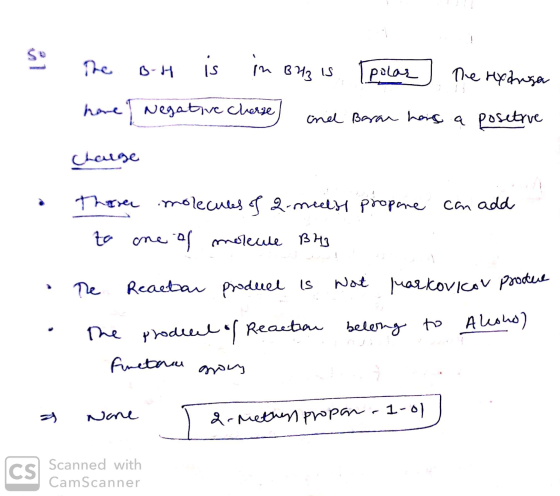
Consider the reaction of 2-methylpropene with BH3 followed by oxidation, and answer the following questions: The...
please help The dehydration of alcohols Under acidic conditions, alcohols will undergo a dehydration reaction, producing...
 please help
The dehydration of alcohols Under acidic conditions, alcohols will undergo a dehydration reaction, producing an alkene and water. During the reaction, the hydroxyl group of the alcohol and a hydrogen atom from an adjacent carbon atom are lost. The reaction takes place in three steps, as shown in the diagram. (Figure 1) In the first step, a hydrogen lon bonds to the hydroxyl group of the alcohol. In the second step, the protonated hydroxl group leaves the compound,...
please help
The dehydration of alcohols Under acidic conditions, alcohols will undergo a dehydration reaction, producing an alkene and water. During the reaction, the hydroxyl group of the alcohol and a hydrogen atom from an adjacent carbon atom are lost. The reaction takes place in three steps, as shown in the diagram. (Figure 1) In the first step, a hydrogen lon bonds to the hydroxyl group of the alcohol. In the second step, the protonated hydroxl group leaves the compound,...
Draw the sulfur-containing product of the following oxidation reaction between two 2-methyl-1-propanethiol molecule...
 Draw the sulfur-containing product of the following oxidation reaction between two 2-methyl-1-propanethiol molecules. Draw all hydrogen atoms.
Predict the product of the reaction of 1-butene with bromine. An alkyne undergoes hydrogenation to produce...
 Predict the product of the reaction of 1-butene with bromine. An alkyne undergoes hydrogenation to produce an alkene as follows: Predict the product and draw it. Draw the molecule on the canvas by choosing buttons from the Tools (for bonds), Atoms, and Advanced Template toolbars. The single bond is active by default. To add an R group, select any atom while the Rectangle Selection tool is active and type R.
In an addition reaction of an alkene or alkyne, a reactant, such as bromine (Br2Br2), hydrogen...
In an addition reaction of an alkene or alkyne, a reactant, such as bromine (Br2Br2), hydrogen (H2H2), or water (H2OH2O), is added to the two atoms that form the multiple bond. When there is a triple bond, the first equivalent is added to form a new bond at each atom of the multiple bond, and the species formed has a double bond. The second equivalent will again add to the two atoms that form the multiple bond, and an alkane...
Ionic & Covalent Virtual Lab Pre-Virtual Lab Questions: Answer these before going to the website to...
 Ionic & Covalent Virtual Lab Pre-Virtual Lab Questions: Answer these before going to the website to begin the virtual lab. 1. Where are metal atoms located on the periodic table? Where are non metal atoms located on the periodic table? 2. What subatomic particles) participate in chemical bonding? 3. In your own words, define valence electrons. 4. How can you determine the number of valence electrons in an atom using the periodic table? 5. Draw a Lewis Dot Structure for...
1. 2. 3. Balancing Oxidation-Reduction Reactions 1. Assign oxidation numbers. 2. Separate into oxidation and reduction...
 1. 2. 3.
Balancing Oxidation-Reduction Reactions 1. Assign oxidation numbers. 2. Separate into oxidation and reduction half reactions. 3. Balance each half reaction using the following steps: a. Balance all elements except oxygen or hydrogen. b. Balance oxygen by adding H20. c. Balance hydrogen by adding H*. d. Balance charge by adding electrons: Electrons go on the RIGHT (product side) for OXIDATION reactions. Electrons go on the LEFT (reactant side) for REDUCTION reactions. e. In BASIC solution, do this additional...
1. 2. 3.
Balancing Oxidation-Reduction Reactions 1. Assign oxidation numbers. 2. Separate into oxidation and reduction half reactions. 3. Balance each half reaction using the following steps: a. Balance all elements except oxygen or hydrogen. b. Balance oxygen by adding H20. c. Balance hydrogen by adding H*. d. Balance charge by adding electrons: Electrons go on the RIGHT (product side) for OXIDATION reactions. Electrons go on the LEFT (reactant side) for REDUCTION reactions. e. In BASIC solution, do this additional...
Questions 7-15 The molecule is ethane 71 2 O ACTIVITY 1.2.1 Biological Macromolecules in 3-D 7....
 Questions 7-15 The molecule is ethane
71 2 O ACTIVITY 1.2.1 Biological Macromolecules in 3-D 7. Orient the two molecules so that portions of the mo lecules that would normally form intermolecular bonds lie next to each other. In this activity, you will build molecular models of biologically important molecules using ball-and-spring molecular model 1) What intermolecular forces help to hold these mo- building kits and then you will view these and other molecules lecules together! of interest using computer-generated...
Questions 7-15 The molecule is ethane
71 2 O ACTIVITY 1.2.1 Biological Macromolecules in 3-D 7. Orient the two molecules so that portions of the mo lecules that would normally form intermolecular bonds lie next to each other. In this activity, you will build molecular models of biologically important molecules using ball-and-spring molecular model 1) What intermolecular forces help to hold these mo- building kits and then you will view these and other molecules lecules together! of interest using computer-generated...
4. Chemical Reaction: Consider the following chemical equation: Where x , y , z ,u and...
 4. Chemical Reaction: Consider the following chemical equation: Where x , y , z ,u and v are the numbers of molecules of NH3 , , H, , H,0 and . respectively, to be determined. [Here, a molecule with the symbol NH indicates that it contains 1 atom of the element N and 3 atoms of the element H. Similar interpretation applies to the other molecules in the equation.] Given that the total number of atoms for each of the...
Piece #1 (1/2 pt) Consider the following reaction (unbalanced): MnO2 (s) + H3AsO3(aq) -Mn²+ (aq) +...
 Piece #1 (1/2 pt) Consider the following reaction (unbalanced): MnO2 (s) + H3AsO3(aq) -Mn²+ (aq) + H2AsO(aq) Split the reaction into two half-reactions. Oxidation half reaction: H:AsO3(aq) → H3 AsO, (aq) Reduction half reaction: MnO2 (s) Mn (aq) Piece #2 (1/2 pt) Consider the following half-reaction: MnOz(s) - Mn2+ (aq) Balance everything but oxygen and hydrogen atoms. MnO2 (s) + 2e Mn (aq) Piece W3 (1/2 pu) Take your answer to Piece #2 and balance the oxygen by adding a...
anyone know the answer to these?! 2. Draw a Lewis dot symbol for kr. (1.5 pts)...
 anyone know the answer to these?!
2. Draw a Lewis dot symbol for kr. (1.5 pts) 3. What is the most correct relationship (like a trend) between bond length, bond energy, and bond order (for example between two carbon atoms) (Choose only one) (1.5 pts): a. Bond order increases then bond length increases then bond energy increases b. Bond order increases then bond length decreases then bond energy increases c. Bond order decreases then bond length increases then bond energy...
anyone know the answer to these?!
2. Draw a Lewis dot symbol for kr. (1.5 pts) 3. What is the most correct relationship (like a trend) between bond length, bond energy, and bond order (for example between two carbon atoms) (Choose only one) (1.5 pts): a. Bond order increases then bond length increases then bond energy increases b. Bond order increases then bond length decreases then bond energy increases c. Bond order decreases then bond length increases then bond energy...
 please help
The dehydration of alcohols Under acidic conditions, alcohols will undergo a dehydration reaction, producing an alkene and water. During the reaction, the hydroxyl group of the alcohol and a hydrogen atom from an adjacent carbon atom are lost. The reaction takes place in three steps, as shown in the diagram. (Figure 1) In the first step, a hydrogen lon bonds to the hydroxyl group of the alcohol. In the second step, the protonated hydroxl group leaves the compound,...
please help
The dehydration of alcohols Under acidic conditions, alcohols will undergo a dehydration reaction, producing an alkene and water. During the reaction, the hydroxyl group of the alcohol and a hydrogen atom from an adjacent carbon atom are lost. The reaction takes place in three steps, as shown in the diagram. (Figure 1) In the first step, a hydrogen lon bonds to the hydroxyl group of the alcohol. In the second step, the protonated hydroxl group leaves the compound,...
 Draw the sulfur-containing product of the following oxidation reaction between two 2-methyl-1-propanethiol molecules. Draw all hydrogen atoms.
 Predict the product of the reaction of 1-butene with bromine. An alkyne undergoes hydrogenation to produce an alkene as follows: Predict the product and draw it. Draw the molecule on the canvas by choosing buttons from the Tools (for bonds), Atoms, and Advanced Template toolbars. The single bond is active by default. To add an R group, select any atom while the Rectangle Selection tool is active and type R.
 Ionic & Covalent Virtual Lab Pre-Virtual Lab Questions: Answer these before going to the website to begin the virtual lab. 1. Where are metal atoms located on the periodic table? Where are non metal atoms located on the periodic table? 2. What subatomic particles) participate in chemical bonding? 3. In your own words, define valence electrons. 4. How can you determine the number of valence electrons in an atom using the periodic table? 5. Draw a Lewis Dot Structure for...
 1. 2. 3.
Balancing Oxidation-Reduction Reactions 1. Assign oxidation numbers. 2. Separate into oxidation and reduction half reactions. 3. Balance each half reaction using the following steps: a. Balance all elements except oxygen or hydrogen. b. Balance oxygen by adding H20. c. Balance hydrogen by adding H*. d. Balance charge by adding electrons: Electrons go on the RIGHT (product side) for OXIDATION reactions. Electrons go on the LEFT (reactant side) for REDUCTION reactions. e. In BASIC solution, do this additional...
1. 2. 3.
Balancing Oxidation-Reduction Reactions 1. Assign oxidation numbers. 2. Separate into oxidation and reduction half reactions. 3. Balance each half reaction using the following steps: a. Balance all elements except oxygen or hydrogen. b. Balance oxygen by adding H20. c. Balance hydrogen by adding H*. d. Balance charge by adding electrons: Electrons go on the RIGHT (product side) for OXIDATION reactions. Electrons go on the LEFT (reactant side) for REDUCTION reactions. e. In BASIC solution, do this additional...
 Questions 7-15 The molecule is ethane
71 2 O ACTIVITY 1.2.1 Biological Macromolecules in 3-D 7. Orient the two molecules so that portions of the mo lecules that would normally form intermolecular bonds lie next to each other. In this activity, you will build molecular models of biologically important molecules using ball-and-spring molecular model 1) What intermolecular forces help to hold these mo- building kits and then you will view these and other molecules lecules together! of interest using computer-generated...
Questions 7-15 The molecule is ethane
71 2 O ACTIVITY 1.2.1 Biological Macromolecules in 3-D 7. Orient the two molecules so that portions of the mo lecules that would normally form intermolecular bonds lie next to each other. In this activity, you will build molecular models of biologically important molecules using ball-and-spring molecular model 1) What intermolecular forces help to hold these mo- building kits and then you will view these and other molecules lecules together! of interest using computer-generated...
 4. Chemical Reaction: Consider the following chemical equation: Where x , y , z ,u and v are the numbers of molecules of NH3 , , H, , H,0 and . respectively, to be determined. [Here, a molecule with the symbol NH indicates that it contains 1 atom of the element N and 3 atoms of the element H. Similar interpretation applies to the other molecules in the equation.] Given that the total number of atoms for each of the...
 Piece #1 (1/2 pt) Consider the following reaction (unbalanced): MnO2 (s) + H3AsO3(aq) -Mn²+ (aq) + H2AsO(aq) Split the reaction into two half-reactions. Oxidation half reaction: H:AsO3(aq) → H3 AsO, (aq) Reduction half reaction: MnO2 (s) Mn (aq) Piece #2 (1/2 pt) Consider the following half-reaction: MnOz(s) - Mn2+ (aq) Balance everything but oxygen and hydrogen atoms. MnO2 (s) + 2e Mn (aq) Piece W3 (1/2 pu) Take your answer to Piece #2 and balance the oxygen by adding a...
 anyone know the answer to these?!
2. Draw a Lewis dot symbol for kr. (1.5 pts) 3. What is the most correct relationship (like a trend) between bond length, bond energy, and bond order (for example between two carbon atoms) (Choose only one) (1.5 pts): a. Bond order increases then bond length increases then bond energy increases b. Bond order increases then bond length decreases then bond energy increases c. Bond order decreases then bond length increases then bond energy...
anyone know the answer to these?!
2. Draw a Lewis dot symbol for kr. (1.5 pts) 3. What is the most correct relationship (like a trend) between bond length, bond energy, and bond order (for example between two carbon atoms) (Choose only one) (1.5 pts): a. Bond order increases then bond length increases then bond energy increases b. Bond order increases then bond length decreases then bond energy increases c. Bond order decreases then bond length increases then bond energy...
Most questions answered within 3 hours.
-
Where is the error in this code sequence?
String s1 = "Hello";
String s2 = "ello";...
asked 11 months ago -
Financial data for Joel de Paris, Inc., for last year
follow:
Joel de Paris, Inc.
Balance...
asked 11 months ago -
Consider this reaction:
Al2(SO4)3 (aq)+ BaCl3
(aq) Al2Cl6 (aq)- +
3BaSO4(s) . What is the...
asked 11 months ago -
Suppose that Savneet is considering increasing her
recent random sample from 20 car rentals to 40...
asked 11 months ago -
Trucks arrive at an unloading terminal at an average rate of 120
per hour.
Trucks arrive...
asked 11 months ago -
Why are methanol and ethanol completely soluble in water while
octanol is not very little soluble....
asked 11 months ago -
A facilities manager at a university reads in a research report
that the mean amount of...
asked 11 months ago -
When the CuSO4 is rehydrated by adding water to the anhydrous
compound, is this an endothermic...
asked 11 months ago -
A ray of sunlight is passing from diamond into crown glass; the
angle of incidence is...
asked 11 months ago -
A block of mass 0.249 kg is placed on top of a light, vertical
spring of...
asked 11 months ago -
how do the kidneys compensate in the presences of acidosis
a) trigger hyperventilate
b) reserve acid...
asked 11 months ago -
Question 501 pts
The rental rate of capital to the firm increases. Which of the
following...
asked 11 months ago