A square wire loop 30 cm on a side, with resistance 39 mΩ, has its plane...
A square wire loop 30 cm on a side, with resistance 39 mΩ, has its plane normal to a uniform magnetic field of magnitude B = 5.0 T. If you pull two opposite sides of the loop away from each other, the other two sides automatically draw toward each other, reducing the area enclosed by the loop. If the area is reduced to zero in time Δt = 0.44 s, what are (a) the average emf and (b) the average current induced in the loop during Δt?
Homework Answers
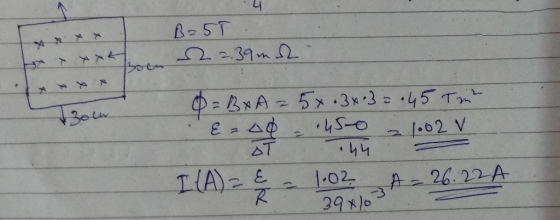
Please like if the solution was helpful thanks
Add Answer to:
A square wire loop 30 cm on a side, with resistance 39 mΩ, has
its plane...
A square wire loop 21 cm on a side, with resistance 37 m2, has its plane...
 A square wire loop 21 cm on a side, with resistance 37 m2, has its plane normal to a uniform magnetic field of magnitude B = 4.4 T. If you pull two opposite sides of the loop away from each other, the other two sides automatically draw toward each other, reducing the area enclosed by the loop. If the area is reduced to zero in time At = 0.40 s, what are (a) the average emf and (b) the average...
Question 10 guare wire loop 22 cm on a side, with resistance 22 ma, has its plane normal to a unrom magnetic neld of magnitude B-4.9 Т.lfyou pul two opposite sides ofthe loop aw from each other,...
 Question 10 guare wire loop 22 cm on a side, with resistance 22 ma, has its plane normal to a unrom magnetic neld of magnitude B-4.9 Т.lfyou pul two opposite sides ofthe loop aw from each other, the other two sides automatically drew toward each other, reducing the area enclosed by the loop. If the area is reduced to zero in time 챦-0.39 s, what are (a) the average emf and (b) the average current induced in the loop during...
A square wire loop is 22 cm on a side. The plane of the loop is...
A square wire loop is 22 cm on a side. The plane of the loop is initially perpendicular to a uniform magnetic field of 0.1 T. Over 20 s the loop is turned until the plane of the loop is parallel to the magnetic field. What EMF is produced?
A horizontal square wire loop of side d lies in a plane perpendicular to a uniform...
A horizontal square wire loop of side d lies in a plane perpendicular to a uniform magnetic field B pointing from above into the plane of the loop. The magnitude of magnetic eld ~ B is: B = 0.80 T. If in ∆t = 4.0 ms the wire is reshaped from a square to a rectangle of dimensions: L = 10.0 cm; W = 6.0 cm, but remains in the same plane. a - What is the side d of...
(a) A square loop of wire with sides of length 40cm is in a uniform magnetic...
(a) A square loop of wire with sides of length 40cm is in a uniform magnetic field perpendicular to its area. if the field's strength is initially 100mT and it decays to zero in 0.010 s, what is the magnitude of the average emf induced into the loop? (b) What is the average emf if the sides of the loop were only 20cm?
1. A square loop whose sides are 6.0-cm long is made with copper wire of radius...
1. A square loop whose sides are 6.0-cm long is made with copper wire of radius 1.0 mm. If a magnetic field perpendicular to the loop is changing at a rate of 5.0 mT/s, what is the current in the loop? 2. A long solenoid with n = 10 turns per centimeter has a cross-sectional area of 5.0 cm2 and carries a current of 0.25 A. A coil with five turns encircles the solenoid. When the current through the solenoid...
1. A square loop of wire with one side of a and resistance R is placed...
 1. A square loop of wire with one side of a and resistance R is
placed in a uniform magnetic field of strength B. The field
vanishes and results an induced current I in the loop.
( a) a) What is the rate of change of magnetic flux
in terms of I and R?
(b) Magnetic field B (on the picture above) was equal to 0.5 T
before it vanished. If the duration of switch is 0.15 sec and the...
1. A square loop of wire with one side of a and resistance R is
placed in a uniform magnetic field of strength B. The field
vanishes and results an induced current I in the loop.
( a) a) What is the rate of change of magnetic flux
in terms of I and R?
(b) Magnetic field B (on the picture above) was equal to 0.5 T
before it vanished. If the duration of switch is 0.15 sec and the...
A uniform magnetic field is at right angles to the plane of a wire loop. The...
A uniform magnetic field is at right angles to the plane of a wire loop. The field decreases by 0.16 Tin 3.0×10⁻³ s and the magnitude of the average emf induced in the loop is 79 V . A) What is the area of the loop? (in m^2) B) What would be the value of the average induced emf if the field change was the same but took twice as long to decrease? (in Volts)
A single-turn circular loop of wire of radius 5.0 cm lies in a plane perpendicular to...
A single-turn circular loop of wire of radius 5.0 cm lies in a plane perpendicular to a spatially uniform magnetic field. During a 0.0243s time interval, the magnitude of the field increases uniformly from 200 to 300 mT. Determine the magnitude of the emf induced in the loop.
A circular loop of flexible iron wire has an initial circumference of 164 cm, but its...
A circular loop of flexible iron wire has an initial circumference of 164 cm, but its circumference is decreasing at a constant rate of 15.0 cm/s due to a tangential pull on the wire. The loop is in a constant uniform magnetic field of magnitude 0.500 T, which is oriented perpendicular to the plane of the loop. Assume that you are facing the loop and that the magnetic field points into the loop. A.) Find the magnitude of the emf...
 A square wire loop 21 cm on a side, with resistance 37 m2, has its plane normal to a uniform magnetic field of magnitude B = 4.4 T. If you pull two opposite sides of the loop away from each other, the other two sides automatically draw toward each other, reducing the area enclosed by the loop. If the area is reduced to zero in time At = 0.40 s, what are (a) the average emf and (b) the average...
 Question 10 guare wire loop 22 cm on a side, with resistance 22 ma, has its plane normal to a unrom magnetic neld of magnitude B-4.9 Т.lfyou pul two opposite sides ofthe loop aw from each other, the other two sides automatically drew toward each other, reducing the area enclosed by the loop. If the area is reduced to zero in time 챦-0.39 s, what are (a) the average emf and (b) the average current induced in the loop during...
 1. A square loop of wire with one side of a and resistance R is
placed in a uniform magnetic field of strength B. The field
vanishes and results an induced current I in the loop.
( a) a) What is the rate of change of magnetic flux
in terms of I and R?
(b) Magnetic field B (on the picture above) was equal to 0.5 T
before it vanished. If the duration of switch is 0.15 sec and the...
1. A square loop of wire with one side of a and resistance R is
placed in a uniform magnetic field of strength B. The field
vanishes and results an induced current I in the loop.
( a) a) What is the rate of change of magnetic flux
in terms of I and R?
(b) Magnetic field B (on the picture above) was equal to 0.5 T
before it vanished. If the duration of switch is 0.15 sec and the...
Most questions answered within 3 hours.
-
Where is the error in this code sequence?
String s1 = "Hello";
String s2 = "ello";...
asked 10 months ago -
Financial data for Joel de Paris, Inc., for last year
follow:
Joel de Paris, Inc.
Balance...
asked 10 months ago -
Consider this reaction:
Al2(SO4)3 (aq)+ BaCl3
(aq) Al2Cl6 (aq)- +
3BaSO4(s) . What is the...
asked 10 months ago -
Suppose that Savneet is considering increasing her
recent random sample from 20 car rentals to 40...
asked 10 months ago -
Trucks arrive at an unloading terminal at an average rate of 120
per hour.
Trucks arrive...
asked 10 months ago -
Why are methanol and ethanol completely soluble in water while
octanol is not very little soluble....
asked 10 months ago -
A facilities manager at a university reads in a research report
that the mean amount of...
asked 10 months ago -
When the CuSO4 is rehydrated by adding water to the anhydrous
compound, is this an endothermic...
asked 10 months ago -
A ray of sunlight is passing from diamond into crown glass; the
angle of incidence is...
asked 10 months ago -
A block of mass 0.249 kg is placed on top of a light, vertical
spring of...
asked 10 months ago -
how do the kidneys compensate in the presences of acidosis
a) trigger hyperventilate
b) reserve acid...
asked 10 months ago -
Question 501 pts
The rental rate of capital to the firm increases. Which of the
following...
asked 10 months ago