
Homework Answers
Add Answer to:
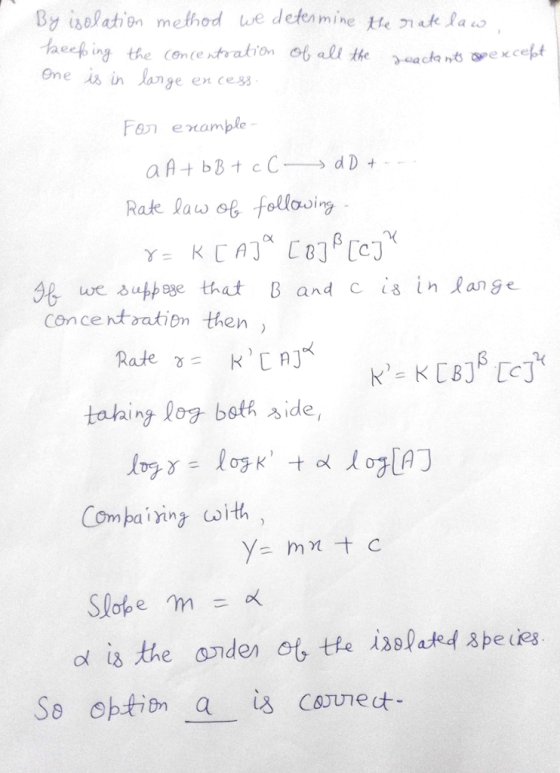
1. When using the isolation method along with the method of initial rates, a plot of...
2. When using the method of initial rates to determine the reaction order of each individual...
2. When using the method of initial rates to determine the reaction order of each individual reactant, why must data only be used in which one reactant is changing concentration but not the other reactants? 3. Briefly explain why the number of total drops being mixed in each experiment is kept constant throughout all five experiments. 4. Sketch a molecular‐level picture that illustrates why reaction rate increases when the concentration of a reactant is increased. Note – this might be...
Isolation Method of Rate Law Determination Consider the base hydrolysis of an ester RCOOR' + OH-→...
 Isolation Method of Rate Law Determination
Consider the base hydrolysis of an ester RCOOR' + OH-→ RCOO-+ R'OH (where R and R"represent organic groups) The kinetics of this reaction, for a particular ester, were studied using the isolation method When [OH>> [RCOOR'] a pseudo-rate law can be posed: With initial concentrations: [OH-]0 = 0.800 M [RCOOR']0 = 0.0010 M, a plot of In[RCOORT versus t gave a straight line with slope =-1.01 s-1 and y-intercept =-6.91 What is the order...
Isolation Method of Rate Law Determination
Consider the base hydrolysis of an ester RCOOR' + OH-→ RCOO-+ R'OH (where R and R"represent organic groups) The kinetics of this reaction, for a particular ester, were studied using the isolation method When [OH>> [RCOOR'] a pseudo-rate law can be posed: With initial concentrations: [OH-]0 = 0.800 M [RCOOR']0 = 0.0010 M, a plot of In[RCOORT versus t gave a straight line with slope =-1.01 s-1 and y-intercept =-6.91 What is the order...
Each reactant from the following data. Show work, of co inspection) method (method of initial rat...
 each reactant from the following data. Show work, of co inspection) method (method of initial rates), calculate the order in course! Consult your text book if needed. wherex isonder(Rotel)=(C Ratel Rate2 log a og Con) Concentrato! ) ' 12/ = log( Order = use this: A Run Initial [A] Initial IB] 2 C of E 0.20M 0.20M 0.40M 0.20M 0.20M 0.20M 0.20M 0.60M Initial IC 0.20M 0.30M 0.30M 0.30M 2.42x10⁶ M/min 2.44x10⁶ M/min 9.67x10⁶ M/min 7.23x10 M/min Remember, the idea...
can you do the 6-12 number 8 is multiple choice 6. The initial rates listed in...
 can
you do the 6-12 number 8 is multiple choice
6. The initial rates listed in the table below were determined for the reaction CO(g) + NO2(g) + CO2(g) + NO(g) at varied concentration of the reactants, CO and NO2. Determine the rate law of this reaction. Experiment Initial [CO] (mol/L) Initial [NO] (mol/L) Initial rate (mol/Ls) 5.0x10+ 3.5x10 3.4x10⁻⁸ 5.0x10+ 7.0x10- 6.8x10⁻⁸ 1.5x10 3.5x10 1.02x10⁻⁷ 7. The half-life of the reaction C&H:(8) ► 2CH.g) at constant temperature is independent...
can
you do the 6-12 number 8 is multiple choice
6. The initial rates listed in the table below were determined for the reaction CO(g) + NO2(g) + CO2(g) + NO(g) at varied concentration of the reactants, CO and NO2. Determine the rate law of this reaction. Experiment Initial [CO] (mol/L) Initial [NO] (mol/L) Initial rate (mol/Ls) 5.0x10+ 3.5x10 3.4x10⁻⁸ 5.0x10+ 7.0x10- 6.8x10⁻⁸ 1.5x10 3.5x10 1.02x10⁻⁷ 7. The half-life of the reaction C&H:(8) ► 2CH.g) at constant temperature is independent...
Most of the time, the rate of a reaction depends on the concentration of the reactant....
 Most of the time, the rate of a reaction depends on the
concentration of the reactant. In the case of second-order
reactions, the rate is proportional to the square of the
concentration of the reactant.
Select the image to explore the simulation, which will help you
to understand how second-order reactions are identified by the
nature of their plots. You can also observe the rate law for
different reactions.
In the simulation, you can select one of the three different...
Most of the time, the rate of a reaction depends on the
concentration of the reactant. In the case of second-order
reactions, the rate is proportional to the square of the
concentration of the reactant.
Select the image to explore the simulation, which will help you
to understand how second-order reactions are identified by the
nature of their plots. You can also observe the rate law for
different reactions.
In the simulation, you can select one of the three different...
A particular reactant decomposes with a half-life of 149s when its initial concentration is 0.352M. The...
A particular reactant decomposes with a half-life of 149s when its initial concentration is 0.352M. The same reactant decomposes with a half-life of 237s when its initial concentration is 0.221M. Determine the reaction order. What is the value and unit of the rate constant for this reaction?
Full Name: ID number: Problem 1. chemical kinetics (5 points Consider the method of initial rates...
 Full Name: ID number: Problem 1. chemical kinetics (5 points Consider the method of initial rates for the hypothetical reaction 2R, R P TRIMIR M Rate M 2 1. Write down the rate equation for this reaction indicating the orders of reaction with respecte species R and Ry (2 points). 2. Determine the numerical value of the rate constant (0.75 points). 3. What are the units (if any) of rate constant 7 (0.5 points) 4. What is initial rate in...
1. Given the table of initial rates below, solve the rate law for the reaction: A...
1. Given the table of initial rates below, solve the rate law for the reaction: A + B + C →→ D + E Trial [A], M [B], M [C], M Initial Rate, M/s 1 0.15 0.10 0.25 0.018 2 0.30 0.10 0.25 0.018 3 0.15 0.10 0.50 0.036 4 0.30 0.20 0.25 0.072 b. What is the order with respect to B? d. What is the value of the rate constant? e. What are the units of the rate...
A reactant decomposes with a half-life of 11.5 s when its initial concentration is 0.150 M....
A reactant decomposes with a half-life of 11.5 s when its initial concentration is 0.150 M. When the initial concentration is 0.875 M, this same reactant decomposes with a half-life of 67.1 s. What is the order of this reaction? What is the value and unit of the rate constant for this reaction?
A reactant decomposes with a half-life of 27.5 s when its initial concentration is 0.239 M....
A reactant decomposes with a half-life of 27.5 s when its initial concentration is 0.239 M. When the initial concentration is 0.667 M, this same reactant decomposes with a half‑life of 76.7 s. What is the order of the reaction? What is the value and unit of the rate constant for this reaction?
 Isolation Method of Rate Law Determination
Consider the base hydrolysis of an ester RCOOR' + OH-→ RCOO-+ R'OH (where R and R"represent organic groups) The kinetics of this reaction, for a particular ester, were studied using the isolation method When [OH>> [RCOOR'] a pseudo-rate law can be posed: With initial concentrations: [OH-]0 = 0.800 M [RCOOR']0 = 0.0010 M, a plot of In[RCOORT versus t gave a straight line with slope =-1.01 s-1 and y-intercept =-6.91 What is the order...
Isolation Method of Rate Law Determination
Consider the base hydrolysis of an ester RCOOR' + OH-→ RCOO-+ R'OH (where R and R"represent organic groups) The kinetics of this reaction, for a particular ester, were studied using the isolation method When [OH>> [RCOOR'] a pseudo-rate law can be posed: With initial concentrations: [OH-]0 = 0.800 M [RCOOR']0 = 0.0010 M, a plot of In[RCOORT versus t gave a straight line with slope =-1.01 s-1 and y-intercept =-6.91 What is the order...
 each reactant from the following data. Show work, of co inspection) method (method of initial rates), calculate the order in course! Consult your text book if needed. wherex isonder(Rotel)=(C Ratel Rate2 log a og Con) Concentrato! ) ' 12/ = log( Order = use this: A Run Initial [A] Initial IB] 2 C of E 0.20M 0.20M 0.40M 0.20M 0.20M 0.20M 0.20M 0.60M Initial IC 0.20M 0.30M 0.30M 0.30M 2.42x10⁶ M/min 2.44x10⁶ M/min 9.67x10⁶ M/min 7.23x10 M/min Remember, the idea...
 can
you do the 6-12 number 8 is multiple choice
6. The initial rates listed in the table below were determined for the reaction CO(g) + NO2(g) + CO2(g) + NO(g) at varied concentration of the reactants, CO and NO2. Determine the rate law of this reaction. Experiment Initial [CO] (mol/L) Initial [NO] (mol/L) Initial rate (mol/Ls) 5.0x10+ 3.5x10 3.4x10⁻⁸ 5.0x10+ 7.0x10- 6.8x10⁻⁸ 1.5x10 3.5x10 1.02x10⁻⁷ 7. The half-life of the reaction C&H:(8) ► 2CH.g) at constant temperature is independent...
can
you do the 6-12 number 8 is multiple choice
6. The initial rates listed in the table below were determined for the reaction CO(g) + NO2(g) + CO2(g) + NO(g) at varied concentration of the reactants, CO and NO2. Determine the rate law of this reaction. Experiment Initial [CO] (mol/L) Initial [NO] (mol/L) Initial rate (mol/Ls) 5.0x10+ 3.5x10 3.4x10⁻⁸ 5.0x10+ 7.0x10- 6.8x10⁻⁸ 1.5x10 3.5x10 1.02x10⁻⁷ 7. The half-life of the reaction C&H:(8) ► 2CH.g) at constant temperature is independent...
 Most of the time, the rate of a reaction depends on the
concentration of the reactant. In the case of second-order
reactions, the rate is proportional to the square of the
concentration of the reactant.
Select the image to explore the simulation, which will help you
to understand how second-order reactions are identified by the
nature of their plots. You can also observe the rate law for
different reactions.
In the simulation, you can select one of the three different...
Most of the time, the rate of a reaction depends on the
concentration of the reactant. In the case of second-order
reactions, the rate is proportional to the square of the
concentration of the reactant.
Select the image to explore the simulation, which will help you
to understand how second-order reactions are identified by the
nature of their plots. You can also observe the rate law for
different reactions.
In the simulation, you can select one of the three different...
 Full Name: ID number: Problem 1. chemical kinetics (5 points Consider the method of initial rates for the hypothetical reaction 2R, R P TRIMIR M Rate M 2 1. Write down the rate equation for this reaction indicating the orders of reaction with respecte species R and Ry (2 points). 2. Determine the numerical value of the rate constant (0.75 points). 3. What are the units (if any) of rate constant 7 (0.5 points) 4. What is initial rate in...
Most questions answered within 3 hours.
-
Where is the error in this code sequence?
String s1 = "Hello";
String s2 = "ello";...
asked 10 months ago -
Financial data for Joel de Paris, Inc., for last year
follow:
Joel de Paris, Inc.
Balance...
asked 10 months ago -
Consider this reaction:
Al2(SO4)3 (aq)+ BaCl3
(aq) Al2Cl6 (aq)- +
3BaSO4(s) . What is the...
asked 10 months ago -
Suppose that Savneet is considering increasing her
recent random sample from 20 car rentals to 40...
asked 10 months ago -
Trucks arrive at an unloading terminal at an average rate of 120
per hour.
Trucks arrive...
asked 10 months ago -
Why are methanol and ethanol completely soluble in water while
octanol is not very little soluble....
asked 10 months ago -
A facilities manager at a university reads in a research report
that the mean amount of...
asked 10 months ago -
When the CuSO4 is rehydrated by adding water to the anhydrous
compound, is this an endothermic...
asked 10 months ago -
A ray of sunlight is passing from diamond into crown glass; the
angle of incidence is...
asked 10 months ago -
A block of mass 0.249 kg is placed on top of a light, vertical
spring of...
asked 10 months ago -
how do the kidneys compensate in the presences of acidosis
a) trigger hyperventilate
b) reserve acid...
asked 10 months ago -
Question 501 pts
The rental rate of capital to the firm increases. Which of the
following...
asked 10 months ago