What is the derivation from T=2π√(L/g) to T^2=((4π^2)/g)L
What is the derivation from T=2π√(L/g) to T^2=((4π^2)/g)L
Homework Answers

According to theory, the period T of a simple pendulum is T = 2π√(L/g). If L...
According to theory, the period T of a simple pendulum is T = 2π√(L/g). If L is measured as L = 1.40 ± 0.01 m ; what is the predicted value of T? b. Would you say that a measured value of T = 2.39 ± 0.01 s is consistent with the theoretical prediction of part (a)?
Question: The period of a simple pendulum is T=2π√(L/g) with L = length of the pendulum...
Question: The period of a simple pendulum is T=2π√(L/g) with L = length of the pendulum and g = gravity of earth. a.Derive the scaling law for the pendulum. b.How much would the period of the pendulum change when you decrease the characteristic dimension by a factor of 10?
5-29. Determine the response of an undamped system to the forcing condition shown, as follows: (a) for the interval 0 <at < 2, and (b) for the interval 2π < at < 4π. (c) Plot the resp...
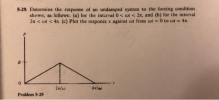 5-29. Determine the response of an undamped system to the forcing condition shown, as follows: (a) for the interval 0 <at < 2, and (b) for the interval 2π < at < 4π. (c) Plot the response x against at from at-0 toot-4m Problem 5-29
5-29. Determine the response of an undamped system to the forcing condition shown, as follows: (a) for the interval 0
5-29. Determine the response of an undamped system to the forcing condition shown, as follows: (a) for the interval 0 <at < 2, and (b) for the interval 2π < at < 4π. (c) Plot the response x against at from at-0 toot-4m Problem 5-29
5-29. Determine the response of an undamped system to the forcing condition shown, as follows: (a) for the interval 0
Show all steps for upvote! l. The 2 functions e(I)-cos(4π), e2 (t)-cos(16m) are sampled every T seconds. (4+5+6-15 pts) (i) In order that that they both be reconstructible from their samples, how lar...
 Show all steps for upvote!
l. The 2 functions e(I)-cos(4π), e2 (t)-cos(16m) are sampled every T seconds. (4+5+6-15 pts) (i) In order that that they both be reconstructible from their samples, how large can Tbe? (ii) If T= 0.1, explain why the 2 transforms E(c) and E2(z) are equal, without actually computing the transforms. Note that cos(2/V-θ)-cos(θ). (iii) If T-0.1, mention how you will design a filter to include as part of the sampler in order to ensure that aliasing...
Show all steps for upvote!
l. The 2 functions e(I)-cos(4π), e2 (t)-cos(16m) are sampled every T seconds. (4+5+6-15 pts) (i) In order that that they both be reconstructible from their samples, how large can Tbe? (ii) If T= 0.1, explain why the 2 transforms E(c) and E2(z) are equal, without actually computing the transforms. Note that cos(2/V-θ)-cos(θ). (iii) If T-0.1, mention how you will design a filter to include as part of the sampler in order to ensure that aliasing...
Please help solve the following question with steps. Thank you! 3. Suppose that an object moves along the helix r(t) - (2 cos t, 2 sin t, L.) , 2π subject to the force field F-(-y, x, z). Determine t...
 Please help solve the following question with steps. Thank
you!
3. Suppose that an object moves along the helix r(t) - (2 cos t, 2 sin t, L.) , 2π subject to the force field F-(-y, x, z). Determine the work 0-t done.
3. Suppose that an object moves along the helix r(t) - (2 cos t, 2 sin t, L.) , 2π subject to the force field F-(-y, x, z). Determine the work 0-t done.
Please help solve the following question with steps. Thank
you!
3. Suppose that an object moves along the helix r(t) - (2 cos t, 2 sin t, L.) , 2π subject to the force field F-(-y, x, z). Determine the work 0-t done.
3. Suppose that an object moves along the helix r(t) - (2 cos t, 2 sin t, L.) , 2π subject to the force field F-(-y, x, z). Determine the work 0-t done.
l, f) is a periodic signal with period f(t)-n(t)-u(t-t/2 ) for 0 2π a.) Find the exponential Fourier series of f() and sketchf). What is the fundamental radian frequency. b.) Evaluate and sketch...
 l, f) is a periodic signal with period f(t)-n(t)-u(t-t/2 ) for 0 2π a.) Find the exponential Fourier series of f() and sketchf). What is the fundamental radian frequency. b.) Evaluate and sketch |Dml, the magnitude of the Fourier series coefficients vs.o in the range of -4s n S4 c.) Evaluate and sketch the phase angle of D, vs. co in the same range (-4S n S4) d.) Find the signal average power e) Find the approximate average power of...
Consider the oscillator position x=2 cos(2π t), where time t is measured in seconds. What is...
Consider the oscillator position x=2 cos(2π t), where time t is measured in seconds. What is the value of x at time t=0.5 seconds?
help 3. Answer each part for the following CFG G (The * symbom in the derivation...
 help
3. Answer each part for the following CFG G (The * symbom in the derivation means with any number of steps): R + XRXS S + aTb | b Ta T→ XTX | x | 6 X + ab (a) What are the variables of G? (b) What are the terminals of G? (c) Which is the start variable of G? (d) Give three strings in L(G) (e) Give three strings not in L(G) (f) True or False: T...
help
3. Answer each part for the following CFG G (The * symbom in the derivation means with any number of steps): R + XRXS S + aTb | b Ta T→ XTX | x | 6 X + ab (a) What are the variables of G? (b) What are the terminals of G? (c) Which is the start variable of G? (d) Give three strings in L(G) (e) Give three strings not in L(G) (f) True or False: T...
Construct a derivation from the premise to the conclusion. Premise1: (Y ⊃ B) Premise2: (B&T) ⊃...
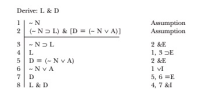 Construct a derivation from the premise to the conclusion.
Premise1: (Y ⊃ B)
Premise2: (B&T) ⊃ D
Premise3: D ⊃∼ Y
Premise4: B ⊃ (O ∨ T)
Premise5: ∼ O
Conclusion: ∼ Y
ex) This is the example from the textbook which I have to do the
same for my question only using &, ~, ∨, ≡, ⊃ I, E.
Derive: L & D Assumption Assumption 1-N 2 (NL) & [D = (-N VA)] 3 -NL 4L 5 D =...
Construct a derivation from the premise to the conclusion.
Premise1: (Y ⊃ B)
Premise2: (B&T) ⊃ D
Premise3: D ⊃∼ Y
Premise4: B ⊃ (O ∨ T)
Premise5: ∼ O
Conclusion: ∼ Y
ex) This is the example from the textbook which I have to do the
same for my question only using &, ~, ∨, ≡, ⊃ I, E.
Derive: L & D Assumption Assumption 1-N 2 (NL) & [D = (-N VA)] 3 -NL 4L 5 D =...
For each of the periodic signals in Fig. P3.4-3, find the exponential Fourier series and sketch the corresponding spectra. 3.5-1 4 Fig. P3.4-3 /2 1 x(t) 1/ 2 0l -2π -π 2π Fig. P3.4-4 II x(t) -2π 0l...
 For each of the periodic signals in Fig. P3.4-3, find the exponential Fourier series and sketch the corresponding spectra. 3.5-1 4 Fig. P3.4-3 /2 1 x(t) 1/ 2 0l -2π -π 2π Fig. P3.4-4 II x(t) -2π 0l t/2
For each of the periodic signals in Fig. P3.4-3, find the exponential Fourier series and sketch the corresponding spectra. 3.5-1
4 Fig. P3.4-3 /2 1 x(t) 1/ 2 0l -2π -π 2π Fig. P3.4-4 II x(t) -2π 0l t/2
For each of the periodic signals in Fig. P3.4-3, find the exponential Fourier series and sketch the corresponding spectra. 3.5-1 4 Fig. P3.4-3 /2 1 x(t) 1/ 2 0l -2π -π 2π Fig. P3.4-4 II x(t) -2π 0l t/2
For each of the periodic signals in Fig. P3.4-3, find the exponential Fourier series and sketch the corresponding spectra. 3.5-1
4 Fig. P3.4-3 /2 1 x(t) 1/ 2 0l -2π -π 2π Fig. P3.4-4 II x(t) -2π 0l t/2
 5-29. Determine the response of an undamped system to the forcing condition shown, as follows: (a) for the interval 0 <at < 2, and (b) for the interval 2π < at < 4π. (c) Plot the response x against at from at-0 toot-4m Problem 5-29
5-29. Determine the response of an undamped system to the forcing condition shown, as follows: (a) for the interval 0
5-29. Determine the response of an undamped system to the forcing condition shown, as follows: (a) for the interval 0 <at < 2, and (b) for the interval 2π < at < 4π. (c) Plot the response x against at from at-0 toot-4m Problem 5-29
5-29. Determine the response of an undamped system to the forcing condition shown, as follows: (a) for the interval 0
 Show all steps for upvote!
l. The 2 functions e(I)-cos(4π), e2 (t)-cos(16m) are sampled every T seconds. (4+5+6-15 pts) (i) In order that that they both be reconstructible from their samples, how large can Tbe? (ii) If T= 0.1, explain why the 2 transforms E(c) and E2(z) are equal, without actually computing the transforms. Note that cos(2/V-θ)-cos(θ). (iii) If T-0.1, mention how you will design a filter to include as part of the sampler in order to ensure that aliasing...
Show all steps for upvote!
l. The 2 functions e(I)-cos(4π), e2 (t)-cos(16m) are sampled every T seconds. (4+5+6-15 pts) (i) In order that that they both be reconstructible from their samples, how large can Tbe? (ii) If T= 0.1, explain why the 2 transforms E(c) and E2(z) are equal, without actually computing the transforms. Note that cos(2/V-θ)-cos(θ). (iii) If T-0.1, mention how you will design a filter to include as part of the sampler in order to ensure that aliasing...
 Please help solve the following question with steps. Thank
you!
3. Suppose that an object moves along the helix r(t) - (2 cos t, 2 sin t, L.) , 2π subject to the force field F-(-y, x, z). Determine the work 0-t done.
3. Suppose that an object moves along the helix r(t) - (2 cos t, 2 sin t, L.) , 2π subject to the force field F-(-y, x, z). Determine the work 0-t done.
Please help solve the following question with steps. Thank
you!
3. Suppose that an object moves along the helix r(t) - (2 cos t, 2 sin t, L.) , 2π subject to the force field F-(-y, x, z). Determine the work 0-t done.
3. Suppose that an object moves along the helix r(t) - (2 cos t, 2 sin t, L.) , 2π subject to the force field F-(-y, x, z). Determine the work 0-t done.
 l, f) is a periodic signal with period f(t)-n(t)-u(t-t/2 ) for 0 2π a.) Find the exponential Fourier series of f() and sketchf). What is the fundamental radian frequency. b.) Evaluate and sketch |Dml, the magnitude of the Fourier series coefficients vs.o in the range of -4s n S4 c.) Evaluate and sketch the phase angle of D, vs. co in the same range (-4S n S4) d.) Find the signal average power e) Find the approximate average power of...
 help
3. Answer each part for the following CFG G (The * symbom in the derivation means with any number of steps): R + XRXS S + aTb | b Ta T→ XTX | x | 6 X + ab (a) What are the variables of G? (b) What are the terminals of G? (c) Which is the start variable of G? (d) Give three strings in L(G) (e) Give three strings not in L(G) (f) True or False: T...
help
3. Answer each part for the following CFG G (The * symbom in the derivation means with any number of steps): R + XRXS S + aTb | b Ta T→ XTX | x | 6 X + ab (a) What are the variables of G? (b) What are the terminals of G? (c) Which is the start variable of G? (d) Give three strings in L(G) (e) Give three strings not in L(G) (f) True or False: T...
 Construct a derivation from the premise to the conclusion.
Premise1: (Y ⊃ B)
Premise2: (B&T) ⊃ D
Premise3: D ⊃∼ Y
Premise4: B ⊃ (O ∨ T)
Premise5: ∼ O
Conclusion: ∼ Y
ex) This is the example from the textbook which I have to do the
same for my question only using &, ~, ∨, ≡, ⊃ I, E.
Derive: L & D Assumption Assumption 1-N 2 (NL) & [D = (-N VA)] 3 -NL 4L 5 D =...
Construct a derivation from the premise to the conclusion.
Premise1: (Y ⊃ B)
Premise2: (B&T) ⊃ D
Premise3: D ⊃∼ Y
Premise4: B ⊃ (O ∨ T)
Premise5: ∼ O
Conclusion: ∼ Y
ex) This is the example from the textbook which I have to do the
same for my question only using &, ~, ∨, ≡, ⊃ I, E.
Derive: L & D Assumption Assumption 1-N 2 (NL) & [D = (-N VA)] 3 -NL 4L 5 D =...
 For each of the periodic signals in Fig. P3.4-3, find the exponential Fourier series and sketch the corresponding spectra. 3.5-1 4 Fig. P3.4-3 /2 1 x(t) 1/ 2 0l -2π -π 2π Fig. P3.4-4 II x(t) -2π 0l t/2
For each of the periodic signals in Fig. P3.4-3, find the exponential Fourier series and sketch the corresponding spectra. 3.5-1
4 Fig. P3.4-3 /2 1 x(t) 1/ 2 0l -2π -π 2π Fig. P3.4-4 II x(t) -2π 0l t/2
For each of the periodic signals in Fig. P3.4-3, find the exponential Fourier series and sketch the corresponding spectra. 3.5-1 4 Fig. P3.4-3 /2 1 x(t) 1/ 2 0l -2π -π 2π Fig. P3.4-4 II x(t) -2π 0l t/2
For each of the periodic signals in Fig. P3.4-3, find the exponential Fourier series and sketch the corresponding spectra. 3.5-1
4 Fig. P3.4-3 /2 1 x(t) 1/ 2 0l -2π -π 2π Fig. P3.4-4 II x(t) -2π 0l t/2
Most questions answered within 3 hours.
-
Where is the error in this code sequence?
String s1 = "Hello";
String s2 = "ello";...
asked 11 months ago -
Financial data for Joel de Paris, Inc., for last year
follow:
Joel de Paris, Inc.
Balance...
asked 11 months ago -
Consider this reaction:
Al2(SO4)3 (aq)+ BaCl3
(aq) Al2Cl6 (aq)- +
3BaSO4(s) . What is the...
asked 11 months ago -
Suppose that Savneet is considering increasing her
recent random sample from 20 car rentals to 40...
asked 11 months ago -
Trucks arrive at an unloading terminal at an average rate of 120
per hour.
Trucks arrive...
asked 11 months ago -
Why are methanol and ethanol completely soluble in water while
octanol is not very little soluble....
asked 11 months ago -
A facilities manager at a university reads in a research report
that the mean amount of...
asked 11 months ago -
When the CuSO4 is rehydrated by adding water to the anhydrous
compound, is this an endothermic...
asked 11 months ago -
A ray of sunlight is passing from diamond into crown glass; the
angle of incidence is...
asked 11 months ago -
A block of mass 0.249 kg is placed on top of a light, vertical
spring of...
asked 11 months ago -
how do the kidneys compensate in the presences of acidosis
a) trigger hyperventilate
b) reserve acid...
asked 11 months ago -
Question 501 pts
The rental rate of capital to the firm increases. Which of the
following...
asked 11 months ago