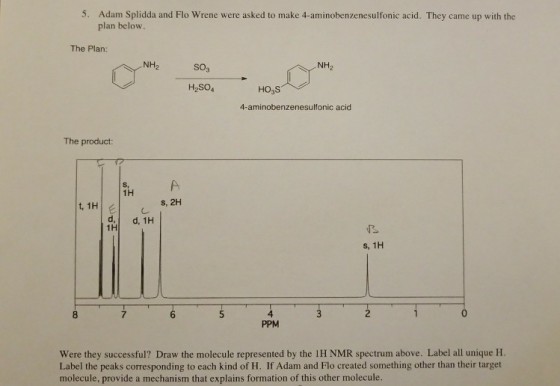
The NMR spectrum suggests the formation of the meta-substituted product, but NH2 is an ortho/para directing group. Using the given chemicals, provide a mechanism to arrive at the meta-substituted product.
Homework Answers
Very good question.
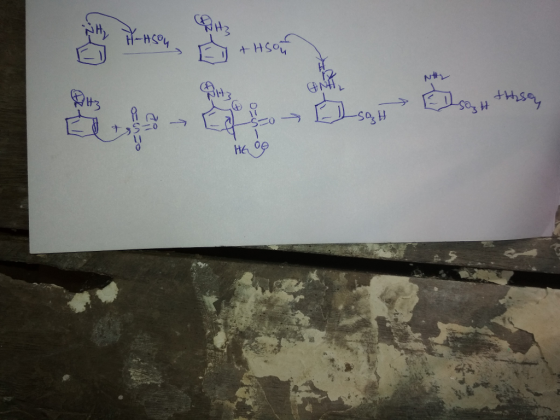
In presence of H2SO4, protonation of aniline occurs and NH2 gets converted into NH3+.
Then NH3+is a deactivating group and directs the new incoming electrophile towards Meta position.
Add Answer to:
The NMR spectrum suggests the formation of the
meta-substituted product, but NH2 is an ortho/para directing...
Considering 1H-NMR analysis of substituted benzenes (for ortho, para, meta nitrobromobenzene and ortho, para dinitro bromobenzene,...
 Considering 1H-NMR analysis of
substituted benzenes (for ortho, para, meta nitrobromobenzene and
ortho, para dinitro bromobenzene, or meta para dinitrobromobenzene)
: What is the splitting patterns for ring hydrogens for the
substituted benzenes? Using ??3-bond and 4-bond J coupling
constants, what are: ??Relative chemical shifts of ring
hydrogens?
Considering 1H-NMR analysis of
substituted benzenes (for ortho, para, meta nitrobromobenzene and
ortho, para dinitro bromobenzene, or meta para dinitrobromobenzene)
: What is the splitting patterns for ring hydrogens for the
substituted benzenes? Using ??3-bond and 4-bond J coupling
constants, what are: ??Relative chemical shifts of ring
hydrogens?
An NH2 substituent in an aromatic ring is: Select one: a. activating ortho-, meta- and para-directing...
An NH2 substituent in an aromatic ring is: Select one: a. activating ortho-, meta- and para-directing b. deactivating and ortho- and para-directing c. deactivating and meta-directing d. activating and meta-directing e. activating and ortho- and para-directing
4. The pKa values of the ortho, para, and meta substituted benzoic acids are shown below....
 4. The pKa values of the ortho, para, and meta substituted benzoic acids are shown below. Use words and drawings to explain these relative acidities. (7 points) HO. 0 HO0 HOO NH2 NH2 NH2 pka = 4.89 pka = 4.95 pka = 4.73
Question1: Introduction Three aromatic compounds that have ortho-para directing and activating substituents will be brominated. The...
 Question1:
Introduction Three aromatic compounds that have ortho-para directing and activating substituents will be brominated. The extent of activation will be judged by the number of bromine atoms that add to the benzene ring in each case. For each of the compounds shown below you will work out if a mono- di- or tri- brominated derivative formed following treatment with acetic acid and bromine in hydrobromic acid. This will be determined by measuring the melting point and interpreting the H...
Question1:
Introduction Three aromatic compounds that have ortho-para directing and activating substituents will be brominated. The extent of activation will be judged by the number of bromine atoms that add to the benzene ring in each case. For each of the compounds shown below you will work out if a mono- di- or tri- brominated derivative formed following treatment with acetic acid and bromine in hydrobromic acid. This will be determined by measuring the melting point and interpreting the H...
15. Indicate those ortho/para director(s) and those meta director(s) - NO2 Br - -C₂Hs - NH2...
 15. Indicate those ortho/para director(s) and those meta director(s) - NO2 Br - -C₂Hs - NH2 CoHs nat reagent(s), solvent(s) and chemicals are needed in making a Grignard reagent (C2HsMgBri? Choose from the following list. Water diethyl ether lithium, phenyl bromide, ethyl bromide (MR) iodine, sodium bromide, heat 17. Which one of the following reaction is a nucleophilic aromatic substitution reaction? Which one is an electrophilic aromatic substitution? HNOH,SO 18. Predict the product:
Categorize the groups attached to the ring in salicylamide as activators, deactivators, ortho/para directors, or meta directors. Predict the product(s) of the reaction .
 Categorize the groups attached to the ring in salicylamide as activators, deactivators, ortho/para directors, or meta directors. Predict the product(s) of the reaction.4 (1,2).png4 (2,2).png
2. Examine the following Electrophilic Aromatic Substitution reaction. 1) Provide the number of 13C NMR signals...
 2. Examine the following Electrophilic Aromatic Substitution reaction. 1) Provide the number of 13C NMR signals expected in both the reactant and the product. 2) Provide the carbocation intermediate that allowed the transformation to happen at that position. 3) This molecule is (ortho, meta, para) substituted (circle one). 4) Using resonance arrows show how that carbocation can be distributed (delocalized) to multiple locations on the arene ring system. 5) Predict a different structure that can form from this delocalization. FeBrg,...
2. D type and strength of each substituents as activating(A) or outcome as ortho-para (O/P) or...
 2. D type and strength of each substituents as activating(A) or outcome as ortho-para (O/P) or meta(M) directors. (6 pts) you expect an electrophile to be attached to the ring You must identify the deactivating(D) and also the expected regiochemical 3. Use aromatic, non aromatic or antiaromatic concepts to explain the reactions or molecules shown (6 pts) Provide a curved arrow mechanism to show the formation of a aromatic carbocation intermediate Show the final product H-I The pK,values for the...
1. Consider the three molecules below to answer the following questions. Circle TRUE or FALSE at...
 1. Consider the three molecules below to answer the following questions. Circle TRUE or FALSE at the end of each question (0.5 points each). Molecule A Molecule C Molecule B A. The rate of EAS with Molecule B will be faster than the rate of EAS with Molecule A (assume MAJOR product formation). TRUE or FALSE B. Molecule C will undergo nitration to yield a meta-product that is the MAJOR product. TRUE or FALSE c. The rate of meta-product formation...
Examine H NMR 4. Examine the attached 'H NMR spectrum of the product from the trans-cinnamic...
 Examine H NMR
4. Examine the attached 'H NMR spectrum of the product from the trans-cinnamic acid + Br (dibromide product) reaction in the lab manual. Indicate which part(s) of the dibromide product give rise to the peaks at 5 and 5.5 ppm. OS SOIT -1093.75 SEZO- ES OEDI- H Ả Br 0 " H OH Bri dibromide product 1H NMR (Note the OH is not shown) 6 84 8.2 8.0 7.8 7.6 74 7.2 70 69 6.6 6.4 6.2...
Examine H NMR
4. Examine the attached 'H NMR spectrum of the product from the trans-cinnamic acid + Br (dibromide product) reaction in the lab manual. Indicate which part(s) of the dibromide product give rise to the peaks at 5 and 5.5 ppm. OS SOIT -1093.75 SEZO- ES OEDI- H Ả Br 0 " H OH Bri dibromide product 1H NMR (Note the OH is not shown) 6 84 8.2 8.0 7.8 7.6 74 7.2 70 69 6.6 6.4 6.2...
 Considering 1H-NMR analysis of
substituted benzenes (for ortho, para, meta nitrobromobenzene and
ortho, para dinitro bromobenzene, or meta para dinitrobromobenzene)
: What is the splitting patterns for ring hydrogens for the
substituted benzenes? Using ??3-bond and 4-bond J coupling
constants, what are: ??Relative chemical shifts of ring
hydrogens?
Considering 1H-NMR analysis of
substituted benzenes (for ortho, para, meta nitrobromobenzene and
ortho, para dinitro bromobenzene, or meta para dinitrobromobenzene)
: What is the splitting patterns for ring hydrogens for the
substituted benzenes? Using ??3-bond and 4-bond J coupling
constants, what are: ??Relative chemical shifts of ring
hydrogens?
 4. The pKa values of the ortho, para, and meta substituted benzoic acids are shown below. Use words and drawings to explain these relative acidities. (7 points) HO. 0 HO0 HOO NH2 NH2 NH2 pka = 4.89 pka = 4.95 pka = 4.73
 Question1:
Introduction Three aromatic compounds that have ortho-para directing and activating substituents will be brominated. The extent of activation will be judged by the number of bromine atoms that add to the benzene ring in each case. For each of the compounds shown below you will work out if a mono- di- or tri- brominated derivative formed following treatment with acetic acid and bromine in hydrobromic acid. This will be determined by measuring the melting point and interpreting the H...
Question1:
Introduction Three aromatic compounds that have ortho-para directing and activating substituents will be brominated. The extent of activation will be judged by the number of bromine atoms that add to the benzene ring in each case. For each of the compounds shown below you will work out if a mono- di- or tri- brominated derivative formed following treatment with acetic acid and bromine in hydrobromic acid. This will be determined by measuring the melting point and interpreting the H...
 15. Indicate those ortho/para director(s) and those meta director(s) - NO2 Br - -C₂Hs - NH2 CoHs nat reagent(s), solvent(s) and chemicals are needed in making a Grignard reagent (C2HsMgBri? Choose from the following list. Water diethyl ether lithium, phenyl bromide, ethyl bromide (MR) iodine, sodium bromide, heat 17. Which one of the following reaction is a nucleophilic aromatic substitution reaction? Which one is an electrophilic aromatic substitution? HNOH,SO 18. Predict the product:
 2. Examine the following Electrophilic Aromatic Substitution reaction. 1) Provide the number of 13C NMR signals expected in both the reactant and the product. 2) Provide the carbocation intermediate that allowed the transformation to happen at that position. 3) This molecule is (ortho, meta, para) substituted (circle one). 4) Using resonance arrows show how that carbocation can be distributed (delocalized) to multiple locations on the arene ring system. 5) Predict a different structure that can form from this delocalization. FeBrg,...
 2. D type and strength of each substituents as activating(A) or outcome as ortho-para (O/P) or meta(M) directors. (6 pts) you expect an electrophile to be attached to the ring You must identify the deactivating(D) and also the expected regiochemical 3. Use aromatic, non aromatic or antiaromatic concepts to explain the reactions or molecules shown (6 pts) Provide a curved arrow mechanism to show the formation of a aromatic carbocation intermediate Show the final product H-I The pK,values for the...
 1. Consider the three molecules below to answer the following questions. Circle TRUE or FALSE at the end of each question (0.5 points each). Molecule A Molecule C Molecule B A. The rate of EAS with Molecule B will be faster than the rate of EAS with Molecule A (assume MAJOR product formation). TRUE or FALSE B. Molecule C will undergo nitration to yield a meta-product that is the MAJOR product. TRUE or FALSE c. The rate of meta-product formation...
 Examine H NMR
4. Examine the attached 'H NMR spectrum of the product from the trans-cinnamic acid + Br (dibromide product) reaction in the lab manual. Indicate which part(s) of the dibromide product give rise to the peaks at 5 and 5.5 ppm. OS SOIT -1093.75 SEZO- ES OEDI- H Ả Br 0 " H OH Bri dibromide product 1H NMR (Note the OH is not shown) 6 84 8.2 8.0 7.8 7.6 74 7.2 70 69 6.6 6.4 6.2...
Examine H NMR
4. Examine the attached 'H NMR spectrum of the product from the trans-cinnamic acid + Br (dibromide product) reaction in the lab manual. Indicate which part(s) of the dibromide product give rise to the peaks at 5 and 5.5 ppm. OS SOIT -1093.75 SEZO- ES OEDI- H Ả Br 0 " H OH Bri dibromide product 1H NMR (Note the OH is not shown) 6 84 8.2 8.0 7.8 7.6 74 7.2 70 69 6.6 6.4 6.2...
Most questions answered within 3 hours.
-
Where is the error in this code sequence?
String s1 = "Hello";
String s2 = "ello";...
asked 11 months ago -
Financial data for Joel de Paris, Inc., for last year
follow:
Joel de Paris, Inc.
Balance...
asked 11 months ago -
Consider this reaction:
Al2(SO4)3 (aq)+ BaCl3
(aq) Al2Cl6 (aq)- +
3BaSO4(s) . What is the...
asked 11 months ago -
Suppose that Savneet is considering increasing her
recent random sample from 20 car rentals to 40...
asked 11 months ago -
Trucks arrive at an unloading terminal at an average rate of 120
per hour.
Trucks arrive...
asked 11 months ago -
Why are methanol and ethanol completely soluble in water while
octanol is not very little soluble....
asked 11 months ago -
A facilities manager at a university reads in a research report
that the mean amount of...
asked 11 months ago -
When the CuSO4 is rehydrated by adding water to the anhydrous
compound, is this an endothermic...
asked 11 months ago -
A ray of sunlight is passing from diamond into crown glass; the
angle of incidence is...
asked 11 months ago -
A block of mass 0.249 kg is placed on top of a light, vertical
spring of...
asked 11 months ago -
how do the kidneys compensate in the presences of acidosis
a) trigger hyperventilate
b) reserve acid...
asked 11 months ago -
Question 501 pts
The rental rate of capital to the firm increases. Which of the
following...
asked 11 months ago