

Homework Answers
Add Answer to:
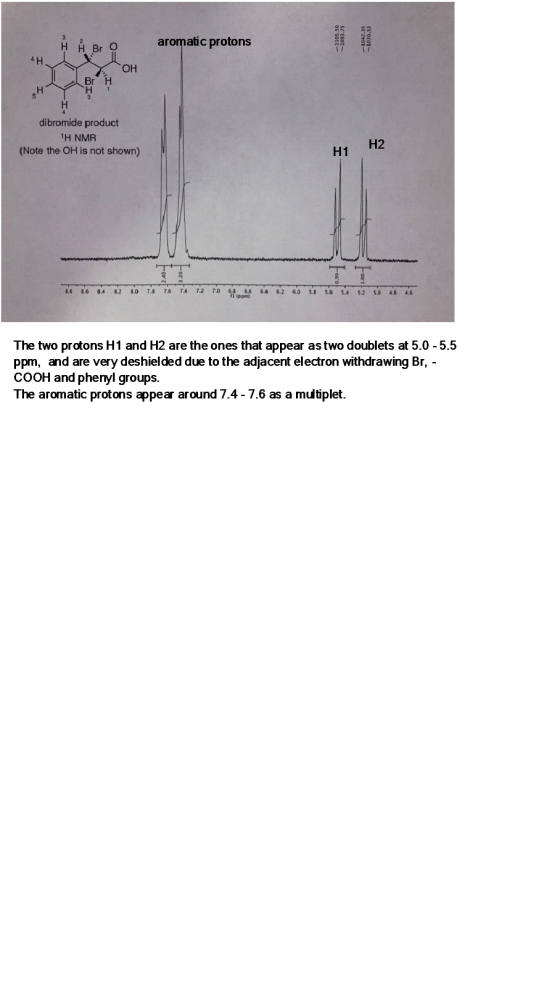
Examine H NMR
4. Examine the attached 'H NMR spectrum of the product from the trans-cinnamic...
5. Examine the attached 'H NMR spectrum of the product that you are making today. What...
 5. Examine the attached 'H NMR spectrum of the product that you are making today. What significant difference(s) are present (with respect to the spectrum of the dibromide product)? 6. For today's experiment, we are doing a reaction with trans-cinnamic acid using NBS (which effectively provides a dilute solution of bromine) in a mixture of water and methanol. Predict the four possible products of this reaction. Note the dibromide product is not a possibility here. (See question 2). For this...
Label peaks and determine the structure of the aldehyde in the 1H NMR and 13C1H NMR:...
 Label peaks and determine the structure of the
aldehyde in the 1H NMR and 13C1H NMR:
pg 1H NMR of product from aldehyde Yin CDCI3 CHCI ppm Hz Intensity 17.73 3091.6 621.6 2 7.69 3075.7 690.3 3 7.59 3036.2 1108.5 4 7.57 3027.5 1199.0 5 6.98 2793.9 961.0 6 6.95 2779.9 1320.9 76.94 2778.0 1279.1 8 6.93 2771.1 1185.2 7.60 7.55 7.50 7.45 7.40 7.35 7.30 7.25 fl (ppm) 7.20 7.15 7.10 7.057.00 6.95 6.90 OK to group CHCl3 -...
Label peaks and determine the structure of the
aldehyde in the 1H NMR and 13C1H NMR:
pg 1H NMR of product from aldehyde Yin CDCI3 CHCI ppm Hz Intensity 17.73 3091.6 621.6 2 7.69 3075.7 690.3 3 7.59 3036.2 1108.5 4 7.57 3027.5 1199.0 5 6.98 2793.9 961.0 6 6.95 2779.9 1320.9 76.94 2778.0 1279.1 8 6.93 2771.1 1185.2 7.60 7.55 7.50 7.45 7.40 7.35 7.30 7.25 fl (ppm) 7.20 7.15 7.10 7.057.00 6.95 6.90 OK to group CHCl3 -...
Can you correspond each of the peaks to the protons in 4-methoxy-4-methyl chalcone? 4.0 3.00 -7.530...
 Can
you correspond each of the peaks to the protons in
4-methoxy-4-methyl chalcone?
4.0 3.00 -7.530 8.051 28.029 7.352 OCUL ΤΙΣ' 800'L- ---7.769 8.2 8.0 7.8 7.6 7.4 7.2 7.0 6.8 6.6 6.4 6.2 ppm 1.BR 2.47 0.67 0.92 1.93
Can
you correspond each of the peaks to the protons in
4-methoxy-4-methyl chalcone?
4.0 3.00 -7.530 8.051 28.029 7.352 OCUL ΤΙΣ' 800'L- ---7.769 8.2 8.0 7.8 7.6 7.4 7.2 7.0 6.8 6.6 6.4 6.2 ppm 1.BR 2.47 0.67 0.92 1.93
You attempt to perform a bromination of trans-cinnamic acid in the hopes of producing the product...
 You attempt to perform a bromination of trans-cinnamic
acid in the hopes of producing the product shown below. You decide
to take a 1H NMR spectrum of what you hope is the
product. Signals with which of the following approximate chemical
shifts would indicate that the product did not
form?
The listed regions would not be useful in determing reaction
success.
~ 12.0 ppm
~ 5.5 ppm
~7.0 ppm
Br O OH Br
You attempt to perform a bromination of trans-cinnamic
acid in the hopes of producing the product shown below. You decide
to take a 1H NMR spectrum of what you hope is the
product. Signals with which of the following approximate chemical
shifts would indicate that the product did not
form?
The listed regions would not be useful in determing reaction
success.
~ 12.0 ppm
~ 5.5 ppm
~7.0 ppm
Br O OH Br
Questions Using the spectrum attached to this procedure, assign the peaks in the 'H NMR spectrum...
 Questions Using the spectrum attached to this procedure, assign the peaks in the 'H NMR spectrum for 3.4-methylenedioxynitrostyrene. Using coupling constants, describe the geometry of the double bond. You should tear out the labeled proton spectrum and turn it in with your notebook pages. Account for the unusual acidity of nitromethane whose pK, is 10. 1) CH3NO2, NaOH 2) HCI, H2O piperonal Mol. Wt.: 150.13 3,4-methylenedioxynitrostyrene Mol. Wt.: 193.16 —3177.4 - 3163.9 -2995.7 -2982.2 -2904.9 2838.0 2836.4 2030.0 2828.3 2801.0...
(a) From the spectral data ( H, C NMR, IR, MS) you were given, identify the...
 (a) From the spectral data ( H, C NMR, IR, MS) you were given,
identify the structure of your product. Explain why you chose your
particular product based on the spectroscopic data.
(b) Fully assign the 1H NMR spectrum of your product (i.e.
determine which peaks in the 1H NMR correspond to which hydrogens
in the product). You will not receive full marks for determination
of the unknown unless you assign the 1H NMR spectrum
completely.
(c) Now work backwards...
(a) From the spectral data ( H, C NMR, IR, MS) you were given,
identify the structure of your product. Explain why you chose your
particular product based on the spectroscopic data.
(b) Fully assign the 1H NMR spectrum of your product (i.e.
determine which peaks in the 1H NMR correspond to which hydrogens
in the product). You will not receive full marks for determination
of the unknown unless you assign the 1H NMR spectrum
completely.
(c) Now work backwards...
Write down problem number. Provide formula, HDI value, and a complete, chemically correct structure for each...
 Write down problem number.
Provide formula, HDI value, and a complete, chemically correct
structure for each problem.
Assign signals in the 1H and 13C spectra to specific atoms,
identify structural units and/or functional groups.
Example:
Problem # 3
Formula: C8H8O2
HDI: 5
1H NMR: p-substituted Ar at 7.27-7.97 ppm, benzylic CH3 group at
2.42 ppm, COOH proton at 12.9 ppm
13C NMR: carbonyl C at 167.8 ppm (ester or acid), benzylic CH3
at 21.40 ppm, 4 remaining signals are Ar...
Write down problem number.
Provide formula, HDI value, and a complete, chemically correct
structure for each problem.
Assign signals in the 1H and 13C spectra to specific atoms,
identify structural units and/or functional groups.
Example:
Problem # 3
Formula: C8H8O2
HDI: 5
1H NMR: p-substituted Ar at 7.27-7.97 ppm, benzylic CH3 group at
2.42 ppm, COOH proton at 12.9 ppm
13C NMR: carbonyl C at 167.8 ppm (ester or acid), benzylic CH3
at 21.40 ppm, 4 remaining signals are Ar...
An aldol condensation reaction was performed where benzaldehyde and cyclopentanone were used. The product is 2,5...
 An aldol condensation reaction was performed where benzaldehyde
and cyclopentanone were used. The product is 2,5
dibenzylidenecyclopentanone or just 2-benzylidenecyclopentanone.
The spectra correspond with the aldehyde being benzaldehyde but the
ketone used could either be acetone, cyclopentanone or cyclohexane.
I need to find the NMR spectra that correspond to cyclopentanone
being the ketone in the aldol condensation. Which NMR spectra
correspond to the correct product?
I think the second set is with cyclohexanone and not
cyclopentanone but I could be...
An aldol condensation reaction was performed where benzaldehyde
and cyclopentanone were used. The product is 2,5
dibenzylidenecyclopentanone or just 2-benzylidenecyclopentanone.
The spectra correspond with the aldehyde being benzaldehyde but the
ketone used could either be acetone, cyclopentanone or cyclohexane.
I need to find the NMR spectra that correspond to cyclopentanone
being the ketone in the aldol condensation. Which NMR spectra
correspond to the correct product?
I think the second set is with cyclohexanone and not
cyclopentanone but I could be...
Match the peaks labeled A,B,C,D,E to the Diels-Adler product and what part of the products structure...
 Match the peaks labeled A,B,C,D,E to the Diels-Adler
product and what part of the products structure creates each peak
on the NMR graph.
3.60 3.58 3.56 3.54 3.52 f1 (ppm) 3.50 3.48 3.46 C (dd) 7.34 7.45 7.40 7.35 7.30 7.25 i (ppm) 7,20 7.15 7.10 B (dd) A (dt) 7.39 7.20 D (t) 4.83 E (dd) 3.53 T T 1.98 1.93 4.00 2.09 2.01 .8 7.6 7.4 7.2 7.0 6.8 6.6 6.4 6.2 6.0 5.8 5.6 5.4 f1 (ppm)...
Match the peaks labeled A,B,C,D,E to the Diels-Adler
product and what part of the products structure creates each peak
on the NMR graph.
3.60 3.58 3.56 3.54 3.52 f1 (ppm) 3.50 3.48 3.46 C (dd) 7.34 7.45 7.40 7.35 7.30 7.25 i (ppm) 7,20 7.15 7.10 B (dd) A (dt) 7.39 7.20 D (t) 4.83 E (dd) 3.53 T T 1.98 1.93 4.00 2.09 2.01 .8 7.6 7.4 7.2 7.0 6.8 6.6 6.4 6.2 6.0 5.8 5.6 5.4 f1 (ppm)...
(10 points) Analysis of 'H NMR spectrum. Below is the 'H NMR spectrum of the product...
 (10 points) Analysis of 'H NMR spectrum. Below is the 'H NMR spectrum of the product from this week's experiment. 3H, t, J = 7.1 Hz 1H, d, J = 15.8 Hz 2H, 9, J = 7.1 Hz 5H, m 1H, d, J= 15.8 Hz 11 10 9 8 7 6 5 4 3 2 1 ppm Summary of peaks (ppm): 1.32 (3H, t, J = 7.1 Hz), 4.24 (2H, q, J = 7.1 Hz), 6.43 (1H, d J =...
 5. Examine the attached 'H NMR spectrum of the product that you are making today. What significant difference(s) are present (with respect to the spectrum of the dibromide product)? 6. For today's experiment, we are doing a reaction with trans-cinnamic acid using NBS (which effectively provides a dilute solution of bromine) in a mixture of water and methanol. Predict the four possible products of this reaction. Note the dibromide product is not a possibility here. (See question 2). For this...
 Label peaks and determine the structure of the
aldehyde in the 1H NMR and 13C1H NMR:
pg 1H NMR of product from aldehyde Yin CDCI3 CHCI ppm Hz Intensity 17.73 3091.6 621.6 2 7.69 3075.7 690.3 3 7.59 3036.2 1108.5 4 7.57 3027.5 1199.0 5 6.98 2793.9 961.0 6 6.95 2779.9 1320.9 76.94 2778.0 1279.1 8 6.93 2771.1 1185.2 7.60 7.55 7.50 7.45 7.40 7.35 7.30 7.25 fl (ppm) 7.20 7.15 7.10 7.057.00 6.95 6.90 OK to group CHCl3 -...
Label peaks and determine the structure of the
aldehyde in the 1H NMR and 13C1H NMR:
pg 1H NMR of product from aldehyde Yin CDCI3 CHCI ppm Hz Intensity 17.73 3091.6 621.6 2 7.69 3075.7 690.3 3 7.59 3036.2 1108.5 4 7.57 3027.5 1199.0 5 6.98 2793.9 961.0 6 6.95 2779.9 1320.9 76.94 2778.0 1279.1 8 6.93 2771.1 1185.2 7.60 7.55 7.50 7.45 7.40 7.35 7.30 7.25 fl (ppm) 7.20 7.15 7.10 7.057.00 6.95 6.90 OK to group CHCl3 -...
 Can
you correspond each of the peaks to the protons in
4-methoxy-4-methyl chalcone?
4.0 3.00 -7.530 8.051 28.029 7.352 OCUL ΤΙΣ' 800'L- ---7.769 8.2 8.0 7.8 7.6 7.4 7.2 7.0 6.8 6.6 6.4 6.2 ppm 1.BR 2.47 0.67 0.92 1.93
Can
you correspond each of the peaks to the protons in
4-methoxy-4-methyl chalcone?
4.0 3.00 -7.530 8.051 28.029 7.352 OCUL ΤΙΣ' 800'L- ---7.769 8.2 8.0 7.8 7.6 7.4 7.2 7.0 6.8 6.6 6.4 6.2 ppm 1.BR 2.47 0.67 0.92 1.93
 You attempt to perform a bromination of trans-cinnamic
acid in the hopes of producing the product shown below. You decide
to take a 1H NMR spectrum of what you hope is the
product. Signals with which of the following approximate chemical
shifts would indicate that the product did not
form?
The listed regions would not be useful in determing reaction
success.
~ 12.0 ppm
~ 5.5 ppm
~7.0 ppm
Br O OH Br
You attempt to perform a bromination of trans-cinnamic
acid in the hopes of producing the product shown below. You decide
to take a 1H NMR spectrum of what you hope is the
product. Signals with which of the following approximate chemical
shifts would indicate that the product did not
form?
The listed regions would not be useful in determing reaction
success.
~ 12.0 ppm
~ 5.5 ppm
~7.0 ppm
Br O OH Br
 Questions Using the spectrum attached to this procedure, assign the peaks in the 'H NMR spectrum for 3.4-methylenedioxynitrostyrene. Using coupling constants, describe the geometry of the double bond. You should tear out the labeled proton spectrum and turn it in with your notebook pages. Account for the unusual acidity of nitromethane whose pK, is 10. 1) CH3NO2, NaOH 2) HCI, H2O piperonal Mol. Wt.: 150.13 3,4-methylenedioxynitrostyrene Mol. Wt.: 193.16 —3177.4 - 3163.9 -2995.7 -2982.2 -2904.9 2838.0 2836.4 2030.0 2828.3 2801.0...
 (a) From the spectral data ( H, C NMR, IR, MS) you were given,
identify the structure of your product. Explain why you chose your
particular product based on the spectroscopic data.
(b) Fully assign the 1H NMR spectrum of your product (i.e.
determine which peaks in the 1H NMR correspond to which hydrogens
in the product). You will not receive full marks for determination
of the unknown unless you assign the 1H NMR spectrum
completely.
(c) Now work backwards...
(a) From the spectral data ( H, C NMR, IR, MS) you were given,
identify the structure of your product. Explain why you chose your
particular product based on the spectroscopic data.
(b) Fully assign the 1H NMR spectrum of your product (i.e.
determine which peaks in the 1H NMR correspond to which hydrogens
in the product). You will not receive full marks for determination
of the unknown unless you assign the 1H NMR spectrum
completely.
(c) Now work backwards...
 Write down problem number.
Provide formula, HDI value, and a complete, chemically correct
structure for each problem.
Assign signals in the 1H and 13C spectra to specific atoms,
identify structural units and/or functional groups.
Example:
Problem # 3
Formula: C8H8O2
HDI: 5
1H NMR: p-substituted Ar at 7.27-7.97 ppm, benzylic CH3 group at
2.42 ppm, COOH proton at 12.9 ppm
13C NMR: carbonyl C at 167.8 ppm (ester or acid), benzylic CH3
at 21.40 ppm, 4 remaining signals are Ar...
Write down problem number.
Provide formula, HDI value, and a complete, chemically correct
structure for each problem.
Assign signals in the 1H and 13C spectra to specific atoms,
identify structural units and/or functional groups.
Example:
Problem # 3
Formula: C8H8O2
HDI: 5
1H NMR: p-substituted Ar at 7.27-7.97 ppm, benzylic CH3 group at
2.42 ppm, COOH proton at 12.9 ppm
13C NMR: carbonyl C at 167.8 ppm (ester or acid), benzylic CH3
at 21.40 ppm, 4 remaining signals are Ar...
 An aldol condensation reaction was performed where benzaldehyde
and cyclopentanone were used. The product is 2,5
dibenzylidenecyclopentanone or just 2-benzylidenecyclopentanone.
The spectra correspond with the aldehyde being benzaldehyde but the
ketone used could either be acetone, cyclopentanone or cyclohexane.
I need to find the NMR spectra that correspond to cyclopentanone
being the ketone in the aldol condensation. Which NMR spectra
correspond to the correct product?
I think the second set is with cyclohexanone and not
cyclopentanone but I could be...
An aldol condensation reaction was performed where benzaldehyde
and cyclopentanone were used. The product is 2,5
dibenzylidenecyclopentanone or just 2-benzylidenecyclopentanone.
The spectra correspond with the aldehyde being benzaldehyde but the
ketone used could either be acetone, cyclopentanone or cyclohexane.
I need to find the NMR spectra that correspond to cyclopentanone
being the ketone in the aldol condensation. Which NMR spectra
correspond to the correct product?
I think the second set is with cyclohexanone and not
cyclopentanone but I could be...
 Match the peaks labeled A,B,C,D,E to the Diels-Adler
product and what part of the products structure creates each peak
on the NMR graph.
3.60 3.58 3.56 3.54 3.52 f1 (ppm) 3.50 3.48 3.46 C (dd) 7.34 7.45 7.40 7.35 7.30 7.25 i (ppm) 7,20 7.15 7.10 B (dd) A (dt) 7.39 7.20 D (t) 4.83 E (dd) 3.53 T T 1.98 1.93 4.00 2.09 2.01 .8 7.6 7.4 7.2 7.0 6.8 6.6 6.4 6.2 6.0 5.8 5.6 5.4 f1 (ppm)...
Match the peaks labeled A,B,C,D,E to the Diels-Adler
product and what part of the products structure creates each peak
on the NMR graph.
3.60 3.58 3.56 3.54 3.52 f1 (ppm) 3.50 3.48 3.46 C (dd) 7.34 7.45 7.40 7.35 7.30 7.25 i (ppm) 7,20 7.15 7.10 B (dd) A (dt) 7.39 7.20 D (t) 4.83 E (dd) 3.53 T T 1.98 1.93 4.00 2.09 2.01 .8 7.6 7.4 7.2 7.0 6.8 6.6 6.4 6.2 6.0 5.8 5.6 5.4 f1 (ppm)...
 (10 points) Analysis of 'H NMR spectrum. Below is the 'H NMR spectrum of the product from this week's experiment. 3H, t, J = 7.1 Hz 1H, d, J = 15.8 Hz 2H, 9, J = 7.1 Hz 5H, m 1H, d, J= 15.8 Hz 11 10 9 8 7 6 5 4 3 2 1 ppm Summary of peaks (ppm): 1.32 (3H, t, J = 7.1 Hz), 4.24 (2H, q, J = 7.1 Hz), 6.43 (1H, d J =...
Most questions answered within 3 hours.
-
Where is the error in this code sequence?
String s1 = "Hello";
String s2 = "ello";...
asked 11 months ago -
Financial data for Joel de Paris, Inc., for last year
follow:
Joel de Paris, Inc.
Balance...
asked 11 months ago -
Consider this reaction:
Al2(SO4)3 (aq)+ BaCl3
(aq) Al2Cl6 (aq)- +
3BaSO4(s) . What is the...
asked 11 months ago -
Suppose that Savneet is considering increasing her
recent random sample from 20 car rentals to 40...
asked 11 months ago -
Trucks arrive at an unloading terminal at an average rate of 120
per hour.
Trucks arrive...
asked 11 months ago -
Why are methanol and ethanol completely soluble in water while
octanol is not very little soluble....
asked 11 months ago -
A facilities manager at a university reads in a research report
that the mean amount of...
asked 11 months ago -
When the CuSO4 is rehydrated by adding water to the anhydrous
compound, is this an endothermic...
asked 11 months ago -
A ray of sunlight is passing from diamond into crown glass; the
angle of incidence is...
asked 11 months ago -
A block of mass 0.249 kg is placed on top of a light, vertical
spring of...
asked 11 months ago -
how do the kidneys compensate in the presences of acidosis
a) trigger hyperventilate
b) reserve acid...
asked 11 months ago -
Question 501 pts
The rental rate of capital to the firm increases. Which of the
following...
asked 11 months ago