
Homework Answers
Add Answer to:
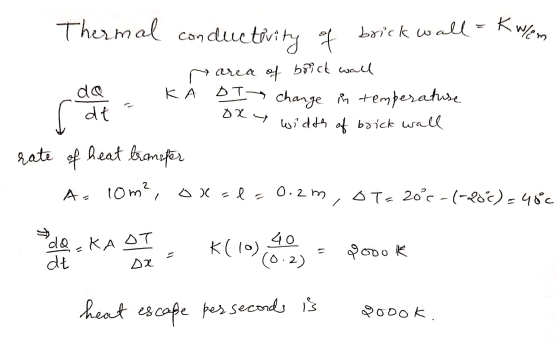
How much heat (in Joules per second) escapes from a house through a brick wall of...
Assist The inner and outer surfaces of a 6-mx7-m brick wall of thickness 40 cm and...
 Assist The inner and outer surfaces of a 6-mx7-m brick wall of thickness 40 cm and thermal conductivity 0.55 W/m°C are maintained at temperatures of 26°C and T°C, respectively Determine the rate of heat transfer through the wall, in W. Chec Print Questi Report Brick wall 28 C
[6] A 20-cm thick wall of a house made of brick (k = 0.72W/m. C) is...
 [6] A 20-cm thick wall of a house made of brick (k = 0.72W/m. C) is subjected to inside air at 22.C with a convection heat-transfer coefficient of 15 W/m2. C. The inner surface temperature of the wall is 18 C and the outside air temperature is -1 °C. Determine the outer surface temperature of the wall and the heat-transfer coefficient at the outer surface.
A wall consists of a 10 cm thick layer of brick (0.84 J/s-m-C). How much heat...
A wall consists of a 10 cm thick layer of brick (0.84 J/s-m-C). How much heat conducts through 30 m^2 area of this wall if the temperature difference across the wall is 36 degrees farenheit?
A detached house is built using a cavity wall, consisting of two layers of brick separated...
A detached house is built using a cavity wall, consisting of two layers of brick separated by a 50 mm air gap. A brick has a thickness of 112.5 mm. kbrick = 0.72 Wm-1K-1 , kair = 0.0262 Wm-1K-1 . The house has dimensions of width 8 m, depth 6 m and height 5 m. Assuming the roof and floor are perfectly insulated (hence most heat loss is through the walls), how much heat must the central heating system supply...
(b) The brick wall of a building has dimensions of 4 m by 10 m, and it is 15 cm thick with a coefficient of thermal con...
 (b) The brick wall of a building has dimensions of 4 m by 10 m, and it is 15 cm thick with a coefficient of thermal conductivity of 0.8 W.m1ec1. How much heat flows through the wall in a 12-hour period when the average inside and outside temperatures are 20 °C and 5 °C respectively? Will a 2 kW heater operating in the room compensate for the heat loss? Justify your answer. A layer of insulating material of thickness 5...
A. Suppose a brick wall of a house is 4.00 inches thick and that the thermal...
A. Suppose a brick wall of a house is 4.00 inches thick and that the thermal conductivity of the brick is about 0.84 J/smK . The area is 240 ft2 and there is a 12F° difference between the inside and outside. Assume a heater pumps the same amount of energy lost via conduction in the opposite direction that the energy is being transferred via conduction, i.e. the heater pumps energy from the cold side to the hot side of the...
Heat Transfer -A wall 20 cm thick is to be constructed from material that has an...
 Heat Transfer
-A wall 20 cm thick is to be constructed from material that has an average thermal conductivity of 2 W/m C. The wall is to be insulated with 5cm material having an average thermal conductivity of 0.5W/m C. Assuming that the inner and outer surface temperatures of the insulated wall are 200 and 20°C, calculate the heat transfer per unit area and the intermediate Temperature between the insulation and the wall.
Heat Transfer
-A wall 20 cm thick is to be constructed from material that has an average thermal conductivity of 2 W/m C. The wall is to be insulated with 5cm material having an average thermal conductivity of 0.5W/m C. Assuming that the inner and outer surface temperatures of the insulated wall are 200 and 20°C, calculate the heat transfer per unit area and the intermediate Temperature between the insulation and the wall.
The wall of a furnace consists of two parts, a ceramic brick lining (k=1.1 W/m C,....
The wall of a furnace consists of two parts, a ceramic brick lining (k=1.1 W/m C,. l=20 mm) and an outer steel wall (k=50 W/ m C, l=10 mm). The inner heat transfer coefficient is 29 W/ m2 C and the outer heat transfer coefficient is 14 W/ m2 C. Taking the bulk temperature of the furnace to be 1000 C and the air temperature outside the furnace as 15 C calculate the temperature of the outer steel wall exposed...
012 The brick wall (of thermal conductivity 0.96 W/m · ◦ C) of a building has...
012 The brick wall (of thermal conductivity 0.96 W/m · ◦ C) of a building has dimensions of 1.7 m by 15 m and is 19 cm thick. How much heat flows through the wall in a 18.6 h period when the average inside and outside temperatures are, respectively, 24◦C and 6◦C? Answer in units of MJ.
012 10.0 points The brick wall (of thermal conductivity 0.62 W/m.° C) of a building has...
 012 10.0 points The brick wall (of thermal conductivity 0.62 W/m.° C) of a building has dimensions of 2.7 m by 15 m and is 9 cm thick. How much heat flows through the wall in a 10.9 h period when the average inside and outside temperatures are, respectively, 29°C and 5°C? Answer in units of MJ.
 Assist The inner and outer surfaces of a 6-mx7-m brick wall of thickness 40 cm and thermal conductivity 0.55 W/m°C are maintained at temperatures of 26°C and T°C, respectively Determine the rate of heat transfer through the wall, in W. Chec Print Questi Report Brick wall 28 C
 [6] A 20-cm thick wall of a house made of brick (k = 0.72W/m. C) is subjected to inside air at 22.C with a convection heat-transfer coefficient of 15 W/m2. C. The inner surface temperature of the wall is 18 C and the outside air temperature is -1 °C. Determine the outer surface temperature of the wall and the heat-transfer coefficient at the outer surface.
 (b) The brick wall of a building has dimensions of 4 m by 10 m, and it is 15 cm thick with a coefficient of thermal conductivity of 0.8 W.m1ec1. How much heat flows through the wall in a 12-hour period when the average inside and outside temperatures are 20 °C and 5 °C respectively? Will a 2 kW heater operating in the room compensate for the heat loss? Justify your answer. A layer of insulating material of thickness 5...
 Heat Transfer
-A wall 20 cm thick is to be constructed from material that has an average thermal conductivity of 2 W/m C. The wall is to be insulated with 5cm material having an average thermal conductivity of 0.5W/m C. Assuming that the inner and outer surface temperatures of the insulated wall are 200 and 20°C, calculate the heat transfer per unit area and the intermediate Temperature between the insulation and the wall.
Heat Transfer
-A wall 20 cm thick is to be constructed from material that has an average thermal conductivity of 2 W/m C. The wall is to be insulated with 5cm material having an average thermal conductivity of 0.5W/m C. Assuming that the inner and outer surface temperatures of the insulated wall are 200 and 20°C, calculate the heat transfer per unit area and the intermediate Temperature between the insulation and the wall.
 012 10.0 points The brick wall (of thermal conductivity 0.62 W/m.° C) of a building has dimensions of 2.7 m by 15 m and is 9 cm thick. How much heat flows through the wall in a 10.9 h period when the average inside and outside temperatures are, respectively, 29°C and 5°C? Answer in units of MJ.
Most questions answered within 3 hours.
-
Where is the error in this code sequence?
String s1 = "Hello";
String s2 = "ello";...
asked 10 months ago -
Financial data for Joel de Paris, Inc., for last year
follow:
Joel de Paris, Inc.
Balance...
asked 10 months ago -
Consider this reaction:
Al2(SO4)3 (aq)+ BaCl3
(aq) Al2Cl6 (aq)- +
3BaSO4(s) . What is the...
asked 10 months ago -
Suppose that Savneet is considering increasing her
recent random sample from 20 car rentals to 40...
asked 10 months ago -
Trucks arrive at an unloading terminal at an average rate of 120
per hour.
Trucks arrive...
asked 10 months ago -
Why are methanol and ethanol completely soluble in water while
octanol is not very little soluble....
asked 10 months ago -
A facilities manager at a university reads in a research report
that the mean amount of...
asked 10 months ago -
When the CuSO4 is rehydrated by adding water to the anhydrous
compound, is this an endothermic...
asked 10 months ago -
A ray of sunlight is passing from diamond into crown glass; the
angle of incidence is...
asked 10 months ago -
A block of mass 0.249 kg is placed on top of a light, vertical
spring of...
asked 10 months ago -
how do the kidneys compensate in the presences of acidosis
a) trigger hyperventilate
b) reserve acid...
asked 10 months ago -
Question 501 pts
The rental rate of capital to the firm increases. Which of the
following...
asked 10 months ago