
Homework Answers
Add Answer to:
2. Determine the forces in members BC, CD, and DE of the truss shown below by...
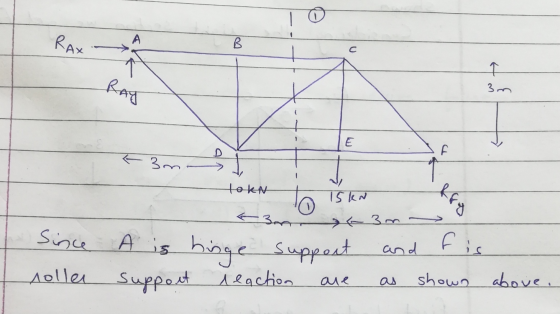
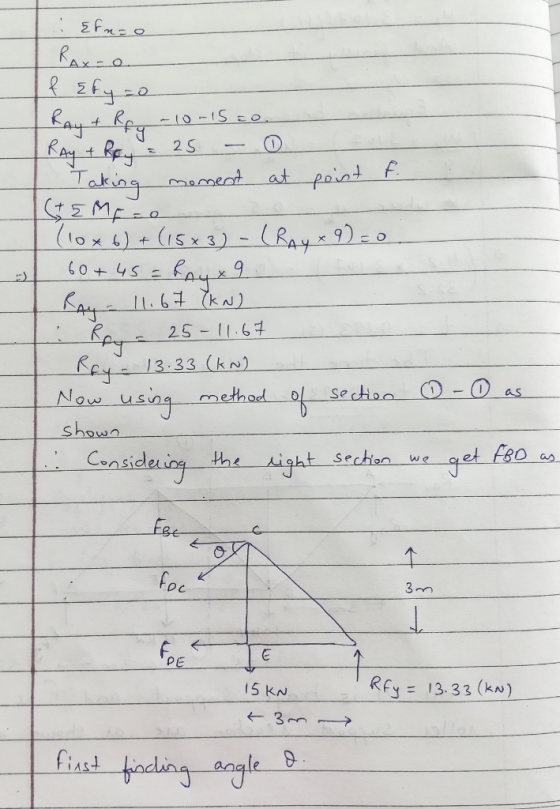
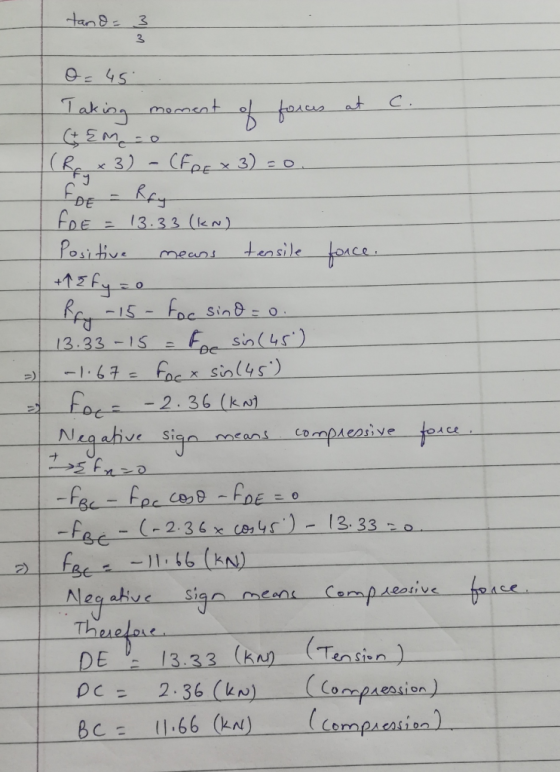
Use the method of sections to determine the forces in members BC, CD, and DE of...
 Use the method of sections to determine the forces in members
BC, CD, and DE of the truss.
Use the method of sections to determine the forces in members BC, CD, and DE of the truss.
Use the method of sections to determine the forces in members
BC, CD, and DE of the truss.
Use the method of sections to determine the forces in members BC, CD, and DE of the truss.
For the roof truss shown, use method of sections to determine the forces in members BC and EF
 For the roof truss shown, use method of sections to determine the forces in members BC and EF. State whether each is in compression or tension.
Problem 2: In the truss shown, determine the forces in members DB and DE and state...
 Problem 2: In the truss shown, determine the forces in members DB and DE and state if the members are in tension or compression. | 7 kN problem 210 5 m - 5 m -
2. For the truss shown, determine the forces acting upon the members BC, FC and FE...
 2. For the truss shown, determine the forces acting upon the members BC, FC and FE by using the method of sections o1 IO KN 5 RN
Part A - Determining the forces in three specified members of the truss Determine the forces...
 Part A - Determining the forces in three
specified members of the truss
Determine the forces in members CD, DH, and
GH.
Express the magnitudes of the forces in pounds to three
significant figures. Separate your answers with commas.
Part B - The Sense of the Forces
State if the members considered in part A are in tension or
compression.
Complete each sentenc
e by dragging the appropriate word into the blank. The words can
be used more than once....
Part A - Determining the forces in three
specified members of the truss
Determine the forces in members CD, DH, and
GH.
Express the magnitudes of the forces in pounds to three
significant figures. Separate your answers with commas.
Part B - The Sense of the Forces
State if the members considered in part A are in tension or
compression.
Complete each sentenc
e by dragging the appropriate word into the blank. The words can
be used more than once....
A roof truss is loaded and supported as shown in Figure 2. The joints are all...
 A roof truss is loaded and supported as shown in Figure 2. The joints are all pinned. (a) Determine the support reactions at A and G. (25 marks) (b)Using "Method of joints" find the forces in members AB, AF, GF, CD and DE of the truss. State whether each of these members is in tension or compression. (75 marks) (c) Determine the force in members BC, CF and EF of the truss using "Method of sections". State whether each of...
Determine the forces in members DC, CB and BA of the truss. State whether the members...
 Determine the forces in members DC,
CB and BA of the truss. State
whether the members are in tension or compression. Set 6 kN
Determine the forces in members DE and
EA of the truss. State whether the members are in
tension or compression.
Determine the forces in members CE and
BE of the truss. State whether the members are in
tension or compression.
4 m 60 60° 4 m 4 m
Determine the forces in members DC,
CB and BA of the truss. State
whether the members are in tension or compression. Set 6 kN
Determine the forces in members DE and
EA of the truss. State whether the members are in
tension or compression.
Determine the forces in members CE and
BE of the truss. State whether the members are in
tension or compression.
4 m 60 60° 4 m 4 m
Incorrect lculate the forces in members BC, CD, and CG of the loaded truss composed of...
 Incorrect lculate the forces in members BC, CD, and CG of the loaded truss composed of equilateral triangles, each of side length 8 m. The forces are positive if in tension, negative if in compression 5.2 KN 8 m 2.1 KN swers: c = T-3.69 kN D7.96 kN kN the tolerance is +/-2% ick if you would like to Show Work for this question:
3. Determine the forces in members BC, CD, and BD, and state whether each is in...
 3. Determine the forces in members BC, CD, and BD, and state whether each is in tension or compression. Note: the truss is supported by a pin joint at A and a simple (roller) support at H. (25 points) G 10 15 10 H E 300 LBS 300 LBS 300 LBS 150 * 15 * 15 15
For the truss shown below determine the forces in members HC, HG and GF and state...
 For the truss shown below determine the forces in members
HC, HG and GF
and state if they are in tension or compression. Assume the
self-weight of the members is negligible.
5 KN 4 KN 4 KN 3 KN --5 --- -5m- 5m-2-5
For the truss shown below determine the forces in members
HC, HG and GF
and state if they are in tension or compression. Assume the
self-weight of the members is negligible.
5 KN 4 KN 4 KN 3 KN --5 --- -5m- 5m-2-5
 Use the method of sections to determine the forces in members
BC, CD, and DE of the truss.
Use the method of sections to determine the forces in members BC, CD, and DE of the truss.
Use the method of sections to determine the forces in members
BC, CD, and DE of the truss.
Use the method of sections to determine the forces in members BC, CD, and DE of the truss.
 For the roof truss shown, use method of sections to determine the forces in members BC and EF. State whether each is in compression or tension.
 Problem 2: In the truss shown, determine the forces in members DB and DE and state if the members are in tension or compression. | 7 kN problem 210 5 m - 5 m -
 2. For the truss shown, determine the forces acting upon the members BC, FC and FE by using the method of sections o1 IO KN 5 RN
 Part A - Determining the forces in three
specified members of the truss
Determine the forces in members CD, DH, and
GH.
Express the magnitudes of the forces in pounds to three
significant figures. Separate your answers with commas.
Part B - The Sense of the Forces
State if the members considered in part A are in tension or
compression.
Complete each sentenc
e by dragging the appropriate word into the blank. The words can
be used more than once....
Part A - Determining the forces in three
specified members of the truss
Determine the forces in members CD, DH, and
GH.
Express the magnitudes of the forces in pounds to three
significant figures. Separate your answers with commas.
Part B - The Sense of the Forces
State if the members considered in part A are in tension or
compression.
Complete each sentenc
e by dragging the appropriate word into the blank. The words can
be used more than once....
 A roof truss is loaded and supported as shown in Figure 2. The joints are all pinned. (a) Determine the support reactions at A and G. (25 marks) (b)Using "Method of joints" find the forces in members AB, AF, GF, CD and DE of the truss. State whether each of these members is in tension or compression. (75 marks) (c) Determine the force in members BC, CF and EF of the truss using "Method of sections". State whether each of...
 Determine the forces in members DC,
CB and BA of the truss. State
whether the members are in tension or compression. Set 6 kN
Determine the forces in members DE and
EA of the truss. State whether the members are in
tension or compression.
Determine the forces in members CE and
BE of the truss. State whether the members are in
tension or compression.
4 m 60 60° 4 m 4 m
Determine the forces in members DC,
CB and BA of the truss. State
whether the members are in tension or compression. Set 6 kN
Determine the forces in members DE and
EA of the truss. State whether the members are in
tension or compression.
Determine the forces in members CE and
BE of the truss. State whether the members are in
tension or compression.
4 m 60 60° 4 m 4 m
 Incorrect lculate the forces in members BC, CD, and CG of the loaded truss composed of equilateral triangles, each of side length 8 m. The forces are positive if in tension, negative if in compression 5.2 KN 8 m 2.1 KN swers: c = T-3.69 kN D7.96 kN kN the tolerance is +/-2% ick if you would like to Show Work for this question:
 3. Determine the forces in members BC, CD, and BD, and state whether each is in tension or compression. Note: the truss is supported by a pin joint at A and a simple (roller) support at H. (25 points) G 10 15 10 H E 300 LBS 300 LBS 300 LBS 150 * 15 * 15 15
 For the truss shown below determine the forces in members
HC, HG and GF
and state if they are in tension or compression. Assume the
self-weight of the members is negligible.
5 KN 4 KN 4 KN 3 KN --5 --- -5m- 5m-2-5
For the truss shown below determine the forces in members
HC, HG and GF
and state if they are in tension or compression. Assume the
self-weight of the members is negligible.
5 KN 4 KN 4 KN 3 KN --5 --- -5m- 5m-2-5
Most questions answered within 3 hours.
-
Where is the error in this code sequence?
String s1 = "Hello";
String s2 = "ello";...
asked 11 months ago -
Financial data for Joel de Paris, Inc., for last year
follow:
Joel de Paris, Inc.
Balance...
asked 11 months ago -
Consider this reaction:
Al2(SO4)3 (aq)+ BaCl3
(aq) Al2Cl6 (aq)- +
3BaSO4(s) . What is the...
asked 11 months ago -
Suppose that Savneet is considering increasing her
recent random sample from 20 car rentals to 40...
asked 11 months ago -
Trucks arrive at an unloading terminal at an average rate of 120
per hour.
Trucks arrive...
asked 11 months ago -
Why are methanol and ethanol completely soluble in water while
octanol is not very little soluble....
asked 11 months ago -
A facilities manager at a university reads in a research report
that the mean amount of...
asked 11 months ago -
When the CuSO4 is rehydrated by adding water to the anhydrous
compound, is this an endothermic...
asked 11 months ago -
A ray of sunlight is passing from diamond into crown glass; the
angle of incidence is...
asked 11 months ago -
A block of mass 0.249 kg is placed on top of a light, vertical
spring of...
asked 11 months ago -
how do the kidneys compensate in the presences of acidosis
a) trigger hyperventilate
b) reserve acid...
asked 11 months ago -
Question 501 pts
The rental rate of capital to the firm increases. Which of the
following...
asked 11 months ago