
Homework Answers
Add Answer to:
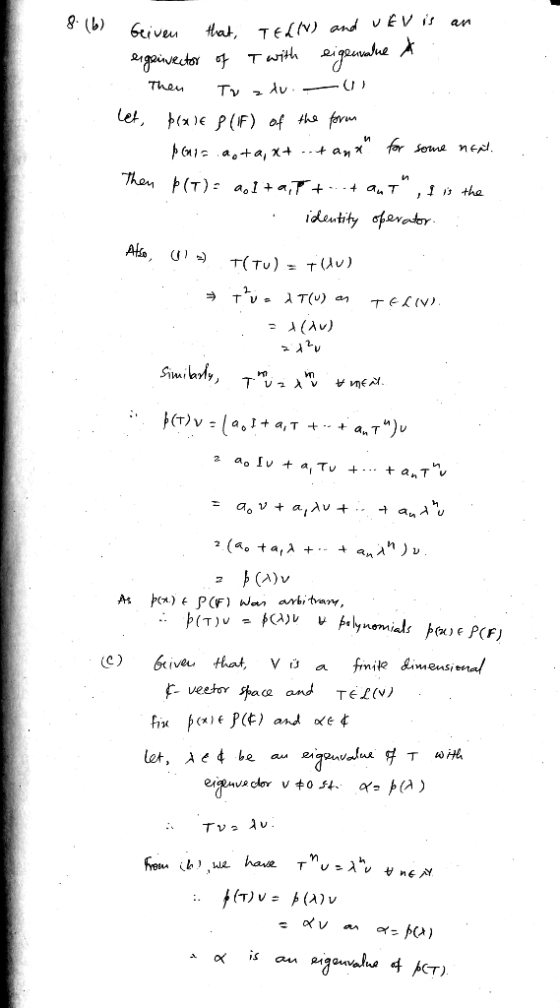
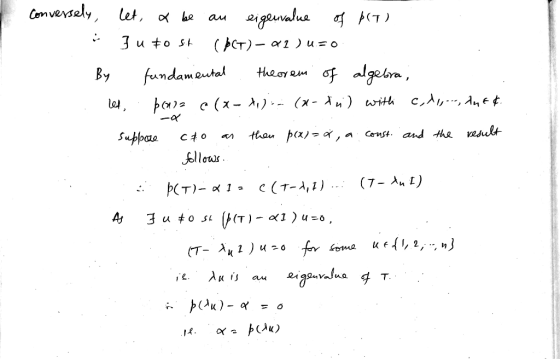
a) Make sure you understand the contents of Axler 5.A and 5.B (including Problem 8. the...
Let V be a finite-dimensional vector space and let T L(V) be an operator. In this problem you sh...
Let V be a finite-dimensional vector space and let T L(V) be an operator. In this problem you show that there is a nonzero polynomial such that p(T) = 0. (a) What is 0 in this context? A polynomial? A linear map? An element of V? (b) Define by . Prove that is a linear map. (c) Prove that if where V is infinite-dimensional and W is finite-dimensional, then S cannot be injective. (d) Use the preceding parts to prove...
Two n x n matrices A and B are called similar if there is an invertible...
 Two n x n matrices A and B are called similar if there is an invertible matrix P such that B = P-AP. Show that two similar matrices enjoy the following properties. (a) They have the same determinant. (b) They have the same eigenvalues: specifically, show that if v is an eigenvector of A with eigenvalue 1, then P-lv is an eigenvector of B with eigenvalue l. (c) For any polynomial p(x), P(A) = 0 is equivalent to p(B) =...
4. Let T be a linear operator on the finite-dimensional space V with eharacteristie polynomial and minimal polynomial Let W be the null space of (T c) Elementary Canonical Forms Chap. 6 226 (a)...
 4. Let T be a linear operator on the finite-dimensional space V with eharacteristie polynomial and minimal polynomial Let W be the null space of (T c) Elementary Canonical Forms Chap. 6 226 (a) Prove that W, is the set of all vector8 α in V such that (T-cd)"a-0 for some positive integer 'n (which may depend upon α). (b) Prove that the dimension of W, is di. (Hint: If T, is the operator induced on Wi by T, then...
Problem 2. For each polynomial p(t) = do +at+...+ amtm with real number coefficients and for...
 Problem 2. For each polynomial p(t) = do +at+...+ amtm with real number coefficients and for each n x n matrix A, we define the n x n matrix p(A) by P(A) = ao In + a A+ ... + amA”. Also, for each n, let Onxn E Rnxn be the n x n zero matrix. (a) Show that for all polynomials p and q and square matrices A, we have p(A)q(A) = 9(A)p(A). (b) Show that for every 2...
Hello, can you please help me understand this problem? Thank you! 3. Let V be finite...
 Hello, can you please help me understand this problem? Thank
you!
3. Let V be finite dimensional vector space. T is a linear transformation from V into W and E is a subspace of V and F is a subspace of W. Define T-(F) = {u € V|T(u) € F} and T(E) = {WE Ww= T(u) for someu e E}. (a) Prove that T-(F) is a subspace of V and dim(T-(F)) = dim(Ker(T)) + dim(F n Im(T)) (b) Prove that...
Hello, can you please help me understand this problem? Thank
you!
3. Let V be finite dimensional vector space. T is a linear transformation from V into W and E is a subspace of V and F is a subspace of W. Define T-(F) = {u € V|T(u) € F} and T(E) = {WE Ww= T(u) for someu e E}. (a) Prove that T-(F) is a subspace of V and dim(T-(F)) = dim(Ker(T)) + dim(F n Im(T)) (b) Prove that...
Let V be a finite-dimensional inner product space. For an operator TEL(V), define its norm by...
 Let V be a finite-dimensional inner product space. For an operator TEL(V), define its norm by ||T|:= max{||Tull VEV. ||0|| = 1}. (1) To explain this, note that {l|Tu ve V, || 0 || = 1} is a non-empty subset of [0,00). The expression max{||TV|| | V EV, ||0|| = 1} means the maximum, or largest, value in this set. In words, the norm of an operator describes the maximal amount that it 'stretches' (or shrinks) vectors. (a) (1 point)...
Question 8 please 5. We start with Schrodinger's Equation in 2(x,t) = H¥(x,t). We can write...
 Question 8 please
5. We start with Schrodinger's Equation in 2(x,t) = H¥(x,t). We can write the time derivative as 2.4(x, t) = V(x,+) - (xt), where At is a sufficiently small increment of time. Plug the algebraic form of the derivative into Schrodinger's Eq. and solve for '(x,t+At). b. Put your answer in the form (x,t+At) = T '(x,t). c. What physically does the operator T do to the function '(x,t)? d. Deduce an expression for '(x,t+24t), in terms...
Question 8 please
5. We start with Schrodinger's Equation in 2(x,t) = H¥(x,t). We can write the time derivative as 2.4(x, t) = V(x,+) - (xt), where At is a sufficiently small increment of time. Plug the algebraic form of the derivative into Schrodinger's Eq. and solve for '(x,t+At). b. Put your answer in the form (x,t+At) = T '(x,t). c. What physically does the operator T do to the function '(x,t)? d. Deduce an expression for '(x,t+24t), in terms...
Problem 5 Let U be an n dimensional vector space and T E L(U,U). Let I...
 Problem 5 Let U be an n dimensional vector space and T E L(U,U). Let I denote the identity transformation I(u) = u for each u EU and let 0 denote the zero transformation. Show that there is a natural number N, and constants C1, ..., CN+1 such that C1I + c2T + ... + CN+1TN = 0 (Hint: Given dim(U) = n, what is the dimension of L(U,U)? consider ciI + c2T + ... + Cn+11'" = 0, where...
12. Consider the unusual eigenvalue problem ux(0) = ur(l) = v(1)-U(0) (a) Show that 2 0 is a double eigenvalue. (b) Get an equation for the positive eigenvalues a>0. 102 CHAPTER 4 BOUNDARY PROBLEM...
 12. Consider the unusual eigenvalue problem ux(0) = ur(l) = v(1)-U(0) (a) Show that 2 0 is a double eigenvalue. (b) Get an equation for the positive eigenvalues a>0. 102 CHAPTER 4 BOUNDARY PROBLEMS (c) Letting γ-IVA, reduce the equation in part (b) to the equation γ sin γ cos γ = sin (d) Use part (c) to find half of the eigenvalues explicitly and half of (e) Assuming that all the eigenvalues are nonnegative, make a list of (t)...
Problem 5. (30 points) Consider a Harmonic oscillator with H that H=(ata + 1 / 2)ho,...
 Problem 5. (30 points) Consider a Harmonic oscillator with H that H=(ata + 1 / 2)ho, where a=dma)X + i (a) (4 points) Show P, and a x 2h 2h 2moh P. Show also 2moh that [a, a]-l. (b) (6 points) Starting from the commuters la, HJand la', A), where H-H(h) show that the eigenvalues of Hare e,=(n+1/2) for n-0, 1,2, Show also that alm)-nln-l), and a l). (( points) Find the normalized ground state wavefunction by projecting alo)-0 on...
 Two n x n matrices A and B are called similar if there is an invertible matrix P such that B = P-AP. Show that two similar matrices enjoy the following properties. (a) They have the same determinant. (b) They have the same eigenvalues: specifically, show that if v is an eigenvector of A with eigenvalue 1, then P-lv is an eigenvector of B with eigenvalue l. (c) For any polynomial p(x), P(A) = 0 is equivalent to p(B) =...
 4. Let T be a linear operator on the finite-dimensional space V with eharacteristie polynomial and minimal polynomial Let W be the null space of (T c) Elementary Canonical Forms Chap. 6 226 (a) Prove that W, is the set of all vector8 α in V such that (T-cd)"a-0 for some positive integer 'n (which may depend upon α). (b) Prove that the dimension of W, is di. (Hint: If T, is the operator induced on Wi by T, then...
 Problem 2. For each polynomial p(t) = do +at+...+ amtm with real number coefficients and for each n x n matrix A, we define the n x n matrix p(A) by P(A) = ao In + a A+ ... + amA”. Also, for each n, let Onxn E Rnxn be the n x n zero matrix. (a) Show that for all polynomials p and q and square matrices A, we have p(A)q(A) = 9(A)p(A). (b) Show that for every 2...
 Hello, can you please help me understand this problem? Thank
you!
3. Let V be finite dimensional vector space. T is a linear transformation from V into W and E is a subspace of V and F is a subspace of W. Define T-(F) = {u € V|T(u) € F} and T(E) = {WE Ww= T(u) for someu e E}. (a) Prove that T-(F) is a subspace of V and dim(T-(F)) = dim(Ker(T)) + dim(F n Im(T)) (b) Prove that...
Hello, can you please help me understand this problem? Thank
you!
3. Let V be finite dimensional vector space. T is a linear transformation from V into W and E is a subspace of V and F is a subspace of W. Define T-(F) = {u € V|T(u) € F} and T(E) = {WE Ww= T(u) for someu e E}. (a) Prove that T-(F) is a subspace of V and dim(T-(F)) = dim(Ker(T)) + dim(F n Im(T)) (b) Prove that...
 Let V be a finite-dimensional inner product space. For an operator TEL(V), define its norm by ||T|:= max{||Tull VEV. ||0|| = 1}. (1) To explain this, note that {l|Tu ve V, || 0 || = 1} is a non-empty subset of [0,00). The expression max{||TV|| | V EV, ||0|| = 1} means the maximum, or largest, value in this set. In words, the norm of an operator describes the maximal amount that it 'stretches' (or shrinks) vectors. (a) (1 point)...
 Question 8 please
5. We start with Schrodinger's Equation in 2(x,t) = H¥(x,t). We can write the time derivative as 2.4(x, t) = V(x,+) - (xt), where At is a sufficiently small increment of time. Plug the algebraic form of the derivative into Schrodinger's Eq. and solve for '(x,t+At). b. Put your answer in the form (x,t+At) = T '(x,t). c. What physically does the operator T do to the function '(x,t)? d. Deduce an expression for '(x,t+24t), in terms...
Question 8 please
5. We start with Schrodinger's Equation in 2(x,t) = H¥(x,t). We can write the time derivative as 2.4(x, t) = V(x,+) - (xt), where At is a sufficiently small increment of time. Plug the algebraic form of the derivative into Schrodinger's Eq. and solve for '(x,t+At). b. Put your answer in the form (x,t+At) = T '(x,t). c. What physically does the operator T do to the function '(x,t)? d. Deduce an expression for '(x,t+24t), in terms...
 Problem 5 Let U be an n dimensional vector space and T E L(U,U). Let I denote the identity transformation I(u) = u for each u EU and let 0 denote the zero transformation. Show that there is a natural number N, and constants C1, ..., CN+1 such that C1I + c2T + ... + CN+1TN = 0 (Hint: Given dim(U) = n, what is the dimension of L(U,U)? consider ciI + c2T + ... + Cn+11'" = 0, where...
 12. Consider the unusual eigenvalue problem ux(0) = ur(l) = v(1)-U(0) (a) Show that 2 0 is a double eigenvalue. (b) Get an equation for the positive eigenvalues a>0. 102 CHAPTER 4 BOUNDARY PROBLEMS (c) Letting γ-IVA, reduce the equation in part (b) to the equation γ sin γ cos γ = sin (d) Use part (c) to find half of the eigenvalues explicitly and half of (e) Assuming that all the eigenvalues are nonnegative, make a list of (t)...
 Problem 5. (30 points) Consider a Harmonic oscillator with H that H=(ata + 1 / 2)ho, where a=dma)X + i (a) (4 points) Show P, and a x 2h 2h 2moh P. Show also 2moh that [a, a]-l. (b) (6 points) Starting from the commuters la, HJand la', A), where H-H(h) show that the eigenvalues of Hare e,=(n+1/2) for n-0, 1,2, Show also that alm)-nln-l), and a l). (( points) Find the normalized ground state wavefunction by projecting alo)-0 on...
Most questions answered within 3 hours.
-
Where is the error in this code sequence?
String s1 = "Hello";
String s2 = "ello";...
asked 11 months ago -
Financial data for Joel de Paris, Inc., for last year
follow:
Joel de Paris, Inc.
Balance...
asked 11 months ago -
Consider this reaction:
Al2(SO4)3 (aq)+ BaCl3
(aq) Al2Cl6 (aq)- +
3BaSO4(s) . What is the...
asked 11 months ago -
Suppose that Savneet is considering increasing her
recent random sample from 20 car rentals to 40...
asked 11 months ago -
Trucks arrive at an unloading terminal at an average rate of 120
per hour.
Trucks arrive...
asked 11 months ago -
Why are methanol and ethanol completely soluble in water while
octanol is not very little soluble....
asked 11 months ago -
A facilities manager at a university reads in a research report
that the mean amount of...
asked 11 months ago -
When the CuSO4 is rehydrated by adding water to the anhydrous
compound, is this an endothermic...
asked 11 months ago -
A ray of sunlight is passing from diamond into crown glass; the
angle of incidence is...
asked 11 months ago -
A block of mass 0.249 kg is placed on top of a light, vertical
spring of...
asked 11 months ago -
how do the kidneys compensate in the presences of acidosis
a) trigger hyperventilate
b) reserve acid...
asked 11 months ago -
Question 501 pts
The rental rate of capital to the firm increases. Which of the
following...
asked 11 months ago