Looking at the following reactions, why is there no SnCl2 produced in the formation of SnCl2(CH2C6H5)2?...
Looking at the following reactions, why is there no SnCl2 produced in the formation of SnCl2(CH2C6H5)2?
3C6H5CH2Cl + 2Sn → SnCl(CH2C6H5)3 + SnCl2
2C6H5CH2Cl + Sn → SnCl2(CH2C6H5)2
Homework Answers

Add Answer to:
Looking at the following reactions, why is there no SnCl2
produced in the formation of SnCl2(CH2C6H5)2?...
Given the standard enthalpy changes for the following two reactions: (1) Sn(s) + Cl2(g) ------> SnCl2(s)...
Given the standard enthalpy changes for the following two reactions: (1) Sn(s) + Cl2(g) ------> SnCl2(s) . ΔH° = -325.1 kJ (2) Sn(s) + 2Cl2(g)-----> SnCl4(l) . ΔH° = -511.3 kJ what is the standard enthalpy change for the reaction: (3) SnCl2(s) + Cl2(g) ------> SnCl4(l) . ΔH° = ? _____kJ
Please show all work! Thanks! Calculate the equilibrium constants of the following reactions at 25°C from...
 Please show all work!
Thanks!
Calculate the equilibrium constants of the following reactions at 25°C from standard potential data (a) Sn(s) Sn+(aq)2 Sn2+(aq) 1.54e-10 (b) Sn(s) + 2 AgCl(s)SnCl2(aq) + 2 Ag(s) 2.04e18
Please show all work!
Thanks!
Calculate the equilibrium constants of the following reactions at 25°C from standard potential data (a) Sn(s) Sn+(aq)2 Sn2+(aq) 1.54e-10 (b) Sn(s) + 2 AgCl(s)SnCl2(aq) + 2 Ag(s) 2.04e18
what is the net ionic equation for 2 AuCl3(aq)+3 Sn(s) → 3 SnCl2(aq)+2 Au(s) express the...
what is the net ionic equation for 2 AuCl3(aq)+3 Sn(s) → 3 SnCl2(aq)+2 Au(s) express the answer as a chemical equation and identify all phases of the answer
5. (3pts) Complete the following imine formation reactions. Draw the line structure of the product and the formula o...
 5. (3pts) Complete the following imine formation reactions. Draw the line structure of the product and the formula of any side products produced a. Ethanal + Aniline b, 2-butanone + ammonia Page 3 of 4
5. (3pts) Complete the following imine formation reactions. Draw the line structure of the product and the formula of any side products produced a. Ethanal + Aniline b, 2-butanone + ammonia Page 3 of 4
5. (3pts) Complete the following imine formation reactions. Draw the line structure of the product and the formula of any side products produced a. Ethanal + Aniline b, 2-butanone + ammonia Page 3 of 4
7. Shown below is the aqueous reaction of KNO2, HCl, and SnCl2. 2 KNO2 (aq) + 6 HCl (aq) + 2 SnCl2 (aq) à 2 SnCl4 (aq) +...
7. Shown below is the aqueous reaction of KNO2, HCl, and SnCl2. 2 KNO2 (aq) + 6 HCl (aq) + 2 SnCl2 (aq) à 2 SnCl4 (aq) + N2O (g) + 3 H2O (l) + 2 KCl (aq) a. Is this a redox reaction? If so, which atom was reduced and which atom was oxidized. Support your answer by determining the oxidation states of the relevant atoms. b. If 50.0 g of KNO2 is consumed in this reaction, how many...
please help me to balance the following equations im having trouble foguiring out the coefficients and how to solve...
 please help me to balance the following equations
im having trouble foguiring out the coefficients and
how to solve
Mg .Ca(NO)2 Mg Mg CUSO4 + Fe(NOs)3 Mg + SnCl Mg Zn(NO3)2 Mg + Sn Ca(NOs)2 Sn+ Sn + .CuSO4 Sn + Fe(NO)3 Sn+ MgSO Zn(NO3)2 _ Sn + Zn Ca(NO)2 Zn + CUSO4 Zn + Fe(NO3)3 Zn + MgsO Zn + SnCl Zn + TTTT T T1TT T
Mg .Ca(NO)2 Mg Mg CUSO4 + Fe(NOs)3 Mg + SnCl Mg Zn(NO3)2...
please help me to balance the following equations
im having trouble foguiring out the coefficients and
how to solve
Mg .Ca(NO)2 Mg Mg CUSO4 + Fe(NOs)3 Mg + SnCl Mg Zn(NO3)2 Mg + Sn Ca(NOs)2 Sn+ Sn + .CuSO4 Sn + Fe(NO)3 Sn+ MgSO Zn(NO3)2 _ Sn + Zn Ca(NO)2 Zn + CUSO4 Zn + Fe(NO3)3 Zn + MgsO Zn + SnCl Zn + TTTT T T1TT T
Mg .Ca(NO)2 Mg Mg CUSO4 + Fe(NOs)3 Mg + SnCl Mg Zn(NO3)2...
Question 2: Write chemical reactions for the standard formation of the following compounds. Assume the reactions tak...
 Question 2: Write chemical reactions for the standard formation of the following compounds. Assume the reactions take place under standard conditions and include states for full credit (hint: refer to slide 33 from Chapter 5 handout) (6 pts). A. Formation of carbon dioxide B. Formation of ethanol (C2H5OH) C. Formation of iron (II) chloride
Why must we use a novel approach when we solve for equilibrium concentrations in formation reactions?...
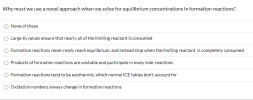 Why must we use a novel approach when we solve for equilibrium concentrations in formation reactions? None of these Large Kfvalues ensure that nearly all of the limiting reactant is consumed Formation reactions never really reach equilibrium, and instead stop when the limiting reactant is completely consumed Products of formation reactions are unstable and participate in many side-reactions Formation reactions tend to be exothermic, which normal ICE tables don't account for Oxidation numbers always change in formation reactions
4. (4 points) Given the conditions, finish the following reactions accordingly. Show the formation of a...
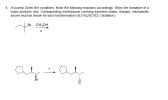 4. (4 points) Given the conditions, finish the following reactions accordingly. Show the formation of a major products only. Corresponding mechanisms involving transition states, charges, mechanistic arrows must be shown for each transformation (SN 1/SN2/E1/E2, Oxidation). Br CH2OH Нон aysay Br2 NaHCO3 CrO3 H2SO4, H20
Using appropriate mechanisms, explain formation of given products in the following reactions and discuss why reaction (...
 Using appropriate mechanisms, explain formation of given products in the following reactions and discuss why reaction (A) goes 670 times faster than reaction (B). ососни сн,со OCOCHE CHECO,H k = 670 OTS "OCOCH OCOCH, CH.COM CH3COH OCOCHE OTS k = 1 OCOCHE
 Please show all work!
Thanks!
Calculate the equilibrium constants of the following reactions at 25°C from standard potential data (a) Sn(s) Sn+(aq)2 Sn2+(aq) 1.54e-10 (b) Sn(s) + 2 AgCl(s)SnCl2(aq) + 2 Ag(s) 2.04e18
Please show all work!
Thanks!
Calculate the equilibrium constants of the following reactions at 25°C from standard potential data (a) Sn(s) Sn+(aq)2 Sn2+(aq) 1.54e-10 (b) Sn(s) + 2 AgCl(s)SnCl2(aq) + 2 Ag(s) 2.04e18
 5. (3pts) Complete the following imine formation reactions. Draw the line structure of the product and the formula of any side products produced a. Ethanal + Aniline b, 2-butanone + ammonia Page 3 of 4
5. (3pts) Complete the following imine formation reactions. Draw the line structure of the product and the formula of any side products produced a. Ethanal + Aniline b, 2-butanone + ammonia Page 3 of 4
5. (3pts) Complete the following imine formation reactions. Draw the line structure of the product and the formula of any side products produced a. Ethanal + Aniline b, 2-butanone + ammonia Page 3 of 4
 please help me to balance the following equations
im having trouble foguiring out the coefficients and
how to solve
Mg .Ca(NO)2 Mg Mg CUSO4 + Fe(NOs)3 Mg + SnCl Mg Zn(NO3)2 Mg + Sn Ca(NOs)2 Sn+ Sn + .CuSO4 Sn + Fe(NO)3 Sn+ MgSO Zn(NO3)2 _ Sn + Zn Ca(NO)2 Zn + CUSO4 Zn + Fe(NO3)3 Zn + MgsO Zn + SnCl Zn + TTTT T T1TT T
Mg .Ca(NO)2 Mg Mg CUSO4 + Fe(NOs)3 Mg + SnCl Mg Zn(NO3)2...
please help me to balance the following equations
im having trouble foguiring out the coefficients and
how to solve
Mg .Ca(NO)2 Mg Mg CUSO4 + Fe(NOs)3 Mg + SnCl Mg Zn(NO3)2 Mg + Sn Ca(NOs)2 Sn+ Sn + .CuSO4 Sn + Fe(NO)3 Sn+ MgSO Zn(NO3)2 _ Sn + Zn Ca(NO)2 Zn + CUSO4 Zn + Fe(NO3)3 Zn + MgsO Zn + SnCl Zn + TTTT T T1TT T
Mg .Ca(NO)2 Mg Mg CUSO4 + Fe(NOs)3 Mg + SnCl Mg Zn(NO3)2...
 Question 2: Write chemical reactions for the standard formation of the following compounds. Assume the reactions take place under standard conditions and include states for full credit (hint: refer to slide 33 from Chapter 5 handout) (6 pts). A. Formation of carbon dioxide B. Formation of ethanol (C2H5OH) C. Formation of iron (II) chloride
 Why must we use a novel approach when we solve for equilibrium concentrations in formation reactions? None of these Large Kfvalues ensure that nearly all of the limiting reactant is consumed Formation reactions never really reach equilibrium, and instead stop when the limiting reactant is completely consumed Products of formation reactions are unstable and participate in many side-reactions Formation reactions tend to be exothermic, which normal ICE tables don't account for Oxidation numbers always change in formation reactions
 4. (4 points) Given the conditions, finish the following reactions accordingly. Show the formation of a major products only. Corresponding mechanisms involving transition states, charges, mechanistic arrows must be shown for each transformation (SN 1/SN2/E1/E2, Oxidation). Br CH2OH Нон aysay Br2 NaHCO3 CrO3 H2SO4, H20
 Using appropriate mechanisms, explain formation of given products in the following reactions and discuss why reaction (A) goes 670 times faster than reaction (B). ососни сн,со OCOCHE CHECO,H k = 670 OTS "OCOCH OCOCH, CH.COM CH3COH OCOCHE OTS k = 1 OCOCHE
Most questions answered within 3 hours.
-
Where is the error in this code sequence?
String s1 = "Hello";
String s2 = "ello";...
asked 10 months ago -
Financial data for Joel de Paris, Inc., for last year
follow:
Joel de Paris, Inc.
Balance...
asked 10 months ago -
Consider this reaction:
Al2(SO4)3 (aq)+ BaCl3
(aq) Al2Cl6 (aq)- +
3BaSO4(s) . What is the...
asked 10 months ago -
Suppose that Savneet is considering increasing her
recent random sample from 20 car rentals to 40...
asked 10 months ago -
Trucks arrive at an unloading terminal at an average rate of 120
per hour.
Trucks arrive...
asked 10 months ago -
Why are methanol and ethanol completely soluble in water while
octanol is not very little soluble....
asked 10 months ago -
A facilities manager at a university reads in a research report
that the mean amount of...
asked 10 months ago -
When the CuSO4 is rehydrated by adding water to the anhydrous
compound, is this an endothermic...
asked 10 months ago -
A ray of sunlight is passing from diamond into crown glass; the
angle of incidence is...
asked 10 months ago -
A block of mass 0.249 kg is placed on top of a light, vertical
spring of...
asked 10 months ago -
how do the kidneys compensate in the presences of acidosis
a) trigger hyperventilate
b) reserve acid...
asked 10 months ago -
Question 501 pts
The rental rate of capital to the firm increases. Which of the
following...
asked 10 months ago