Describe Kepler’s three laws of planetary motion.
Describe Kepler’s three laws of planetary motion.
Homework Answers
Kepler enunciated the three law of planetary motion after a laborious analysis, extending over long 18 years, of a vast amount of data collected by Tycho Brahe over the years, of the position of the planets, without the use of even any telescope. His three laws of planetary motion are described below.
First law:
All planet move in elliptic orbit round the sun that occupies one of the focus of the ellipse.
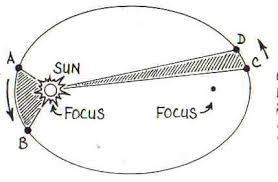
As we can see in the above image that a planet moving around the sun in a elliptic orbit. Now the elliptic orbit means that the path of the planet around the sun is an ellipse. Now we all know from mathematics that ellipse is a curved line forming a closed loop, where the sum of the distances from two points ( called focus of ellipse) to every point on the line is constant. So in the above image the distance from first focus (where the sun is located) to point A plus the distance from the second focus to the point A is always constant. The sun is situated at one of the focus point of the ellipse as in the above image the sun is situated in the left focus point.
Second law:
The radius vector  of the
planet from the sun sweeps out equal areas in the equal
times.
of the
planet from the sun sweeps out equal areas in the equal
times.
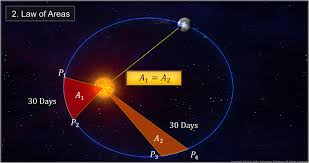
Here we can think radius vector as a
straight line connecting sun and the planet. So as the planet moves
around the sun, this radius vector that is the straight line,
sweeps out some area. Now the speed and the distance of the planet
from the sun changes as the planet moves around the sun. But the
area swept out by the radius vector ( the line connecting the
planet and sun) is equal in equal time interval. In the above image
when the planet moves from point  to point
 , the area swept
out by the radius vector is
, the area swept
out by the radius vector is  and when when
the planet moves from point
and when when
the planet moves from point  to point
 the area swept
out by the radius vector is
the area swept
out by the radius vector is  . Then according
to the second law planetary motion these two area would be same. So
according to second law of Kepler planetary motion
. Then according
to the second law planetary motion these two area would be same. So
according to second law of Kepler planetary motion
 .
.
Third law:
The square of the period of the revolution of the planet is directly proportional to the cube of the semi-major axis of the elliptic orbit.
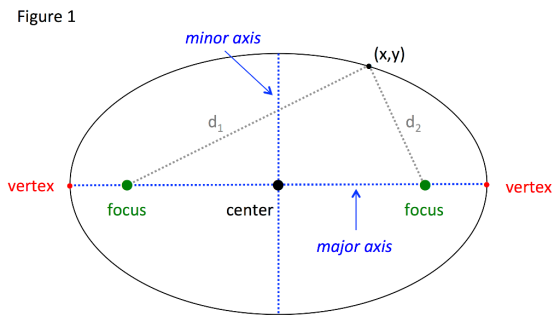
Here the major axis of ellipse is a
axis passes through two focuses of the ellipse as shown in the
above image. The length of semi-major axis is the distance from the
center of the ellipse to the one of vertex. The time of revolution
of a planet is the time taken by the planet to complete a full
revolution around the sun along the elliptic orbit. Let the time of
revolution is T and the length of semi-major axis
is a, then according to the third law of planetary
motion square T is directly proportional to the
cube of a. That is  .
.
HW: Kepler's Laws of Planetary Motion Instructions: Use Kepler's Laws of Planetary Motion to answer the...
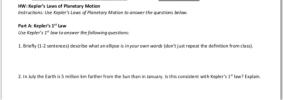 HW: Kepler's Laws of Planetary Motion Instructions: Use Kepler's Laws of Planetary Motion to answer the questions below Part A: Kepler's 1st Law Use Kepler's 1st law to answer the following questions 1. Briefly (1-2 sentences) describe what an ellipse is in your own words (don't just repeat the definition from class) 2. In July the Earth is 5 million km farther from the Sun than in January. Is this consistent with Kepler's 1t law? Explain
How can Kepler’s law of planetary motion be applied to the case of geo-stationary satellite? What are the orbital parameters required to determine a satellite orbit? Name and explain them. Determine...
How can Kepler’s law of planetary motion be applied to the case of geo-stationary satellite? What are the orbital parameters required to determine a satellite orbit? Name and explain them. Determine the maximum and minimum range in kilometer from an earth station to a geo-synchronous satellite. To what round trip propagation times do these correspond? Mention the effect of eclipse on the orbital motion of a satellite. Mention the effect of gravitational force due to sun and moon on the...
Kepler’s third law
Kepler’s third law. According to Kepler’s third law of planetary motion, the ratio t^2/r^3 has the same value for every planet in our solar system. R is the average radius of the orbit of the planet measured in astronomical units (AU), and T is the number of years it takes for one complete orbit of the sun. Jupiter orbits the sun in 11.86 years with an average radius of 5.2 AU, whereas Saturn orbits the sun in 29.46 years If...
How do Kepler’s Laws help calculate the radius of the synchronous orbit of an Earth-orbiting satellite?...
How do Kepler’s Laws help calculate the radius of the synchronous orbit of an Earth-orbiting satellite? Discuss why you think Kepler’s laws are relevant to other scientists who came after him.
How do Kepler’s Laws help calculate the radius of the synchronous orbit of an Earth-orbiting satellite?...
How do Kepler’s Laws help calculate the radius of the synchronous orbit of an Earth-orbiting satellite? Discuss why you think Kepler’s laws are relevant to other scientists who came after him
Which of the following are Kepler's Laws of Planetary Motion? (Choose all that apply.) The planets...
 Which of the following are Kepler's Laws of Planetary Motion? (Choose all that apply.) The planets sweep out equal areas in equal times The torque on a planet about the sun's position is zero O The planets travel in conic sections 12oxas The planets travel in ellipses around the sun with the sun at one focus От3 ока2 An object completely submerged in an incompressible fluid is at rest. Which of the following are true? (Select all that apply.) The...
1.) a. List Kepler’s Laws, and explain how each one differed from the Greek idea of...
1.) a. List Kepler’s Laws, and explain how each one differed from the Greek idea of the heavens. b. List Newton’s Laws, and give an example of them.
Sort the items below into the bins corresponding to the correct Kepler\'s law of planetary motion....
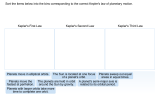 Sort the items below into the bins corresponding to the correct
Kepler\'s law of planetary motion.
Sort the items below into the bins corresponding to the correct Kepler's law of planetary motion.
Sort the items below into the bins corresponding to the correct
Kepler\'s law of planetary motion.
Sort the items below into the bins corresponding to the correct Kepler's law of planetary motion.
Think about Newton’s three laws, the law of inertia, the law of motion, and the law...
Think about Newton’s three laws, the law of inertia, the law of motion, and the law of action-reaction. How do you see each of these laws in action in your daily life?
Kepler’s 1st Law If you have not already done so, launch the NAAP Planetary Orbit Simulator....
Kepler’s 1st Law If you have not already done so, launch the NAAP Planetary Orbit Simulator. • Open the Kepler’s 1st Law tab if it is not already (it’s open by default). • Enable all 5 check boxes. • The white dot is the “simulated planet.” One can click on it and drag it around. • Change the size of the orbit with the semi-major axis slider. Note how the background grid indicates change in scale while the displayed orbit...
 HW: Kepler's Laws of Planetary Motion Instructions: Use Kepler's Laws of Planetary Motion to answer the questions below Part A: Kepler's 1st Law Use Kepler's 1st law to answer the following questions 1. Briefly (1-2 sentences) describe what an ellipse is in your own words (don't just repeat the definition from class) 2. In July the Earth is 5 million km farther from the Sun than in January. Is this consistent with Kepler's 1t law? Explain
 Which of the following are Kepler's Laws of Planetary Motion? (Choose all that apply.) The planets sweep out equal areas in equal times The torque on a planet about the sun's position is zero O The planets travel in conic sections 12oxas The planets travel in ellipses around the sun with the sun at one focus От3 ока2 An object completely submerged in an incompressible fluid is at rest. Which of the following are true? (Select all that apply.) The...
 Sort the items below into the bins corresponding to the correct
Kepler\'s law of planetary motion.
Sort the items below into the bins corresponding to the correct Kepler's law of planetary motion.
Sort the items below into the bins corresponding to the correct
Kepler\'s law of planetary motion.
Sort the items below into the bins corresponding to the correct Kepler's law of planetary motion.
Most questions answered within 3 hours.
-
Where is the error in this code sequence?
String s1 = "Hello";
String s2 = "ello";...
asked 11 months ago -
Financial data for Joel de Paris, Inc., for last year
follow:
Joel de Paris, Inc.
Balance...
asked 11 months ago -
Consider this reaction:
Al2(SO4)3 (aq)+ BaCl3
(aq) Al2Cl6 (aq)- +
3BaSO4(s) . What is the...
asked 11 months ago -
Suppose that Savneet is considering increasing her
recent random sample from 20 car rentals to 40...
asked 11 months ago -
Trucks arrive at an unloading terminal at an average rate of 120
per hour.
Trucks arrive...
asked 11 months ago -
Why are methanol and ethanol completely soluble in water while
octanol is not very little soluble....
asked 11 months ago -
A facilities manager at a university reads in a research report
that the mean amount of...
asked 11 months ago -
When the CuSO4 is rehydrated by adding water to the anhydrous
compound, is this an endothermic...
asked 11 months ago -
A ray of sunlight is passing from diamond into crown glass; the
angle of incidence is...
asked 11 months ago -
A block of mass 0.249 kg is placed on top of a light, vertical
spring of...
asked 11 months ago -
how do the kidneys compensate in the presences of acidosis
a) trigger hyperventilate
b) reserve acid...
asked 11 months ago -
Question 501 pts
The rental rate of capital to the firm increases. Which of the
following...
asked 11 months ago