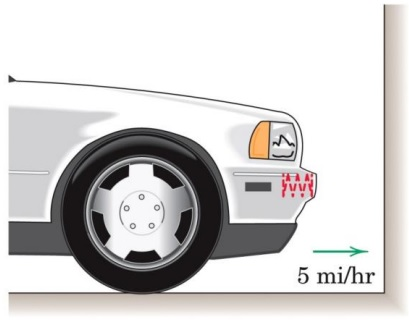
In the design of a spring bumper for a 3500-lb car, it is desired to bring the car to a stop from a speed of 5 mi/hr in a distance equal to 6 in. of spring deformation. Specify the required stiffness k for each of the two springs behind the bumper. The springs are undeformed at the start of impact.
Homework Answers


Add Answer to:
In the design of a spring bumper for a 3500-lb car, it is
desired to bring...
In the design of a spring bumper for a 2780-Ib car, it is desired to bring...
 In the design of a spring bumper for a 2780-Ib car, it is desired to bring the car to a stop from a speed of 10.0 mi/hr in a distance equal to 11 in. of spring deformation. Specify the required stiffness k for each of the two springs behind the bumper. The springs are undeformed at the start of impact. 10.0 mi/hr Answer:k= lb/in.
The spring bumper is used to arrest the motion of the 8 lb block, which is...
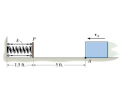 The spring bumper is used to
arrest the motion of the 8 lb block, which is sliding toward it at
5 ft/s . As shown, the spring is confined by the plate P and wall
using cables so that its length is 1.5 ft.
(Figure 1)
Part A
If the stiffness of the spring is k = 50 lb/ft, determine the
required unstretched length of the spring so that the plate is not
displaced more than 0.2 ft after the...
The spring bumper is used to
arrest the motion of the 8 lb block, which is sliding toward it at
5 ft/s . As shown, the spring is confined by the plate P and wall
using cables so that its length is 1.5 ft.
(Figure 1)
Part A
If the stiffness of the spring is k = 50 lb/ft, determine the
required unstretched length of the spring so that the plate is not
displaced more than 0.2 ft after the...
The spring bumper is used to arrest the motion of the 9 lb block, which is sliding toward it at 5...
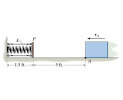 The spring bumper is used to arrest the motion of the 9 lb
block, which is sliding toward it at 5 ft/s . As shown, the spring
is confined by the plate P and wall using cables so that its length
is 1.5 ft.
If the stiffness of the spring is k = 50 lb/ft, determine the
required unstretched length of the spring so that the plate is not
displaced more than 0.2 ft after the block collides into it....
The spring bumper is used to arrest the motion of the 9 lb
block, which is sliding toward it at 5 ft/s . As shown, the spring
is confined by the plate P and wall using cables so that its length
is 1.5 ft.
If the stiffness of the spring is k = 50 lb/ft, determine the
required unstretched length of the spring so that the plate is not
displaced more than 0.2 ft after the block collides into it....
F(N) *14-12. Design considerations for the bumper B on the 5-Mg train car require use of...
 F(N) *14-12. Design considerations for the bumper B on the 5-Mg train car require use of a nonlinear spring having the load- deflection characteristics shown in the graph. Select the proper value of k so that the maximum deflection of the spring is limited to 0.2 m when the car, traveling at 4 m/s, strikes the rigid stop. Neglect the mass of the car wheels.
Review The spring bumper is used to arrest the motion of the 6 lb block, which...
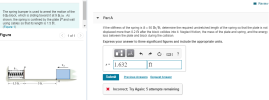 Review The spring bumper is used to arrest the motion of the 6 lb block, which is sliding toward it at 9 ft/s. As shown, the spring is confined by the plate P and wall using cables so that its length is 1.5 ft. (Figure 1) Part A Figure 1 of 1 > If the stiffness of the spring is k = 50 lb/ft, determine the required unstretched length of the spring so that the plate is not displaced more...
An 18000 kg freight car rests against a spring bumper at the end of a railroad...
An 18000 kg freight car rests against a spring bumper at the end of a railroad track. The spring has constant k=3.2×10^5 N/m. The car is hit by a second car of 9400 kg mass moving at 8.0 m/s , and the two couple together. Find the maximum compression of the spring. Find the speed of the two cars when they rebound together from the spring.
A car moving initially at a speed of 52.0 mi/h and weighing 3,000 lb is brought...
A car moving initially at a speed of 52.0 mi/h and weighing 3,000 lb is brought to a stop in a distance of 205 ft. Find (a) the breaking force (b) the time required to stop. Assuming the same braking force find (a) the distance and (d) the time required to stop if the car were going 26.0mi/h initially. (Hint: Convert to SI units)
2. Suppose a car travels 108 km at a speed of 20.0 m/s, and uses 2.20...
 2. Suppose a car travels 108 km at a speed of 20.0 m/s, and uses
2.20 gallons of gasoline. Only 30% of the gasoline goes into useful
work by the force that keeps the car moving at constant speed
despite friction. (The energy content of gasoline is 1.3 ✕
108 J per gallon.)
(a) What is the force exerted to keep the car moving at constant
speed?
N
(b) If the required force is directly proportional to speed, how
many...
2. Suppose a car travels 108 km at a speed of 20.0 m/s, and uses
2.20 gallons of gasoline. Only 30% of the gasoline goes into useful
work by the force that keeps the car moving at constant speed
despite friction. (The energy content of gasoline is 1.3 ✕
108 J per gallon.)
(a) What is the force exerted to keep the car moving at constant
speed?
N
(b) If the required force is directly proportional to speed, how
many...
Part A You have been hired to design a spring-launched roller coaster that will carry two...
 Part A You have been hired to design a spring-launched roller coaster that will carry two passengers per car. The car goes up a 12-m-high hill, then descends 17 m to the track's lowest point. You've determined that the spring can be compressed a maximum of 2.1 m and that a loaded car will have a maximum mass of 440 kg. For safety reasons, the spring constant should be 12 % larger than the minimum needed for the car to...
Problems care for the car og man Molg is Propeted from rest by a spring with...
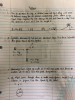 Problems care for the car og man Molg is Propeted from rest by a spring with 2005 oy potential energy The Cá Collidesinelastically with a slond av og equal mass Together the cars rou up the hill and come to a stop Find the speed at A and at B. find the height h. A m 2 sit to Inelastic collisions of two lars as the final speed of the system sketched below. Find tano: Calculate in op: 1 o...
 In the design of a spring bumper for a 2780-Ib car, it is desired to bring the car to a stop from a speed of 10.0 mi/hr in a distance equal to 11 in. of spring deformation. Specify the required stiffness k for each of the two springs behind the bumper. The springs are undeformed at the start of impact. 10.0 mi/hr Answer:k= lb/in.
 The spring bumper is used to
arrest the motion of the 8 lb block, which is sliding toward it at
5 ft/s . As shown, the spring is confined by the plate P and wall
using cables so that its length is 1.5 ft.
(Figure 1)
Part A
If the stiffness of the spring is k = 50 lb/ft, determine the
required unstretched length of the spring so that the plate is not
displaced more than 0.2 ft after the...
The spring bumper is used to
arrest the motion of the 8 lb block, which is sliding toward it at
5 ft/s . As shown, the spring is confined by the plate P and wall
using cables so that its length is 1.5 ft.
(Figure 1)
Part A
If the stiffness of the spring is k = 50 lb/ft, determine the
required unstretched length of the spring so that the plate is not
displaced more than 0.2 ft after the...
 The spring bumper is used to arrest the motion of the 9 lb
block, which is sliding toward it at 5 ft/s . As shown, the spring
is confined by the plate P and wall using cables so that its length
is 1.5 ft.
If the stiffness of the spring is k = 50 lb/ft, determine the
required unstretched length of the spring so that the plate is not
displaced more than 0.2 ft after the block collides into it....
The spring bumper is used to arrest the motion of the 9 lb
block, which is sliding toward it at 5 ft/s . As shown, the spring
is confined by the plate P and wall using cables so that its length
is 1.5 ft.
If the stiffness of the spring is k = 50 lb/ft, determine the
required unstretched length of the spring so that the plate is not
displaced more than 0.2 ft after the block collides into it....
 F(N) *14-12. Design considerations for the bumper B on the 5-Mg train car require use of a nonlinear spring having the load- deflection characteristics shown in the graph. Select the proper value of k so that the maximum deflection of the spring is limited to 0.2 m when the car, traveling at 4 m/s, strikes the rigid stop. Neglect the mass of the car wheels.
 Review The spring bumper is used to arrest the motion of the 6 lb block, which is sliding toward it at 9 ft/s. As shown, the spring is confined by the plate P and wall using cables so that its length is 1.5 ft. (Figure 1) Part A Figure 1 of 1 > If the stiffness of the spring is k = 50 lb/ft, determine the required unstretched length of the spring so that the plate is not displaced more...
 2. Suppose a car travels 108 km at a speed of 20.0 m/s, and uses
2.20 gallons of gasoline. Only 30% of the gasoline goes into useful
work by the force that keeps the car moving at constant speed
despite friction. (The energy content of gasoline is 1.3 ✕
108 J per gallon.)
(a) What is the force exerted to keep the car moving at constant
speed?
N
(b) If the required force is directly proportional to speed, how
many...
2. Suppose a car travels 108 km at a speed of 20.0 m/s, and uses
2.20 gallons of gasoline. Only 30% of the gasoline goes into useful
work by the force that keeps the car moving at constant speed
despite friction. (The energy content of gasoline is 1.3 ✕
108 J per gallon.)
(a) What is the force exerted to keep the car moving at constant
speed?
N
(b) If the required force is directly proportional to speed, how
many...
 Part A You have been hired to design a spring-launched roller coaster that will carry two passengers per car. The car goes up a 12-m-high hill, then descends 17 m to the track's lowest point. You've determined that the spring can be compressed a maximum of 2.1 m and that a loaded car will have a maximum mass of 440 kg. For safety reasons, the spring constant should be 12 % larger than the minimum needed for the car to...
 Problems care for the car og man Molg is Propeted from rest by a spring with 2005 oy potential energy The Cá Collidesinelastically with a slond av og equal mass Together the cars rou up the hill and come to a stop Find the speed at A and at B. find the height h. A m 2 sit to Inelastic collisions of two lars as the final speed of the system sketched below. Find tano: Calculate in op: 1 o...
Most questions answered within 3 hours.
-
Where is the error in this code sequence?
String s1 = "Hello";
String s2 = "ello";...
asked 11 months ago -
Financial data for Joel de Paris, Inc., for last year
follow:
Joel de Paris, Inc.
Balance...
asked 11 months ago -
Consider this reaction:
Al2(SO4)3 (aq)+ BaCl3
(aq) Al2Cl6 (aq)- +
3BaSO4(s) . What is the...
asked 11 months ago -
Suppose that Savneet is considering increasing her
recent random sample from 20 car rentals to 40...
asked 11 months ago -
Trucks arrive at an unloading terminal at an average rate of 120
per hour.
Trucks arrive...
asked 11 months ago -
Why are methanol and ethanol completely soluble in water while
octanol is not very little soluble....
asked 11 months ago -
A facilities manager at a university reads in a research report
that the mean amount of...
asked 11 months ago -
When the CuSO4 is rehydrated by adding water to the anhydrous
compound, is this an endothermic...
asked 11 months ago -
A ray of sunlight is passing from diamond into crown glass; the
angle of incidence is...
asked 11 months ago -
A block of mass 0.249 kg is placed on top of a light, vertical
spring of...
asked 11 months ago -
how do the kidneys compensate in the presences of acidosis
a) trigger hyperventilate
b) reserve acid...
asked 11 months ago -
Question 501 pts
The rental rate of capital to the firm increases. Which of the
following...
asked 11 months ago