
Homework Answers
Add Answer to:
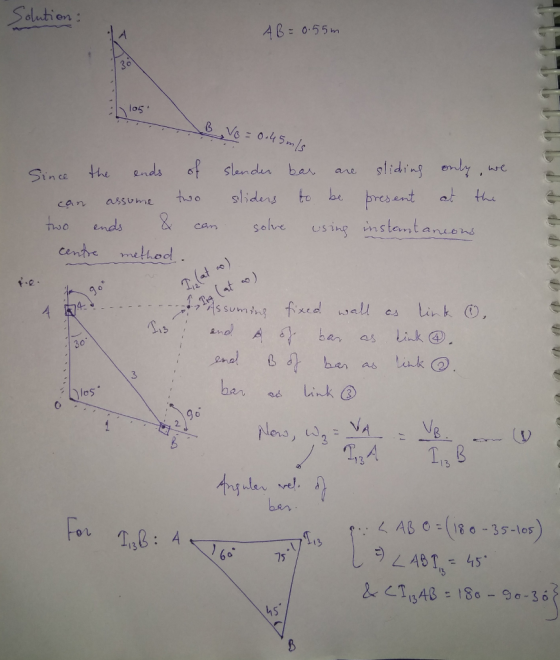
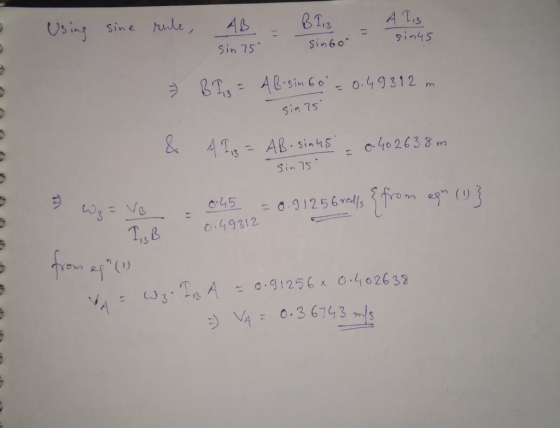
(5 points) The ends of the 0.55 m slender bar AB remain in contact with their...
The ends of the 0.56-m bar remain in contact with their respective support surfaces. End B has a ...
 The ends of the 0.56-m bar remain in contact with their
respective support surfaces. End B has a velocity of 0.37
m/s and an acceleration of 0.49 m/s2 in the directions
shown. Determine the angular acceleration α (positive if
counterclockwise, negative if clockwise) of the bar and the
acceleration of end A (positive if up, negative if
down).
Chapter 5, Problem 5/102 The ends of the 0.56-m bar remain in contact with their respective support surfaces. End B has a...
The ends of the 0.56-m bar remain in contact with their
respective support surfaces. End B has a velocity of 0.37
m/s and an acceleration of 0.49 m/s2 in the directions
shown. Determine the angular acceleration α (positive if
counterclockwise, negative if clockwise) of the bar and the
acceleration of end A (positive if up, negative if
down).
Chapter 5, Problem 5/102 The ends of the 0.56-m bar remain in contact with their respective support surfaces. End B has a...
The ends of the 0.35-m bar remain in contact with their respective support surfaces. End B...
 The ends of the 0.35-m bar remain in contact with their
respective support surfaces. End B has a velocity of 0.45 m/s and
an acceleration of 0.51 m/s2 in the directions shown. Determine the
angular acceleration α (positive if counterclockwise, negative if
clockwise) of the bar and the acceleration of end A (positive if
up, negative if down).
28 0.35 m 106 B -Ug = 0.51 m/s2 Ug = 0.45 ms Answers: a = 0.74 Orad/s² X ад 0.2490 Um/s²
The ends of the 0.35-m bar remain in contact with their
respective support surfaces. End B has a velocity of 0.45 m/s and
an acceleration of 0.51 m/s2 in the directions shown. Determine the
angular acceleration α (positive if counterclockwise, negative if
clockwise) of the bar and the acceleration of end A (positive if
up, negative if down).
28 0.35 m 106 B -Ug = 0.51 m/s2 Ug = 0.45 ms Answers: a = 0.74 Orad/s² X ад 0.2490 Um/s²
Your answer is partially correct. Try again. The ends of the 0.30-m bar remain in contact...
 Your answer is partially correct. Try again. The ends of the 0.30-m bar remain in contact with their respective support surfaces. End B has a velocity of 0.40 m/s and an acceleration of 0.46 m/s in the directions shown. Determine the angular acceleration (positive if counterdockwise, negative if dockwise) of the bar and the acceleration of end A (positive if up, negative if down). 0.30 m 1101 -0.46 m 30-0.40
PROBLEM 17.113 The slender rod AB of length L = 1 m forms an angle B...
 PROBLEM 17.113 The slender rod AB of length L = 1 m forms an angle B = 30° with the vertical as it strikes the frictionless surface shown with a vertical velocity 7 = 2 m/s and no angular velocity. Knowing that the coefficient of restitution between the rod and the ground is e = 0.8, determine the angular velocity of the rod immediately after the impact.
Find the forces acting on the bar when in this position. lce anwel last aid use BOTH angles A slender bar, AB, has a 5.10 kg mass, and a 2.40 m length. Point A on the bar is in er end with a smoot...
 Find the forces acting on the bar when in this
position.
lce anwel last aid use BOTH angles A slender bar, AB, has a 5.10 kg mass, and a 2.40 m length. Point A on the bar is in er end with a smooth, incline tilted at an angle of 77.0° with res of the bar at B is in contact with a smooth, horizontal floor. When With respect to the floor, the magnitude of the angular velocity about the...
Find the forces acting on the bar when in this
position.
lce anwel last aid use BOTH angles A slender bar, AB, has a 5.10 kg mass, and a 2.40 m length. Point A on the bar is in er end with a smooth, incline tilted at an angle of 77.0° with res of the bar at B is in contact with a smooth, horizontal floor. When With respect to the floor, the magnitude of the angular velocity about the...
Sketch a 2 kg slender uniform homogeneous bar AB that is leaning against a vertical wall....
 Sketch a 2 kg slender uniform homogeneous bar AB that is leaning against a vertical wall. The end A is a point on the floor 5 ft away from the wall on the left or right (your choice), and end B is 12 ft above the floor (the datum). At the instant, the bar has an angular velocity of 3 rad/s CW. Determine the magnitudes and directions of the velocities of the ends A and B. What are the kinetic...
1. The slender bar AB weighs 60 lb and moves in the vertical plane, with its...
 1. The slender bar AB weighs 60 lb and moves in the vertical plane, with its ends constrained to follow the smooth horizontal and vertical guides. If the 30 - Ib force is applied at A with the bar initially at rest in the position for which =30°, calculate the resulting angular acceleration of the bar and the forces on the small end rollers A and B. // 2 BO
A uniform slender bar AB of mass m has two light pegs A and B which...
 A uniform slender bar AB of mass m has two light pegs A and B
which are constrained to move in the frictionless circular slot
with center O in the vertical plane. At the position depicted, the
bar is released from rest. Find the bar's initial angular
acceleration when the bar is released in terms of appropriate given
quantities. The pegs each contact only one side of the slot at a
given time.
A uniform slender bar AB of mass m has two light pegs A and B
which are constrained to move in the frictionless circular slot
with center O in the vertical plane. At the position depicted, the
bar is released from rest. Find the bar's initial angular
acceleration when the bar is released in terms of appropriate given
quantities. The pegs each contact only one side of the slot at a
given time.
3 A homogeneous slender bar AB with length and mass M rotates around point A. At...
 3 A homogeneous slender bar AB with length and mass M rotates around point A. At the position shown, bar AB has an angular velocity w = 0 and angular acceleration. The inertial force system could be A α F* w=0 M* B F* = MLa/2 M = M10/3 W a 0=0 "С M* B F = ML./2 M = M2/12 c. F* a o=0 C M* B 1* = ML0/2 M = ML°/12 F* α 0=0 с M* B
please do not just copy solution manual.. B PROBLEM 17.113 The slender rod AB of length...
 please do not just copy solution manual..
B PROBLEM 17.113 The slender rod AB of length L = 1 m forms an angle B = 30° with the vertical as it strikes the frictionless surface shown with a vertical velocity 7 = 2 m/s and no angular velocity. Knowing that the coefficient of restitution between the rod and the ground is e = 0.8, determine the angular velocity of the rod immediately after the impact
please do not just copy solution manual..
B PROBLEM 17.113 The slender rod AB of length L = 1 m forms an angle B = 30° with the vertical as it strikes the frictionless surface shown with a vertical velocity 7 = 2 m/s and no angular velocity. Knowing that the coefficient of restitution between the rod and the ground is e = 0.8, determine the angular velocity of the rod immediately after the impact
 The ends of the 0.56-m bar remain in contact with their
respective support surfaces. End B has a velocity of 0.37
m/s and an acceleration of 0.49 m/s2 in the directions
shown. Determine the angular acceleration α (positive if
counterclockwise, negative if clockwise) of the bar and the
acceleration of end A (positive if up, negative if
down).
Chapter 5, Problem 5/102 The ends of the 0.56-m bar remain in contact with their respective support surfaces. End B has a...
The ends of the 0.56-m bar remain in contact with their
respective support surfaces. End B has a velocity of 0.37
m/s and an acceleration of 0.49 m/s2 in the directions
shown. Determine the angular acceleration α (positive if
counterclockwise, negative if clockwise) of the bar and the
acceleration of end A (positive if up, negative if
down).
Chapter 5, Problem 5/102 The ends of the 0.56-m bar remain in contact with their respective support surfaces. End B has a...
 The ends of the 0.35-m bar remain in contact with their
respective support surfaces. End B has a velocity of 0.45 m/s and
an acceleration of 0.51 m/s2 in the directions shown. Determine the
angular acceleration α (positive if counterclockwise, negative if
clockwise) of the bar and the acceleration of end A (positive if
up, negative if down).
28 0.35 m 106 B -Ug = 0.51 m/s2 Ug = 0.45 ms Answers: a = 0.74 Orad/s² X ад 0.2490 Um/s²
The ends of the 0.35-m bar remain in contact with their
respective support surfaces. End B has a velocity of 0.45 m/s and
an acceleration of 0.51 m/s2 in the directions shown. Determine the
angular acceleration α (positive if counterclockwise, negative if
clockwise) of the bar and the acceleration of end A (positive if
up, negative if down).
28 0.35 m 106 B -Ug = 0.51 m/s2 Ug = 0.45 ms Answers: a = 0.74 Orad/s² X ад 0.2490 Um/s²
 Your answer is partially correct. Try again. The ends of the 0.30-m bar remain in contact with their respective support surfaces. End B has a velocity of 0.40 m/s and an acceleration of 0.46 m/s in the directions shown. Determine the angular acceleration (positive if counterdockwise, negative if dockwise) of the bar and the acceleration of end A (positive if up, negative if down). 0.30 m 1101 -0.46 m 30-0.40
 PROBLEM 17.113 The slender rod AB of length L = 1 m forms an angle B = 30° with the vertical as it strikes the frictionless surface shown with a vertical velocity 7 = 2 m/s and no angular velocity. Knowing that the coefficient of restitution between the rod and the ground is e = 0.8, determine the angular velocity of the rod immediately after the impact.
 Find the forces acting on the bar when in this
position.
lce anwel last aid use BOTH angles A slender bar, AB, has a 5.10 kg mass, and a 2.40 m length. Point A on the bar is in er end with a smooth, incline tilted at an angle of 77.0° with res of the bar at B is in contact with a smooth, horizontal floor. When With respect to the floor, the magnitude of the angular velocity about the...
Find the forces acting on the bar when in this
position.
lce anwel last aid use BOTH angles A slender bar, AB, has a 5.10 kg mass, and a 2.40 m length. Point A on the bar is in er end with a smooth, incline tilted at an angle of 77.0° with res of the bar at B is in contact with a smooth, horizontal floor. When With respect to the floor, the magnitude of the angular velocity about the...
 Sketch a 2 kg slender uniform homogeneous bar AB that is leaning against a vertical wall. The end A is a point on the floor 5 ft away from the wall on the left or right (your choice), and end B is 12 ft above the floor (the datum). At the instant, the bar has an angular velocity of 3 rad/s CW. Determine the magnitudes and directions of the velocities of the ends A and B. What are the kinetic...
 1. The slender bar AB weighs 60 lb and moves in the vertical plane, with its ends constrained to follow the smooth horizontal and vertical guides. If the 30 - Ib force is applied at A with the bar initially at rest in the position for which =30°, calculate the resulting angular acceleration of the bar and the forces on the small end rollers A and B. // 2 BO
 A uniform slender bar AB of mass m has two light pegs A and B
which are constrained to move in the frictionless circular slot
with center O in the vertical plane. At the position depicted, the
bar is released from rest. Find the bar's initial angular
acceleration when the bar is released in terms of appropriate given
quantities. The pegs each contact only one side of the slot at a
given time.
A uniform slender bar AB of mass m has two light pegs A and B
which are constrained to move in the frictionless circular slot
with center O in the vertical plane. At the position depicted, the
bar is released from rest. Find the bar's initial angular
acceleration when the bar is released in terms of appropriate given
quantities. The pegs each contact only one side of the slot at a
given time.
 3 A homogeneous slender bar AB with length and mass M rotates around point A. At the position shown, bar AB has an angular velocity w = 0 and angular acceleration. The inertial force system could be A α F* w=0 M* B F* = MLa/2 M = M10/3 W a 0=0 "С M* B F = ML./2 M = M2/12 c. F* a o=0 C M* B 1* = ML0/2 M = ML°/12 F* α 0=0 с M* B
 please do not just copy solution manual..
B PROBLEM 17.113 The slender rod AB of length L = 1 m forms an angle B = 30° with the vertical as it strikes the frictionless surface shown with a vertical velocity 7 = 2 m/s and no angular velocity. Knowing that the coefficient of restitution between the rod and the ground is e = 0.8, determine the angular velocity of the rod immediately after the impact
please do not just copy solution manual..
B PROBLEM 17.113 The slender rod AB of length L = 1 m forms an angle B = 30° with the vertical as it strikes the frictionless surface shown with a vertical velocity 7 = 2 m/s and no angular velocity. Knowing that the coefficient of restitution between the rod and the ground is e = 0.8, determine the angular velocity of the rod immediately after the impact
Most questions answered within 3 hours.
-
Where is the error in this code sequence?
String s1 = "Hello";
String s2 = "ello";...
asked 11 months ago -
Financial data for Joel de Paris, Inc., for last year
follow:
Joel de Paris, Inc.
Balance...
asked 11 months ago -
Consider this reaction:
Al2(SO4)3 (aq)+ BaCl3
(aq) Al2Cl6 (aq)- +
3BaSO4(s) . What is the...
asked 11 months ago -
Suppose that Savneet is considering increasing her
recent random sample from 20 car rentals to 40...
asked 11 months ago -
Trucks arrive at an unloading terminal at an average rate of 120
per hour.
Trucks arrive...
asked 11 months ago -
Why are methanol and ethanol completely soluble in water while
octanol is not very little soluble....
asked 11 months ago -
A facilities manager at a university reads in a research report
that the mean amount of...
asked 11 months ago -
When the CuSO4 is rehydrated by adding water to the anhydrous
compound, is this an endothermic...
asked 11 months ago -
A ray of sunlight is passing from diamond into crown glass; the
angle of incidence is...
asked 11 months ago -
A block of mass 0.249 kg is placed on top of a light, vertical
spring of...
asked 11 months ago -
how do the kidneys compensate in the presences of acidosis
a) trigger hyperventilate
b) reserve acid...
asked 11 months ago -
Question 501 pts
The rental rate of capital to the firm increases. Which of the
following...
asked 11 months ago