
Homework Answers
Ans. Let the dominant allele for height = T
The recessive allele for height = t
Genotype of heterozygous tall plant = T t
Gametes produced by it = T, t
Genotype of homozygous small plant = t t
Gametes produced by it = t
Now, Tt x tt
[T, t] x [t] = Tt, tt
Total number of progeny = 2 , (Tt and tt)
Phenotypic ration = Tall : short = 1: 2
So, if the total number of progeny were 50, the theoretical outcomes would have been 25 tall and 25 short (1:1 ratio).
So,
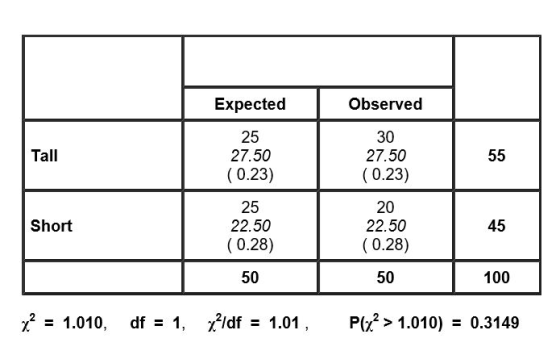
Ans. a. Theoretical (expected) phenotypic frequency = 25 : 25
Ans. b. See figure
Ans. c. degree of freedom = 1
Add Answer to:
GENETICS:
Assume that a cross is made between a heterozygous tall pea plant and a homozygous...
Bio 302 Genetics Practice Problems 2 ESSAY. Write your answer in the space provided or on...
 Bio 302 Genetics Practice Problems 2 ESSAY. Write your answer in the space provided or on a separate sheet of paper 1) Assume that a cross is made between a heterozygous tall pea plant and a homozygous short pea plant. Fifty offspring are produced in the following frequency: 30 = tall 20 = short (a) What frequency of tall and short plants is expected? (b) To test the goodness of fit between the observed and expected values, provide the needed...
In pea plants, tall (T) is dominant and short (t) id recessive. A heterozygous tall plant...
 In
pea plants, tall (T) is dominant and short (t) id recessive.
A heterozygous tall plant is crossed with a short plant.
What is the expected phenotypic ratio?
In pea plants, tall (T) is dominant and short (t) is recessive. A heterozygous tall plant is crossed with a short plant. What is the expected phenotypic ratio? all offspring will be tall 3:1 1:2:1 9:3:3:1 1:1 all offspring will be short
In
pea plants, tall (T) is dominant and short (t) id recessive.
A heterozygous tall plant is crossed with a short plant.
What is the expected phenotypic ratio?
In pea plants, tall (T) is dominant and short (t) is recessive. A heterozygous tall plant is crossed with a short plant. What is the expected phenotypic ratio? all offspring will be tall 3:1 1:2:1 9:3:3:1 1:1 all offspring will be short
In a cross between a heterozygous tall pea plant and a dwarf pea plant predict the...
In a cross between a heterozygous tall pea plant and a dwarf pea plant predict the ratios of the offspring's genotypes and phenotypes?
A heterozygous pea plant that is tall with purple flower, TtPp, is allowed to self-fertilize. Tall...
A heterozygous pea plant that is tall with purple flower, TtPp, is allowed to self-fertilize. Tall (T) is dominant over dwarf (t), Purple (P) is dominant over white (p). In the offspring, the probability of plants that are short with purple flowers will be?
Mendelian Genetics Lab Practice Mendelian Genetics Lab Practice Practice with Crosses. Show all work below: 9....
 Mendelian Genetics Lab Practice Mendelian Genetics Lab Practice Practice with Crosses. Show all work below: 9. In pea plants purple flowers are dominant to white flowers. Two white flowered plants are crossed... 5. ATT (tall) plant is crossed with a short plant). What percentage of their offspring wil have white flowers? What percentage of the offspring will be tall? 10. A white flowered plant is crossed with a plant that is heterozygous for the trait. 6. Show the cross of...
GGg Gg GİGg G GgGg 10. A cross between a green pea plant (GG) and a...
 GGg Gg GİGg G GgGg 10. A cross between a green pea plant (GG) and a yellow pea plant (gg) is shown in the Punnett Square above. Which of these BEST describes the genotype of the offspring from this cross? O A homozygous recessive 0 B. heterozygous recessive O c. homozygous dominant O D. heterozygous dominant
G=yellow and g=green pea seeds. You cross a heterozygous yellow-seeded plant with a green-seeded plant to...
G=yellow and g=green pea seeds. You cross a heterozygous yellow-seeded plant with a green-seeded plant to produce the F1. In the F1, you find 70 yellow-seeded and 35 green-seeded offspring. Conduct a Chi-squared test. The critical value in the chi squared table is 3.84. What is the calculated Chi-square value? Are your results consistent with autosomal dominance? Explain.
Perform a chi-square test to determine if an observed ratio of 40 tall:10 dwarf pea plants...
Perform a chi-square test to determine if an observed ratio of 40 tall:10 dwarf pea plants is consistent with an expected ratio of 1:1 from the cross of Dd x dd. What is your degrees of freedom What is your critical value Is this observed ratio consistent with an expected ratio of 1:1? (yes or no)
8. Pea plant breeders wanted to pick healthy tall plants that were homozygous for the height...
 8. Pea plant breeders wanted to pick healthy tall plants that were homozygous for the height gene. They had a collection of 10 plants that were healthy and tall, but the genotypes were unknown. How might they determine if the 10 tall plants were heterozygous or homozygous for the height gene? a. What genotypes are possible for tall pea plants? b. What cross would be most useful in distinguishing between homozygous and heterozygous tall plants? c. Explain the concept of...
Chi square: You cross a red heterozygous flower with a white homozygous flower and get the...
Chi square: You cross a red heterozygous flower with a white homozygous flower and get the following progeny: 55 red and 45 white. You hypothesis that the plants are following Mendelian Genetics inheritance rules. You preform a chi-square analysis to test your hypothesis. Do you.. a. not accept your hypothesis b. accept your hypothesis c. reject your hypothesis d. fail to reject your hypothesis
 Bio 302 Genetics Practice Problems 2 ESSAY. Write your answer in the space provided or on a separate sheet of paper 1) Assume that a cross is made between a heterozygous tall pea plant and a homozygous short pea plant. Fifty offspring are produced in the following frequency: 30 = tall 20 = short (a) What frequency of tall and short plants is expected? (b) To test the goodness of fit between the observed and expected values, provide the needed...
 In
pea plants, tall (T) is dominant and short (t) id recessive.
A heterozygous tall plant is crossed with a short plant.
What is the expected phenotypic ratio?
In pea plants, tall (T) is dominant and short (t) is recessive. A heterozygous tall plant is crossed with a short plant. What is the expected phenotypic ratio? all offspring will be tall 3:1 1:2:1 9:3:3:1 1:1 all offspring will be short
In
pea plants, tall (T) is dominant and short (t) id recessive.
A heterozygous tall plant is crossed with a short plant.
What is the expected phenotypic ratio?
In pea plants, tall (T) is dominant and short (t) is recessive. A heterozygous tall plant is crossed with a short plant. What is the expected phenotypic ratio? all offspring will be tall 3:1 1:2:1 9:3:3:1 1:1 all offspring will be short
 Mendelian Genetics Lab Practice Mendelian Genetics Lab Practice Practice with Crosses. Show all work below: 9. In pea plants purple flowers are dominant to white flowers. Two white flowered plants are crossed... 5. ATT (tall) plant is crossed with a short plant). What percentage of their offspring wil have white flowers? What percentage of the offspring will be tall? 10. A white flowered plant is crossed with a plant that is heterozygous for the trait. 6. Show the cross of...
 GGg Gg GİGg G GgGg 10. A cross between a green pea plant (GG) and a yellow pea plant (gg) is shown in the Punnett Square above. Which of these BEST describes the genotype of the offspring from this cross? O A homozygous recessive 0 B. heterozygous recessive O c. homozygous dominant O D. heterozygous dominant
 8. Pea plant breeders wanted to pick healthy tall plants that were homozygous for the height gene. They had a collection of 10 plants that were healthy and tall, but the genotypes were unknown. How might they determine if the 10 tall plants were heterozygous or homozygous for the height gene? a. What genotypes are possible for tall pea plants? b. What cross would be most useful in distinguishing between homozygous and heterozygous tall plants? c. Explain the concept of...
Most questions answered within 3 hours.
-
Where is the error in this code sequence?
String s1 = "Hello";
String s2 = "ello";...
asked 10 months ago -
Financial data for Joel de Paris, Inc., for last year
follow:
Joel de Paris, Inc.
Balance...
asked 10 months ago -
Consider this reaction:
Al2(SO4)3 (aq)+ BaCl3
(aq) Al2Cl6 (aq)- +
3BaSO4(s) . What is the...
asked 10 months ago -
Suppose that Savneet is considering increasing her
recent random sample from 20 car rentals to 40...
asked 10 months ago -
Trucks arrive at an unloading terminal at an average rate of 120
per hour.
Trucks arrive...
asked 10 months ago -
Why are methanol and ethanol completely soluble in water while
octanol is not very little soluble....
asked 10 months ago -
A facilities manager at a university reads in a research report
that the mean amount of...
asked 10 months ago -
When the CuSO4 is rehydrated by adding water to the anhydrous
compound, is this an endothermic...
asked 10 months ago -
A ray of sunlight is passing from diamond into crown glass; the
angle of incidence is...
asked 10 months ago -
A block of mass 0.249 kg is placed on top of a light, vertical
spring of...
asked 10 months ago -
how do the kidneys compensate in the presences of acidosis
a) trigger hyperventilate
b) reserve acid...
asked 10 months ago -
Question 501 pts
The rental rate of capital to the firm increases. Which of the
following...
asked 10 months ago