
Homework Answers
Add Answer to:
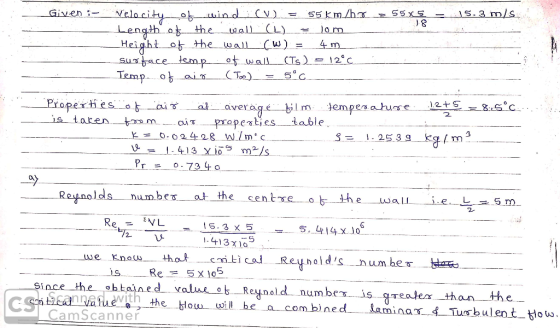
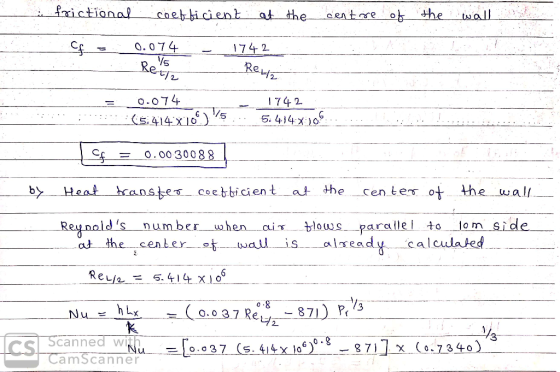
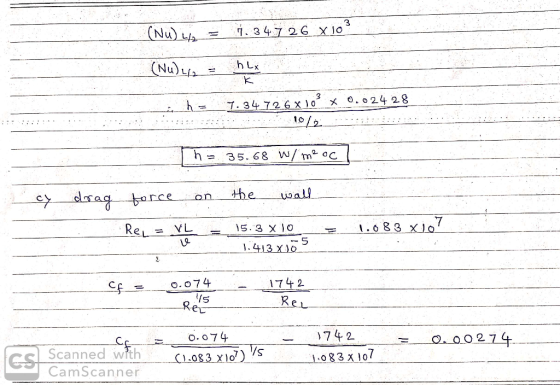
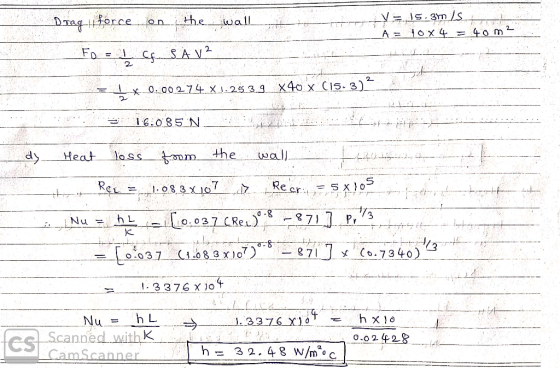
Heat Transfer 1 Problem 1 During a cold winter day, wind at 55 km/h is blowing...
Assume constant acceleration, During a winter day, wind at 58 km/h, 5°C, and 1 atm is blowing parallel to a 3.5-m-high a...
Assume constant acceleration, During a winter day, wind at 58 km/h, 5°C, and 1 atm is blowing parallel to a 3.5-m-high and 9-m-long wall of a house. Approximating the wall surfaces as smooth, determine the friction drag acting on the wall. What would your answer be if the wind velocity has doubled? How realistic is it to treat the flow over side wall surfaces as flow over a flat plate?
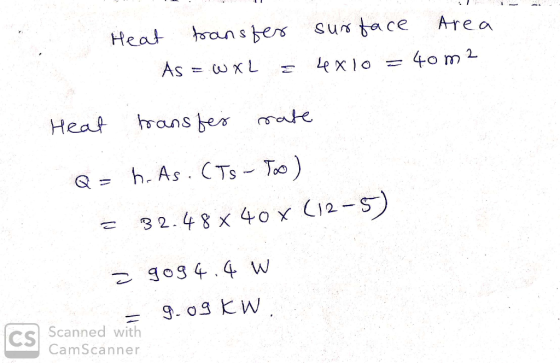
Wind is blowing at 5 km/h over a building wall of size 5 mx10 m. Air temperature is 0°C and wall 1) surface is at 1...
 Wind is blowing at 5 km/h over a building wall of size 5 mx10 m. Air temperature is 0°C and wall 1) surface is at 10°C. 1) Calculate the avg. heat transfer coefficient along the 10 m width of the wall. 2) Calculate the local heat transfer coefficient at a location 10 cm from the leading edge of the wall. (25pts)
Wind is blowing at 5 km/h over a building wall of size 5 mx10 m. Air temperature is 0°C...
Wind is blowing at 5 km/h over a building wall of size 5 mx10 m. Air temperature is 0°C and wall 1) surface is at 10°C. 1) Calculate the avg. heat transfer coefficient along the 10 m width of the wall. 2) Calculate the local heat transfer coefficient at a location 10 cm from the leading edge of the wall. (25pts)
Wind is blowing at 5 km/h over a building wall of size 5 mx10 m. Air temperature is 0°C...
Question 1: Identify the classification of the following heat transfer (convective flow) problems: *Note that there...
 Question 1: Identify the classification of the following heat transfer (convective flow) problems: *Note that there may be other modes of heat transfer present (e.g. radiation or conduction), but ignore those effects. For example, a hot ball bearing being dropped from a building roof. Ans. Forced, external convection over a sphere. a. Water flow through a fire hose from a hydrant. b. Heat transfer from a clothes iron sitting on an ironing board. c. Heat transfer from a climber trapped...
A 0.1 m thick brick wall with thermal conductivity 0.66 Wm K-1 is exposed to cold wind on the out...
 A 0.1 m thick brick wall with thermal conductivity 0.66 Wm K-1 is exposed to cold wind on the outside of a house, at 270 K with convective heat transfer coefficient of 22.43 Wm2K1. On the inside of the house is calm air at 295.8 K, with a natural convective heat transfer coefficient of 10.49 Calculate the rate of heat transfer per unit area, in Wm, giving your answer to 3 decimal places
A 0.1 m thick brick wall with...
A 0.1 m thick brick wall with thermal conductivity 0.66 Wm K-1 is exposed to cold wind on the outside of a house, at 270 K with convective heat transfer coefficient of 22.43 Wm2K1. On the inside of the house is calm air at 295.8 K, with a natural convective heat transfer coefficient of 10.49 Calculate the rate of heat transfer per unit area, in Wm, giving your answer to 3 decimal places
A 0.1 m thick brick wall with...
Could someone help me by answering all of this questions from Q7) A to D and...
 Could someone help me by answering all of this questions
from Q7) A to D and Q8) A to C. Thank You
Q.C7 An 80 kg cyclist is riding her 15 kg bicycle down a hill with a slope of 12 degrees without pedalling or braking. The cyclist has a frontal area of 0.45 m and a drag coefficient of 1.1 in the upright position. Taking air density to be 1.25 kg/m2, and neglecting bearing friction and rolling resistance (a)...
Could someone help me by answering all of this questions
from Q7) A to D and Q8) A to C. Thank You
Q.C7 An 80 kg cyclist is riding her 15 kg bicycle down a hill with a slope of 12 degrees without pedalling or braking. The cyclist has a frontal area of 0.45 m and a drag coefficient of 1.1 in the upright position. Taking air density to be 1.25 kg/m2, and neglecting bearing friction and rolling resistance (a)...
On a cold winter day where the outside temperature is -10o C, a heat pump provides...
On a cold winter day where the outside temperature is -10o C, a heat pump provides 20 kW to heat a house to 20o C. The heat pump has a COPHP of 4 at the maximum power. The next day a storm brings the outside temperature down to −15o C. If the ratio of COPHP and the reversible COPrev for day 1 and day 2 is the same, COPHP for both days is the same, and that the house loses...
In this problem you will estimate the heat lost by a typical house, assuming that the temperature inside is T(in) = 20 degrees celcius and the temperature outside is T(out) = 0 degrees celcius
In this problem you will estimate the heat lost by a typical house, assuming that the temperature inside is T(in) = 20 degrees celcius and the temperature outside is T(out) = 0 degrees celcius. The walls have fiberglass insulation, which dominates the heat conduction properties of the wall So we can consider the wall to have a thermal conductivity of k(wall) = 0.048 W/m/K . We will take the thickness of the walls and ceiling to be L(wall) = 12...
Solve the following problem using theories from heat transfer. On a cold winter day, the inside...
 Solve the following problem
using theories from heat transfer.
On a cold winter day, the inside of a window of a heated building is colder than the inside surrounding air. Natural convection results from this temperature difference. (a) Imagine this window as a vertical surface where T; < Ta, sketch the resulting boundary layer that forms. Also sketch the velocity profile of the air through the boundary layer. (b) What are the key differences between the velocities in this boundary...
Solve the following problem
using theories from heat transfer.
On a cold winter day, the inside of a window of a heated building is colder than the inside surrounding air. Natural convection results from this temperature difference. (a) Imagine this window as a vertical surface where T; < Ta, sketch the resulting boundary layer that forms. Also sketch the velocity profile of the air through the boundary layer. (b) What are the key differences between the velocities in this boundary...
Heat Transfer Problems 1. A window pane (1/8 inch thick) in an old house owned by...
 Heat Transfer
Problems 1. A window pane (1/8 inch thick) in an old house owned by a professor is 3 ft. by 4 ft. He likes to be warm in the winter so the inside temperature is kept at 70 °F even when the outside temperature is 10 •F. For this problem assume the inside and outside temperatures are for the window surface. How much heat is transferred through the window (k=.54 BTU/hr ft ° F)? 2. A small heated...
Heat Transfer
Problems 1. A window pane (1/8 inch thick) in an old house owned by a professor is 3 ft. by 4 ft. He likes to be warm in the winter so the inside temperature is kept at 70 °F even when the outside temperature is 10 •F. For this problem assume the inside and outside temperatures are for the window surface. How much heat is transferred through the window (k=.54 BTU/hr ft ° F)? 2. A small heated...
During a big storm a 60 km/h wind blows across the surface of a 2.00 m...
 During a big storm a 60 km/h wind blows across the surface of a 2.00 m times 1.00 m window. What is the force on the window associated with this wind? The density of the air is 1.20 kg/m^3. A) 333 N pointed toward the inside the house. B) 333 N pointed toward the outside of the house. C) 3000 N pointed toward the inside of the house. D) 3000 N pointed toward the outside of the house F) 0...
 Wind is blowing at 5 km/h over a building wall of size 5 mx10 m. Air temperature is 0°C and wall 1) surface is at 10°C. 1) Calculate the avg. heat transfer coefficient along the 10 m width of the wall. 2) Calculate the local heat transfer coefficient at a location 10 cm from the leading edge of the wall. (25pts)
Wind is blowing at 5 km/h over a building wall of size 5 mx10 m. Air temperature is 0°C...
Wind is blowing at 5 km/h over a building wall of size 5 mx10 m. Air temperature is 0°C and wall 1) surface is at 10°C. 1) Calculate the avg. heat transfer coefficient along the 10 m width of the wall. 2) Calculate the local heat transfer coefficient at a location 10 cm from the leading edge of the wall. (25pts)
Wind is blowing at 5 km/h over a building wall of size 5 mx10 m. Air temperature is 0°C...
 Question 1: Identify the classification of the following heat transfer (convective flow) problems: *Note that there may be other modes of heat transfer present (e.g. radiation or conduction), but ignore those effects. For example, a hot ball bearing being dropped from a building roof. Ans. Forced, external convection over a sphere. a. Water flow through a fire hose from a hydrant. b. Heat transfer from a clothes iron sitting on an ironing board. c. Heat transfer from a climber trapped...
 A 0.1 m thick brick wall with thermal conductivity 0.66 Wm K-1 is exposed to cold wind on the outside of a house, at 270 K with convective heat transfer coefficient of 22.43 Wm2K1. On the inside of the house is calm air at 295.8 K, with a natural convective heat transfer coefficient of 10.49 Calculate the rate of heat transfer per unit area, in Wm, giving your answer to 3 decimal places
A 0.1 m thick brick wall with...
A 0.1 m thick brick wall with thermal conductivity 0.66 Wm K-1 is exposed to cold wind on the outside of a house, at 270 K with convective heat transfer coefficient of 22.43 Wm2K1. On the inside of the house is calm air at 295.8 K, with a natural convective heat transfer coefficient of 10.49 Calculate the rate of heat transfer per unit area, in Wm, giving your answer to 3 decimal places
A 0.1 m thick brick wall with...
 Could someone help me by answering all of this questions
from Q7) A to D and Q8) A to C. Thank You
Q.C7 An 80 kg cyclist is riding her 15 kg bicycle down a hill with a slope of 12 degrees without pedalling or braking. The cyclist has a frontal area of 0.45 m and a drag coefficient of 1.1 in the upright position. Taking air density to be 1.25 kg/m2, and neglecting bearing friction and rolling resistance (a)...
Could someone help me by answering all of this questions
from Q7) A to D and Q8) A to C. Thank You
Q.C7 An 80 kg cyclist is riding her 15 kg bicycle down a hill with a slope of 12 degrees without pedalling or braking. The cyclist has a frontal area of 0.45 m and a drag coefficient of 1.1 in the upright position. Taking air density to be 1.25 kg/m2, and neglecting bearing friction and rolling resistance (a)...
 Solve the following problem
using theories from heat transfer.
On a cold winter day, the inside of a window of a heated building is colder than the inside surrounding air. Natural convection results from this temperature difference. (a) Imagine this window as a vertical surface where T; < Ta, sketch the resulting boundary layer that forms. Also sketch the velocity profile of the air through the boundary layer. (b) What are the key differences between the velocities in this boundary...
Solve the following problem
using theories from heat transfer.
On a cold winter day, the inside of a window of a heated building is colder than the inside surrounding air. Natural convection results from this temperature difference. (a) Imagine this window as a vertical surface where T; < Ta, sketch the resulting boundary layer that forms. Also sketch the velocity profile of the air through the boundary layer. (b) What are the key differences between the velocities in this boundary...
 Heat Transfer
Problems 1. A window pane (1/8 inch thick) in an old house owned by a professor is 3 ft. by 4 ft. He likes to be warm in the winter so the inside temperature is kept at 70 °F even when the outside temperature is 10 •F. For this problem assume the inside and outside temperatures are for the window surface. How much heat is transferred through the window (k=.54 BTU/hr ft ° F)? 2. A small heated...
Heat Transfer
Problems 1. A window pane (1/8 inch thick) in an old house owned by a professor is 3 ft. by 4 ft. He likes to be warm in the winter so the inside temperature is kept at 70 °F even when the outside temperature is 10 •F. For this problem assume the inside and outside temperatures are for the window surface. How much heat is transferred through the window (k=.54 BTU/hr ft ° F)? 2. A small heated...
 During a big storm a 60 km/h wind blows across the surface of a 2.00 m times 1.00 m window. What is the force on the window associated with this wind? The density of the air is 1.20 kg/m^3. A) 333 N pointed toward the inside the house. B) 333 N pointed toward the outside of the house. C) 3000 N pointed toward the inside of the house. D) 3000 N pointed toward the outside of the house F) 0...
Most questions answered within 3 hours.
-
Where is the error in this code sequence?
String s1 = "Hello";
String s2 = "ello";...
asked 10 months ago -
Financial data for Joel de Paris, Inc., for last year
follow:
Joel de Paris, Inc.
Balance...
asked 10 months ago -
Consider this reaction:
Al2(SO4)3 (aq)+ BaCl3
(aq) Al2Cl6 (aq)- +
3BaSO4(s) . What is the...
asked 10 months ago -
Suppose that Savneet is considering increasing her
recent random sample from 20 car rentals to 40...
asked 10 months ago -
Trucks arrive at an unloading terminal at an average rate of 120
per hour.
Trucks arrive...
asked 10 months ago -
Why are methanol and ethanol completely soluble in water while
octanol is not very little soluble....
asked 10 months ago -
A facilities manager at a university reads in a research report
that the mean amount of...
asked 10 months ago -
When the CuSO4 is rehydrated by adding water to the anhydrous
compound, is this an endothermic...
asked 10 months ago -
A ray of sunlight is passing from diamond into crown glass; the
angle of incidence is...
asked 10 months ago -
A block of mass 0.249 kg is placed on top of a light, vertical
spring of...
asked 10 months ago -
how do the kidneys compensate in the presences of acidosis
a) trigger hyperventilate
b) reserve acid...
asked 10 months ago -
Question 501 pts
The rental rate of capital to the firm increases. Which of the
following...
asked 10 months ago