Lipids are transported in the blood as complexes with proteins. These water-soluble complexes are called lipoproteins. Complete the sentences below by selecting the lipoprotein that transports each lipid.

Homework Answers
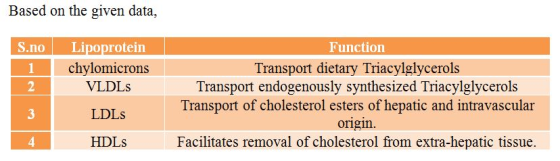
all are correctly placed,
chylomicrons they are lipoproteins that transport triglycerides, phospholipids,and cholestrol.
VLDLs transport triglycerides from liver to tissues mainly adipose tissue
HDLs tranport cholesterol from cells to liver for excretion.
LDLs carry cholesterol from liver to tissue for membrane synthesis
Add Answer to:
Lipids are transported in the blood as complexes with proteins. These water-soluble complexes are called lipoproteins....
Lipoproteins in Lipid Transport Lipids either enter the body through diet, are released from storage in...
 Lipoproteins in Lipid Transport Lipids either enter the body through diet, are released from storage in adipose tissue, or are manufactured in the liver. All lipids are transported in the blood. Because blood is aqueous and lipids are nonpolar, lipids must form associations with other molecules to form lipoproteins that can be transported in blood. Chylomicrons, very-low-density lipoproteins (VLDLs), intermediate-density lipoproteins (IDLs), low-density lipoproteins (LDLs), and high-density lipoproteins (HDLs) are five types of lipoproteins. Chylomicrons exclusively carry lipids from the...
perilipins, nor lipoproteins is not the correct answer. What proteins bind to lipids for the purpose...
 perilipins, nor lipoproteins is not the correct answer.
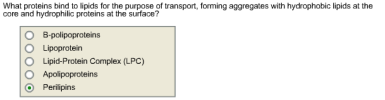
What proteins bind to lipids for the purpose of transport, forming aggregates with hydrophobic lipids at the core and hydrophilic proteins at the surface? Lipoprotein Lipid-Protein Complex(LPC)
perilipins, nor lipoproteins is not the correct answer.
What proteins bind to lipids for the purpose of transport, forming aggregates with hydrophobic lipids at the core and hydrophilic proteins at the surface? Lipoprotein Lipid-Protein Complex(LPC)
Which of the following statements about the lipoproteins given in the introduction are true? Check all...
Which of the following statements about the lipoproteins given in the introduction are true? Check all that apply. A- Lipoproteins are complexes of lipids and proteins. B- Lipoproteins can be distinguished by their densities and composition. C- Lipoprotein densities increase in the following order: chylomicrons, VLDLs, LDLs, HDLs, IDLs. D- Chylomicrons are the only lipoproteins that exclusively carry dietary lipids. E- HDL has a high lipid-to-protein ratio. HDL is termed "bad" cholesterol because it can deposit excess cholesterol in the...
Lipoproteins are globular structures that are responsible for transporting lipids through the blood stream. Two types...
 Lipoproteins are globular structures that are responsible for transporting lipids through the blood stream. Two types of lipoproteins are LDL and HDL. Sort each statement as applying to LDL, HDL, or both.
Identify whether steroid hormones are water soluble or lipophilic. How are they transported in the blood?...
Identify whether steroid hormones are water soluble or lipophilic. How are they transported in the blood? Where on the cell are the receptors for these hormones located?
29) Insulin is a water-soluble hormone transported in the blood. Which describes a likely way in...
29) Insulin is a water-soluble hormone transported in the blood. Which describes a likely way in which it exerts its actions? A) crosses the membrane of cells and binds to transcription factors B) crosses the membranes of cells and bind to DNA C) binds to G-protein coupled receptor proteins in the plasma membrane and generates second messengers. D) binds to G-protein coupled receptors which bind to DNA E) binds to the plasma membrane and is endocytosed into the cell to...
Lipoproteins are like suitcases that move cholesterol, fatty acid remnants, triglycerides, and phospholipids from one place...
Lipoproteins are like suitcases that move cholesterol, fatty acid remnants, triglycerides, and phospholipids from one place to another. Given what you know about the insolubility of lipids in water and the unique structures of each of these molecules, which of the 4 kinds of aforementioned lipids would you predict to be on the outside of a lipoprotein clump, bathed in the water-based fluid portion of blood and why?
please answer number 5 piu lmeiuPANE. The main two types of lipoproteins are: lo density lipoproteins,...
 please answer number 5
piu lmeiuPANE. The main two types of lipoproteins are: lo density lipoproteins, and High density lipoprotein. The low density lipoproteins a not considered to be healthy for our body but HDL is considered to be good cholesterol as it keeps our heart healthy. Explain Types of fatty acids their structural difference, as well as their effects health and dietary sources. The types of fatty acids are Saturated: each carbon aton bonded with two hydrogen atoms, Monounsaturated:...
please answer number 5
piu lmeiuPANE. The main two types of lipoproteins are: lo density lipoproteins, and High density lipoprotein. The low density lipoproteins a not considered to be healthy for our body but HDL is considered to be good cholesterol as it keeps our heart healthy. Explain Types of fatty acids their structural difference, as well as their effects health and dietary sources. The types of fatty acids are Saturated: each carbon aton bonded with two hydrogen atoms, Monounsaturated:...
Compare and contrast water soluble and lipid soluble hormones in terms of transport in the blood,...
Compare and contrast water soluble and lipid soluble hormones in terms of transport in the blood, location of target cell receptors and mechanism of action in target cells. (Answer in Paragragh format only)
Question 1 20 pts 1. a type of oil that is rich in monounsaturated fatty acids...
 Question 1 20 pts 1. a type of oil that is rich in monounsaturated fatty acids olive 2. a type of nut that is rich in omega-3 fatty acids (ALA) walnuts 3. a lipid that contains glycerol, two fatty acids, and a phosphate group phospholipid 4. a dietary lipid found only in animal foods cholesterol 5. organ in the body that produces all the cholesterol a body needs liver 6. type of lipid with a multi-ring structure sterol 7. a...
 Lipoproteins in Lipid Transport Lipids either enter the body through diet, are released from storage in adipose tissue, or are manufactured in the liver. All lipids are transported in the blood. Because blood is aqueous and lipids are nonpolar, lipids must form associations with other molecules to form lipoproteins that can be transported in blood. Chylomicrons, very-low-density lipoproteins (VLDLs), intermediate-density lipoproteins (IDLs), low-density lipoproteins (LDLs), and high-density lipoproteins (HDLs) are five types of lipoproteins. Chylomicrons exclusively carry lipids from the...
 perilipins, nor lipoproteins is not the correct answer.
What proteins bind to lipids for the purpose of transport, forming aggregates with hydrophobic lipids at the core and hydrophilic proteins at the surface? Lipoprotein Lipid-Protein Complex(LPC)
perilipins, nor lipoproteins is not the correct answer.
What proteins bind to lipids for the purpose of transport, forming aggregates with hydrophobic lipids at the core and hydrophilic proteins at the surface? Lipoprotein Lipid-Protein Complex(LPC)
 Lipoproteins are globular structures that are responsible for transporting lipids through the blood stream. Two types of lipoproteins are LDL and HDL. Sort each statement as applying to LDL, HDL, or both.
 please answer number 5
piu lmeiuPANE. The main two types of lipoproteins are: lo density lipoproteins, and High density lipoprotein. The low density lipoproteins a not considered to be healthy for our body but HDL is considered to be good cholesterol as it keeps our heart healthy. Explain Types of fatty acids their structural difference, as well as their effects health and dietary sources. The types of fatty acids are Saturated: each carbon aton bonded with two hydrogen atoms, Monounsaturated:...
please answer number 5
piu lmeiuPANE. The main two types of lipoproteins are: lo density lipoproteins, and High density lipoprotein. The low density lipoproteins a not considered to be healthy for our body but HDL is considered to be good cholesterol as it keeps our heart healthy. Explain Types of fatty acids their structural difference, as well as their effects health and dietary sources. The types of fatty acids are Saturated: each carbon aton bonded with two hydrogen atoms, Monounsaturated:...
 Question 1 20 pts 1. a type of oil that is rich in monounsaturated fatty acids olive 2. a type of nut that is rich in omega-3 fatty acids (ALA) walnuts 3. a lipid that contains glycerol, two fatty acids, and a phosphate group phospholipid 4. a dietary lipid found only in animal foods cholesterol 5. organ in the body that produces all the cholesterol a body needs liver 6. type of lipid with a multi-ring structure sterol 7. a...
Most questions answered within 3 hours.
-
Where is the error in this code sequence?
String s1 = "Hello";
String s2 = "ello";...
asked 10 months ago -
Financial data for Joel de Paris, Inc., for last year
follow:
Joel de Paris, Inc.
Balance...
asked 10 months ago -
Consider this reaction:
Al2(SO4)3 (aq)+ BaCl3
(aq) Al2Cl6 (aq)- +
3BaSO4(s) . What is the...
asked 10 months ago -
Suppose that Savneet is considering increasing her
recent random sample from 20 car rentals to 40...
asked 10 months ago -
Trucks arrive at an unloading terminal at an average rate of 120
per hour.
Trucks arrive...
asked 10 months ago -
Why are methanol and ethanol completely soluble in water while
octanol is not very little soluble....
asked 10 months ago -
A facilities manager at a university reads in a research report
that the mean amount of...
asked 10 months ago -
When the CuSO4 is rehydrated by adding water to the anhydrous
compound, is this an endothermic...
asked 10 months ago -
A ray of sunlight is passing from diamond into crown glass; the
angle of incidence is...
asked 10 months ago -
A block of mass 0.249 kg is placed on top of a light, vertical
spring of...
asked 10 months ago -
how do the kidneys compensate in the presences of acidosis
a) trigger hyperventilate
b) reserve acid...
asked 10 months ago -
Question 501 pts
The rental rate of capital to the firm increases. Which of the
following...
asked 10 months ago