
Evaluate \(\iiint_{\mathcal{B}} f(x, y, z) d V\) for the specified function \(f\) and \(\mathcal{B}\) :
$$ f(x, y, z)=\frac{z}{x} \quad 2 \leq x \leq 16,0 \leq y \leq 5,0 \leq z \leq 2 $$
\(\iiint_{\mathcal{B}} f(x, y, z) d V=\)
Homework Answers

Evaluate f(x, y, z) dV for the function f and region W specified. f(x, y, z)...
 Evaluate f(x, y, z) dV for the function f and region W specified. f(x, y, z) = ex + y + 2; W: 0 SX S 4,0 S Y S x, 0 sz s 2 eBook
The joint probability density function of X and Y is given by f(x, y) = e-(x+y)...
The joint probability density function of \(X\) and \(Y\) is given by$$ f(x, y)=e^{-(x+y)} \quad 0 \leq x \leq \infty, 0 \leq y<\infty $$Find \(P(X<Y)\)
Evaluate the surface integral lis(r,y,z) (x, y, z) ds where f(x, y, z) = x +...
 Evaluate the surface integral lis(r,y,z) (x, y, z) ds where f(x, y, z) = x + y + z and o is the is the surface of the cube defined by the inequalities 0 < x < 5,0 Sy < 5 and 0 <3 < 5. [Hint: integrate over each face separately.] 1 f(x, y, z) ds =
1-Given the function:
1-Given the function: \(y=\frac{x^{2}-3 x-4}{x^{2}-5 x+4}\), decide if \(f(x)=y\) is continuous or has a removable discontinuity, and find horizontal tond vertical asymptotes.2 A-Use the definition \(\lim _{h \rightarrow 0} \frac{f(x+h)-f(x)}{h}\) to prove that derivative of \(f(x)=\sqrt{4-x}\) is \(\frac{-1}{2 \sqrt{4-x}}\)2 B- Evaluate the limit \(\lim _{h \rightarrow 0} \frac{f(x+h) - f(x)}{h}\) for the given value of \(x\) and function \(f(x) .\)$$ f(x)=\sin x, \quad x=\frac{\pi}{4} $$3-Given the function: \(y=(x+4)^{3}(x-2)^{2}\), find y' and classify critical numbers very carefully using first derivative tess...
(1 point) Evaluate the function at the specified points. f(x, y) = y + xy?,(-2,-1), (2,5),(-4,-4)|...
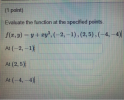 (1 point) Evaluate the function at the specified points. f(x, y) = y + xy?,(-2,-1), (2,5),(-4,-4)| At (-2, -1) At (2,5) At (-4,-4)
Evaluate the integral for the following data. F = [x - z, y - x,z-y], 5....
 Evaluate the integral for the following data. F = [x - z, y - x,z-y], 5. r= [ucos(v), usin(v), u), osus6, 0SVSH F.ndA=
a's Evaluate for the function f(x, y, z) = ln(5xạy - ha) özdy
 a's Evaluate for the function f(x, y, z) = ln(5xạy - ha) özdy
using discrete structures 3. Consider the function F(x, y, z) for x, y, z z 0 defined as follows: a. F(x, y, 0)-y+1 b. F(x, 0, 1)-x c, F(x, 0, 2) = 0 d. F(x, 0, z+ 3)-1 e. F(x, y, z)-F(x, F(x, y-1, z...
 using discrete structures
3. Consider the function F(x, y, z) for x, y, z z 0 defined as follows: a. F(x, y, 0)-y+1 b. F(x, 0, 1)-x c, F(x, 0, 2) = 0 d. F(x, 0, z+ 3)-1 e. F(x, y, z)-F(x, F(x, y-1, z), z-1) Using Induction, prove the following a. F(x, y, 1)-x +y b, F(x, y, 2) = xy c. F(x, y, 3)-xy
3. Consider the function F(x, y, z) for x, y, z z 0 defined...
using discrete structures
3. Consider the function F(x, y, z) for x, y, z z 0 defined as follows: a. F(x, y, 0)-y+1 b. F(x, 0, 1)-x c, F(x, 0, 2) = 0 d. F(x, 0, z+ 3)-1 e. F(x, y, z)-F(x, F(x, y-1, z), z-1) Using Induction, prove the following a. F(x, y, 1)-x +y b, F(x, y, 2) = xy c. F(x, y, 3)-xy
3. Consider the function F(x, y, z) for x, y, z z 0 defined...
which of the following is a potential function for F(x,y,z)= < y2 +y?ex?,x2 + 2ye*?,xy +...
 which of the following is a potential function for F(x,y,z)= < y2 +y?ex?,x2 + 2ye*?,xy + xy?e *V> f(x,y,z) = xyz + y2exyz f(x,y,z) = xyz + y2e*+2 b. F(x,y,z) has a potential function but it is not one of the other choices. F(x,y,z) does not have a potential function. d. f(x,y,z) = xyz + y2exZ e.
I would like to know if the SOP function f(v,w,x,y,z)=(x+z)(w+y)(!w+x+!y)(!y+z+!v) and The Quartus II obtained function...
I would like to know if the SOP function f(v,w,x,y,z)=(x+z)(w+y)(!w+x+!y)(!y+z+!v) and The Quartus II obtained function F(v,w,x,y,z)=(v((!x(z(!w xor (!y))))+(x((!y(w))+(y((z)))))))+(!v((!x(z(!w xor (!y))))+(x(((y))+(w))))) for the above SOP are equivalent?
 Evaluate f(x, y, z) dV for the function f and region W specified. f(x, y, z) = ex + y + 2; W: 0 SX S 4,0 S Y S x, 0 sz s 2 eBook
 Evaluate the surface integral lis(r,y,z) (x, y, z) ds where f(x, y, z) = x + y + z and o is the is the surface of the cube defined by the inequalities 0 < x < 5,0 Sy < 5 and 0 <3 < 5. [Hint: integrate over each face separately.] 1 f(x, y, z) ds =
 (1 point) Evaluate the function at the specified points. f(x, y) = y + xy?,(-2,-1), (2,5),(-4,-4)| At (-2, -1) At (2,5) At (-4,-4)
 Evaluate the integral for the following data. F = [x - z, y - x,z-y], 5. r= [ucos(v), usin(v), u), osus6, 0SVSH F.ndA=
 a's Evaluate for the function f(x, y, z) = ln(5xạy - ha) özdy
 using discrete structures
3. Consider the function F(x, y, z) for x, y, z z 0 defined as follows: a. F(x, y, 0)-y+1 b. F(x, 0, 1)-x c, F(x, 0, 2) = 0 d. F(x, 0, z+ 3)-1 e. F(x, y, z)-F(x, F(x, y-1, z), z-1) Using Induction, prove the following a. F(x, y, 1)-x +y b, F(x, y, 2) = xy c. F(x, y, 3)-xy
3. Consider the function F(x, y, z) for x, y, z z 0 defined...
using discrete structures
3. Consider the function F(x, y, z) for x, y, z z 0 defined as follows: a. F(x, y, 0)-y+1 b. F(x, 0, 1)-x c, F(x, 0, 2) = 0 d. F(x, 0, z+ 3)-1 e. F(x, y, z)-F(x, F(x, y-1, z), z-1) Using Induction, prove the following a. F(x, y, 1)-x +y b, F(x, y, 2) = xy c. F(x, y, 3)-xy
3. Consider the function F(x, y, z) for x, y, z z 0 defined...
 which of the following is a potential function for F(x,y,z)= < y2 +y?ex?,x2 + 2ye*?,xy + xy?e *V> f(x,y,z) = xyz + y2exyz f(x,y,z) = xyz + y2e*+2 b. F(x,y,z) has a potential function but it is not one of the other choices. F(x,y,z) does not have a potential function. d. f(x,y,z) = xyz + y2exZ e.
Most questions answered within 3 hours.
-
Where is the error in this code sequence?
String s1 = "Hello";
String s2 = "ello";...
asked 10 months ago -
Financial data for Joel de Paris, Inc., for last year
follow:
Joel de Paris, Inc.
Balance...
asked 10 months ago -
Consider this reaction:
Al2(SO4)3 (aq)+ BaCl3
(aq) Al2Cl6 (aq)- +
3BaSO4(s) . What is the...
asked 10 months ago -
Suppose that Savneet is considering increasing her
recent random sample from 20 car rentals to 40...
asked 10 months ago -
Trucks arrive at an unloading terminal at an average rate of 120
per hour.
Trucks arrive...
asked 10 months ago -
Why are methanol and ethanol completely soluble in water while
octanol is not very little soluble....
asked 10 months ago -
A facilities manager at a university reads in a research report
that the mean amount of...
asked 10 months ago -
When the CuSO4 is rehydrated by adding water to the anhydrous
compound, is this an endothermic...
asked 10 months ago -
A ray of sunlight is passing from diamond into crown glass; the
angle of incidence is...
asked 10 months ago -
A block of mass 0.249 kg is placed on top of a light, vertical
spring of...
asked 10 months ago -
how do the kidneys compensate in the presences of acidosis
a) trigger hyperventilate
b) reserve acid...
asked 10 months ago -
Question 501 pts
The rental rate of capital to the firm increases. Which of the
following...
asked 10 months ago