I would like to know if the SOP function f(v,w,x,y,z)=(x+z)(w+y)(!w+x+!y)(!y+z+!v) and The Quartus II obtained function...
I would like to know if the SOP function f(v,w,x,y,z)=(x+z)(w+y)(!w+x+!y)(!y+z+!v)
and
The Quartus II obtained function F(v,w,x,y,z)=(v((!x(z(!w xor (!y))))+(x((!y(w))+(y((z)))))))+(!v((!x(z(!w xor (!y))))+(x(((y))+(w))))) for the above SOP are equivalent?
Homework Answers


Add Answer to:
I would like to know if the SOP function
f(v,w,x,y,z)=(x+z)(w+y)(!w+x+!y)(!y+z+!v)
and
The Quartus II obtained function...
1. (8 points) Obtain a minimal SOP form for the boolean function f(x,y,z,w) implemented by logic...
 1. (8 points) Obtain a minimal SOP form for the boolean function f(x,y,z,w) implemented by logic network below. Compare the gate count and number of gate inputs in your minimal SOP expression with those for the network below. f(x,y,z,w)
The following logic function is given as a sum of minterms F(W,X,Y,Z) = ∑W,X,Y,Z(2,7,10,13,14) + d(5,6,15)...
The following logic function is given as a sum of minterms F(W,X,Y,Z) = ∑W,X,Y,Z(2,7,10,13,14) + d(5,6,15) a) Draw the K-map for the given function F. b) What is the minimized SOP equation? c) Give all input pairs in the form of WXYZ where a transition between them would create a timing hazard. d) Draw the timing diagram showing the hazard for one of the cases. Assume ALL gate delays are equal. e) Provide the expression of an equivalent logic function...
Compare your simplified expression equation derived manually with the equation obtained with Quartus II. Use Quartus II...
 Compare your simplified expression equation derived manually
with the equation obtained with Quartus II. Use Quartus II analysis
and synthesis report to get the equation after successful
compilation. My question is where to find the equation? I have
compiled my code but couldn't find the equation from Quartus.
rary 1000: use feee.std logic 1164. a11 usc iece.numeric std.al1 114 use iete. nuneroi entity 1s in stdlogi :u Sto logic port A,B.C,D,w,x,Y,Z ผู้ไ end o2; E architecture azs or a2 1s...
Compare your simplified expression equation derived manually
with the equation obtained with Quartus II. Use Quartus II analysis
and synthesis report to get the equation after successful
compilation. My question is where to find the equation? I have
compiled my code but couldn't find the equation from Quartus.
rary 1000: use feee.std logic 1164. a11 usc iece.numeric std.al1 114 use iete. nuneroi entity 1s in stdlogi :u Sto logic port A,B.C,D,w,x,Y,Z ผู้ไ end o2; E architecture azs or a2 1s...
Given the function f : {w, x, y, z} 5 with ordering w < x < y < z and f = (4, 3, 5, 4). ...
Given the function f : {w, x, y, z} 5 with ordering w < x < y < z and f = (4, 3, 5, 4). i. Identify each of the following: domain, codomain or range, image ii. Is f one-to-one? Explain. 1 iii. Is f onto? Explain.
Design a logic circuit (NOR-NOR gates only) , simulate and test the circuit using an Altera Quartus II Software based on the Boolean function below: G1(X, Y, Z) = ∑ m (1,5,6,7) G2 (X, Y, Z) = ∏ M (0,1...
Design a logic circuit (NOR-NOR gates only) , simulate and test the circuit using an Altera Quartus II Software based on the Boolean function below: G1(X, Y, Z) = ∑ m (1,5,6,7) G2 (X, Y, Z) = ∏ M (0,1,4,7) I'm not sure how to design the circuit and how to verify the output using Altera Quartus II, anyone help? Thanks :)
18. The minimum SOP of F(w,x, y, z)- 20,3,4,5,8,10,11,13,15) has a literal cost of (a) 9...
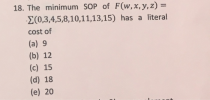 18. The minimum SOP of F(w,x, y, z)- 20,3,4,5,8,10,11,13,15) has a literal cost of (a) 9 (b) 12 (c) 15 (d) 18 (e) 20
1. In the following function, evaluate the derivatives i-iii below: f(w,x,y,z)=3xy5 + w2z4/(16y) - xy3z/w2 ...
1. In the following function, evaluate the derivatives i-iii below: f(w,x,y,z)=3xy5 + w2z4/(16y) - xy3z/w2 i) (dF/dx)w,y,z ii) (dF/dy)w,x,z iii) [d/dz (dF/dx)w,y,z]w,x,y
Q3: 1. For the Boolean function shown below, answer the questions F(W,X,Y,Z) = 11 (6,8,9,10,11,12,13) use...
 Q3: 1. For the Boolean function shown below, answer the questions F(W,X,Y,Z) = 11 (6,8,9,10,11,12,13) use K-MAP to: • Derive the BF as SOP. • Derive the BF as POS. • Find All prime implicants of the BF. • Determine the Essential prime implicant(s). 2. Let the BF change to have don't care condition as: F(W,X,Y,Z) = 1,3,7,11,15 + de E(0.2,5) Derive the BF as SOP and POS.
Let f(w, x, y, z) = Q M(4, 9, 12, 13, 14) and d(w, x, y,...
Let f(w, x, y, z) = Q M(4, 9, 12, 13, 14) and d(w, x, y, z) = P m(5, 6, 11, 15). {[d(w, x, y, z) defines the don’t care conditions of f}. (a) (10pts) Find the minimal SOP of f. (b) (10pts) Find the minimal POS of f. (c) (20pts) Design a circuit from the minimal SOP of f. The circuit should contain only NAND gates
Evaluate f(x, y, z) dV for the function f and region W specified. f(x, y, z)...
 Evaluate f(x, y, z) dV for the function f and region W specified. f(x, y, z) = ex + y + 2; W: 0 SX S 4,0 S Y S x, 0 sz s 2 eBook
 1. (8 points) Obtain a minimal SOP form for the boolean function f(x,y,z,w) implemented by logic network below. Compare the gate count and number of gate inputs in your minimal SOP expression with those for the network below. f(x,y,z,w)
 Compare your simplified expression equation derived manually
with the equation obtained with Quartus II. Use Quartus II analysis
and synthesis report to get the equation after successful
compilation. My question is where to find the equation? I have
compiled my code but couldn't find the equation from Quartus.
rary 1000: use feee.std logic 1164. a11 usc iece.numeric std.al1 114 use iete. nuneroi entity 1s in stdlogi :u Sto logic port A,B.C,D,w,x,Y,Z ผู้ไ end o2; E architecture azs or a2 1s...
Compare your simplified expression equation derived manually
with the equation obtained with Quartus II. Use Quartus II analysis
and synthesis report to get the equation after successful
compilation. My question is where to find the equation? I have
compiled my code but couldn't find the equation from Quartus.
rary 1000: use feee.std logic 1164. a11 usc iece.numeric std.al1 114 use iete. nuneroi entity 1s in stdlogi :u Sto logic port A,B.C,D,w,x,Y,Z ผู้ไ end o2; E architecture azs or a2 1s...
 18. The minimum SOP of F(w,x, y, z)- 20,3,4,5,8,10,11,13,15) has a literal cost of (a) 9 (b) 12 (c) 15 (d) 18 (e) 20
 Q3: 1. For the Boolean function shown below, answer the questions F(W,X,Y,Z) = 11 (6,8,9,10,11,12,13) use K-MAP to: • Derive the BF as SOP. • Derive the BF as POS. • Find All prime implicants of the BF. • Determine the Essential prime implicant(s). 2. Let the BF change to have don't care condition as: F(W,X,Y,Z) = 1,3,7,11,15 + de E(0.2,5) Derive the BF as SOP and POS.
 Evaluate f(x, y, z) dV for the function f and region W specified. f(x, y, z) = ex + y + 2; W: 0 SX S 4,0 S Y S x, 0 sz s 2 eBook
Most questions answered within 3 hours.
-
Where is the error in this code sequence?
String s1 = "Hello";
String s2 = "ello";...
asked 1 year ago -
Financial data for Joel de Paris, Inc., for last year
follow:
Joel de Paris, Inc.
Balance...
asked 1 year ago -
Consider this reaction:
Al2(SO4)3 (aq)+ BaCl3
(aq) Al2Cl6 (aq)- +
3BaSO4(s) . What is the...
asked 1 year ago -
Suppose that Savneet is considering increasing her
recent random sample from 20 car rentals to 40...
asked 1 year ago -
Trucks arrive at an unloading terminal at an average rate of 120
per hour.
Trucks arrive...
asked 1 year ago -
Why are methanol and ethanol completely soluble in water while
octanol is not very little soluble....
asked 1 year ago -
A facilities manager at a university reads in a research report
that the mean amount of...
asked 1 year ago -
When the CuSO4 is rehydrated by adding water to the anhydrous
compound, is this an endothermic...
asked 1 year ago -
A ray of sunlight is passing from diamond into crown glass; the
angle of incidence is...
asked 1 year ago -
A block of mass 0.249 kg is placed on top of a light, vertical
spring of...
asked 1 year ago -
how do the kidneys compensate in the presences of acidosis
a) trigger hyperventilate
b) reserve acid...
asked 1 year ago -
Question 501 pts
The rental rate of capital to the firm increases. Which of the
following...
asked 1 year ago