
Homework Answers
![Decay is first order kinetice, thus HereT to top [A]. = [A] = k= pate constant a ka to time = t = 3.4 yeard Initial ce amount](http://img.homeworklib.com/questions/008c54a0-10ef-11ec-b10b-456447d94a48.png?x-oss-process=image/resize,w_560)
Add Answer to:
17. If it takes 3.4 years for a radioactive isotope to decay to 1/16 of its...
Question 22 (1 point) Suppose the exponential decay of a radioactive isotope is modeled by the...
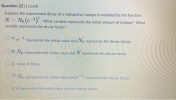 Question 22 (1 point) Suppose the exponential decay of a radioactive isotope is modeled by the function N = No (N ). What variable represents the initial amount of isotope? What variable represents the decay factor? A e represents the initial value and No represents the decay factor. B) No represents the initial value and N represents the decay factor. C) none of these OD No represents the initial value and e represents the decay factor. E) e represents the...
14C is a radioactive isotope with a half life of 5.73x10^3 years. Radioactive decay is first...
14C is a radioactive isotope with a half life of 5.73x10^3 years. Radioactive decay is first order process and the amount of 14C present in an object can be used to determine its age. How long does it take for for 90 % of the 14C in a sample to decompose?
A Radioactive Isotope is 1. Time for half of a sample to decay from parent isotope...
A Radioactive Isotope is 1. Time for half of a sample to decay from parent isotope to daughter isotope for radioactive atoms 2. The technique of getting the age of something by using unstable isotopes 3. An element that has unstable nuclei and will transform itself into another element 4. The process of an element transforming into another element by changes of its nucleus
Element X is a radioactive isotope such that every 30 years, its mass decreases by half....
 Element X is a radioactive isotope such that every 30 years, its mass decreases by half. Given that the initial mass of a sample of Element X is 4000 grams, write a function showing the mass of the sample remaining after t years, where the annual decay rate can be found from a constant in the function. Round all coefficients in the function to four decimal places. Also, determine the percentage rate of decay per year, to the nearest hundredth...
11. If calcium-40 were to undergo radioactive decay, which isotope would it most likely form? A)...
 11. If calcium-40 were to undergo radioactive decay, which isotope would it most likely form? A) calcium-41 B) calcium-39 C) potassium-40 D) scandium-40 E) argon-36
Radioactive decay occurs when a radioactive isotope ("parent" isotope) gradually transforms into ...
 Radioactive decay occurs when a radioactive isotope ("parent" isotope) gradually transforms into a radiogenic isotope ("daughter" isotope) over time. This process is modeled by the following function: where r is the ratio of parent to daughter atoms, t is time and τΗ is called the halflife. The following table shows several parent-daughter pairs along with their half-lives. Daughter N14 Srs7 Ar4o Pb206 Pb207 Half-Life (years) 5730 48.8 x 10⁹ 1.3 x 10⁹ 4.6 x 10⁹ 0.7 x 10 arent Rbs7...
Questions 3.03 Suppose a radioactive isotope has half-life-99.11. How long will take for a sample of...
 Questions 3.03 Suppose a radioactive isotope has half-life-99.11. How long will take for a sample of the Isotope to decay to 3.0% of its originaltivity? a 2181 b. 0.0354h C348 yr d. 297 h e. 501 he Oь Od Od O. Question 303 A radioactive stope has halte-273 How long will be for 3.27 mmple of the Isotope to decay to 0.351 CIT 00817 y 382 y 133 y d. 87.9 y 6.60.9 y O. Оe Question 7 3.03 pts...
The Cadmium isotope 109Cd is radioactive. A sample begins decay with 1012 Cd atoms. After 500...
The Cadmium isotope 109Cd is radioactive. A sample begins decay with 1012 Cd atoms. After 500 days, 4.7 x 10¹¹ atoms remain. What is the half-life of this sample? (a) 46 days (b) 102 days (c) 459 days -- right answer but not sure how to get it (d) 662 days (e) none of the above
The isotope lodine-131 is a radioactive isotope used in industrial and medical applications. It is prepared...
 The isotope lodine-131 is a radioactive isotope used in industrial and medical applications. It is prepared just before use because it decays rapidly through beta emission. Use the data in the table below to answer the following questions (a) Write the reaction equation. (Note m indicates an excited state of the isotope, which is generally denoted with an asterisks after the symbol, such as X*) (b) What is the rate constant for the decay? Show how you obtained this rate...
The decay curve of a radioactive nuclide sample is shown. Its initial activity is measured to...
 The
decay curve of a radioactive nuclide sample is shown. Its initial
activity is measured to be X Bq.
14. What is the population at t=8.0
15. After how many half lives will the population be 125
nuclides?
16. What will be the level of activity (in terms of X) after
two half lives have elapsed?
17. What would the activity of the above sample be if we
tripled its size?
18. If the initial activity of 0.356 grams of...
The
decay curve of a radioactive nuclide sample is shown. Its initial
activity is measured to be X Bq.
14. What is the population at t=8.0
15. After how many half lives will the population be 125
nuclides?
16. What will be the level of activity (in terms of X) after
two half lives have elapsed?
17. What would the activity of the above sample be if we
tripled its size?
18. If the initial activity of 0.356 grams of...
 Question 22 (1 point) Suppose the exponential decay of a radioactive isotope is modeled by the function N = No (N ). What variable represents the initial amount of isotope? What variable represents the decay factor? A e represents the initial value and No represents the decay factor. B) No represents the initial value and N represents the decay factor. C) none of these OD No represents the initial value and e represents the decay factor. E) e represents the...
 Element X is a radioactive isotope such that every 30 years, its mass decreases by half. Given that the initial mass of a sample of Element X is 4000 grams, write a function showing the mass of the sample remaining after t years, where the annual decay rate can be found from a constant in the function. Round all coefficients in the function to four decimal places. Also, determine the percentage rate of decay per year, to the nearest hundredth...
 11. If calcium-40 were to undergo radioactive decay, which isotope would it most likely form? A) calcium-41 B) calcium-39 C) potassium-40 D) scandium-40 E) argon-36
 Radioactive decay occurs when a radioactive isotope ("parent" isotope) gradually transforms into a radiogenic isotope ("daughter" isotope) over time. This process is modeled by the following function: where r is the ratio of parent to daughter atoms, t is time and τΗ is called the halflife. The following table shows several parent-daughter pairs along with their half-lives. Daughter N14 Srs7 Ar4o Pb206 Pb207 Half-Life (years) 5730 48.8 x 10⁹ 1.3 x 10⁹ 4.6 x 10⁹ 0.7 x 10 arent Rbs7...
 Questions 3.03 Suppose a radioactive isotope has half-life-99.11. How long will take for a sample of the Isotope to decay to 3.0% of its originaltivity? a 2181 b. 0.0354h C348 yr d. 297 h e. 501 he Oь Od Od O. Question 303 A radioactive stope has halte-273 How long will be for 3.27 mmple of the Isotope to decay to 0.351 CIT 00817 y 382 y 133 y d. 87.9 y 6.60.9 y O. Оe Question 7 3.03 pts...
 The isotope lodine-131 is a radioactive isotope used in industrial and medical applications. It is prepared just before use because it decays rapidly through beta emission. Use the data in the table below to answer the following questions (a) Write the reaction equation. (Note m indicates an excited state of the isotope, which is generally denoted with an asterisks after the symbol, such as X*) (b) What is the rate constant for the decay? Show how you obtained this rate...
 The
decay curve of a radioactive nuclide sample is shown. Its initial
activity is measured to be X Bq.
14. What is the population at t=8.0
15. After how many half lives will the population be 125
nuclides?
16. What will be the level of activity (in terms of X) after
two half lives have elapsed?
17. What would the activity of the above sample be if we
tripled its size?
18. If the initial activity of 0.356 grams of...
The
decay curve of a radioactive nuclide sample is shown. Its initial
activity is measured to be X Bq.
14. What is the population at t=8.0
15. After how many half lives will the population be 125
nuclides?
16. What will be the level of activity (in terms of X) after
two half lives have elapsed?
17. What would the activity of the above sample be if we
tripled its size?
18. If the initial activity of 0.356 grams of...
Most questions answered within 3 hours.
-
Where is the error in this code sequence?
String s1 = "Hello";
String s2 = "ello";...
asked 11 months ago -
Financial data for Joel de Paris, Inc., for last year
follow:
Joel de Paris, Inc.
Balance...
asked 11 months ago -
Consider this reaction:
Al2(SO4)3 (aq)+ BaCl3
(aq) Al2Cl6 (aq)- +
3BaSO4(s) . What is the...
asked 11 months ago -
Suppose that Savneet is considering increasing her
recent random sample from 20 car rentals to 40...
asked 11 months ago -
Trucks arrive at an unloading terminal at an average rate of 120
per hour.
Trucks arrive...
asked 11 months ago -
Why are methanol and ethanol completely soluble in water while
octanol is not very little soluble....
asked 11 months ago -
A facilities manager at a university reads in a research report
that the mean amount of...
asked 11 months ago -
When the CuSO4 is rehydrated by adding water to the anhydrous
compound, is this an endothermic...
asked 11 months ago -
A ray of sunlight is passing from diamond into crown glass; the
angle of incidence is...
asked 11 months ago -
A block of mass 0.249 kg is placed on top of a light, vertical
spring of...
asked 11 months ago -
how do the kidneys compensate in the presences of acidosis
a) trigger hyperventilate
b) reserve acid...
asked 11 months ago -
Question 501 pts
The rental rate of capital to the firm increases. Which of the
following...
asked 11 months ago