
Homework Answers
Add Answer to:
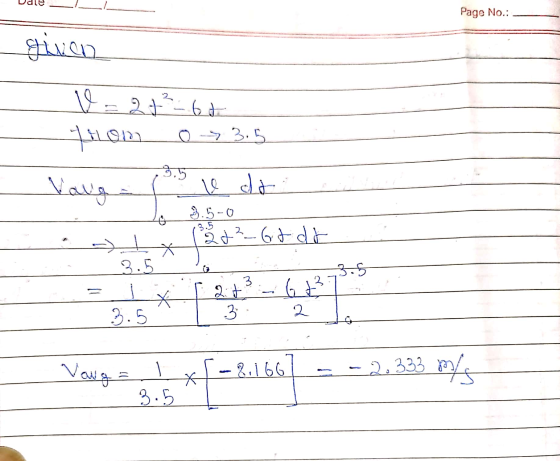
D Question 7 Aparticle moves along a horizontal path with a velocity of v 212 -...
A projectile, initially at the origin, moves along a straight-line path through a fluid medium such...
A projectile, initially at the origin, moves along a straight-line path through a fluid medium such that its velocity is v=1800(1−e−0.3t)mm/s where t is in seconds. Determine the displacement of the projectile during the first 2 s .
The position of a particle along a straight-line path is defined by s=(t3−6t2−15t+7) ft, wheret is...
The position of a particle along a straight-line path is defined by s=(t3−6t2−15t+7) ft, wheret is in seconds. Part A: Determine the total distance traveled when t = 8.3 s . Part B: What are the particle's average velocity at the time given in part A? Part C: What are the particle's average speed at the time given in part A? Part D: What are the particle's instantaneous velocity at the time given in part A? Part E: What are...
CYLINDRICAL COMPONENTS OF VELOCITY: The airplane on the amusement park ride moves along a path...
 The airplane on the amusement park ride moves along a path defined by the equations r = 4 m, θ = (0.2t)rad, and z = (0.5cosθ)m, where t is in seconds.A)Determine the cylindrical components of the velocity of the airplane when t = 6s.B)Determine the cylindrical components of the acceleration of the airplane when t = 6s.
Question 13 A particle moves along a circular path over a horizontal y cosrinate system, at...
 Question 13 A particle moves along a circular path over a horizontal y cosrinate system, at constant speed, A tm 3.30s, ts atpont (4.40 m, 6.80 m) with veloity (3,00 m/sj and acceleration in the postivex drection. At time t-11.1s, it has velocity (-3.00 m/si and acceleration in the postive y dárection. What are the (a) r and (b) y coordnates of the center of the corcular path? Assume at both times that the particle is on the same orbit...
A particle starts from rest at x = -1.8 m and moves along the x-axis with...
 A particle starts from rest at x = -1.8 m and moves
along the x-axis with the velocity history shown. Plot the
corresponding acceleration and the displacement histories for the
2.0 seconds. Find the time t when the particle crosses the
origin. After you have the plots, answer the questions.
Chapter 2, Practice Problem 2/015 A particle starts from rest at x = -1.8 m and moves along the x-axis with the velocity history shown. Plot the corresponding acceleration and...
A particle starts from rest at x = -1.8 m and moves
along the x-axis with the velocity history shown. Plot the
corresponding acceleration and the displacement histories for the
2.0 seconds. Find the time t when the particle crosses the
origin. After you have the plots, answer the questions.
Chapter 2, Practice Problem 2/015 A particle starts from rest at x = -1.8 m and moves along the x-axis with the velocity history shown. Plot the corresponding acceleration and...
48% + B 1. A particle moves along a grooved path on a horizontal board as...
 48% + B 1. A particle moves along a grooved path on a horizontal board as shown. The particle has an initial velocity of 0. It starts at A at its speed increases at a constant rate of 20 m/s?. Determine the acceleration at C. (30) -3 m 3.5 m с
A particle moves along the path r-8tH + (t3 + 5)j) m, where t s in...
 A particle moves along the path r-8tH + (t3 + 5)j) m, where t s in seconds. Determine the magnitudes of the particle's velocity and acceleration whent-3 s.
А P B A particle moves along a grooved path on a horizontal board as shown....
 А P B A particle moves along a grooved path on a horizontal board as shown. The particle has an initial velocity of 0. It starts at A at its speed increases at a constant rate of 20 m/s. Determine the acceleration at C. (30) 3 m 3.5 m с
(10 pts) Suppose an object moves along a line with velocity v(t) = 3+- 18t +24,...
 (10 pts) Suppose an object moves along a line with velocity v(t) = 3+- 18t +24, for 0 st < 5, where t is measured in seconds and velocity have unit of ft/s. (a) Determine when the motion is in the positive direction and when it is in the negative direction. (b) Find the displacement of the object on the interval 0 st 35. (c) Write down an expression for the distance traveled by the object over the interval 0...
A car moves along a horizontal road with constant velocity v0=v0xi
 A car moves along a horizontal road with constant velocity v0 =
v0xi until it encounters a smooth inclined hill, which it climbs
with constant
Problem 1: A car moves along a horizontal road with constant velocity vo voi until it encounters a smooth inclined hill, which it climbs with constant velocity vl = v1xit vhj as indicated in the figure. The period of time during which the car changes its velocity is Randomized Variables vox = 48 m/s Vix...
A car moves along a horizontal road with constant velocity v0 =
v0xi until it encounters a smooth inclined hill, which it climbs
with constant
Problem 1: A car moves along a horizontal road with constant velocity vo voi until it encounters a smooth inclined hill, which it climbs with constant velocity vl = v1xit vhj as indicated in the figure. The period of time during which the car changes its velocity is Randomized Variables vox = 48 m/s Vix...
 Question 13 A particle moves along a circular path over a horizontal y cosrinate system, at constant speed, A tm 3.30s, ts atpont (4.40 m, 6.80 m) with veloity (3,00 m/sj and acceleration in the postivex drection. At time t-11.1s, it has velocity (-3.00 m/si and acceleration in the postive y dárection. What are the (a) r and (b) y coordnates of the center of the corcular path? Assume at both times that the particle is on the same orbit...
 A particle starts from rest at x = -1.8 m and moves
along the x-axis with the velocity history shown. Plot the
corresponding acceleration and the displacement histories for the
2.0 seconds. Find the time t when the particle crosses the
origin. After you have the plots, answer the questions.
Chapter 2, Practice Problem 2/015 A particle starts from rest at x = -1.8 m and moves along the x-axis with the velocity history shown. Plot the corresponding acceleration and...
A particle starts from rest at x = -1.8 m and moves
along the x-axis with the velocity history shown. Plot the
corresponding acceleration and the displacement histories for the
2.0 seconds. Find the time t when the particle crosses the
origin. After you have the plots, answer the questions.
Chapter 2, Practice Problem 2/015 A particle starts from rest at x = -1.8 m and moves along the x-axis with the velocity history shown. Plot the corresponding acceleration and...
 48% + B 1. A particle moves along a grooved path on a horizontal board as shown. The particle has an initial velocity of 0. It starts at A at its speed increases at a constant rate of 20 m/s?. Determine the acceleration at C. (30) -3 m 3.5 m с
 A particle moves along the path r-8tH + (t3 + 5)j) m, where t s in seconds. Determine the magnitudes of the particle's velocity and acceleration whent-3 s.
 А P B A particle moves along a grooved path on a horizontal board as shown. The particle has an initial velocity of 0. It starts at A at its speed increases at a constant rate of 20 m/s. Determine the acceleration at C. (30) 3 m 3.5 m с
 (10 pts) Suppose an object moves along a line with velocity v(t) = 3+- 18t +24, for 0 st < 5, where t is measured in seconds and velocity have unit of ft/s. (a) Determine when the motion is in the positive direction and when it is in the negative direction. (b) Find the displacement of the object on the interval 0 st 35. (c) Write down an expression for the distance traveled by the object over the interval 0...
 A car moves along a horizontal road with constant velocity v0 =
v0xi until it encounters a smooth inclined hill, which it climbs
with constant
Problem 1: A car moves along a horizontal road with constant velocity vo voi until it encounters a smooth inclined hill, which it climbs with constant velocity vl = v1xit vhj as indicated in the figure. The period of time during which the car changes its velocity is Randomized Variables vox = 48 m/s Vix...
A car moves along a horizontal road with constant velocity v0 =
v0xi until it encounters a smooth inclined hill, which it climbs
with constant
Problem 1: A car moves along a horizontal road with constant velocity vo voi until it encounters a smooth inclined hill, which it climbs with constant velocity vl = v1xit vhj as indicated in the figure. The period of time during which the car changes its velocity is Randomized Variables vox = 48 m/s Vix...
Most questions answered within 3 hours.
-
Where is the error in this code sequence?
String s1 = "Hello";
String s2 = "ello";...
asked 10 months ago -
Financial data for Joel de Paris, Inc., for last year
follow:
Joel de Paris, Inc.
Balance...
asked 10 months ago -
Consider this reaction:
Al2(SO4)3 (aq)+ BaCl3
(aq) Al2Cl6 (aq)- +
3BaSO4(s) . What is the...
asked 10 months ago -
Suppose that Savneet is considering increasing her
recent random sample from 20 car rentals to 40...
asked 10 months ago -
Trucks arrive at an unloading terminal at an average rate of 120
per hour.
Trucks arrive...
asked 10 months ago -
Why are methanol and ethanol completely soluble in water while
octanol is not very little soluble....
asked 10 months ago -
A facilities manager at a university reads in a research report
that the mean amount of...
asked 10 months ago -
When the CuSO4 is rehydrated by adding water to the anhydrous
compound, is this an endothermic...
asked 10 months ago -
A ray of sunlight is passing from diamond into crown glass; the
angle of incidence is...
asked 10 months ago -
A block of mass 0.249 kg is placed on top of a light, vertical
spring of...
asked 10 months ago -
how do the kidneys compensate in the presences of acidosis
a) trigger hyperventilate
b) reserve acid...
asked 10 months ago -
Question 501 pts
The rental rate of capital to the firm increases. Which of the
following...
asked 10 months ago