
Homework Answers
Suppose that the block B is moving with speed v just after the collision.
Now, assume the 2 block system is whole system. As we can see that there is not net external force acting on the system, therefore the linear momentum of the system must conserve.
From linear momentum conservation,
mAvAi + mBvBi = mAvAf + mAvAf .........(1)
where
vAi = Initial velocity of block A
vAf = Final velocity of Blcok A after collison
vBi = Initial velocity of block B
vBf = Final velocity of block B after collison
Using Equation (1)
6.9×4.8 + 13.8×3.2 = 6.9×v + 13.8×4
⇒ v = 3.2 m/s
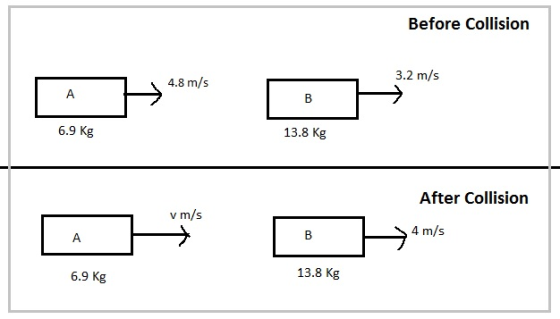
(a) Velocity of 6.9 Kg Block will be 3.2 m/s
Change is Kinetic Energy= KEf - KEi = ΔKE ......... (2)
KE = ½mv²
ΔKE = [½mAvAf²+ ½mBvBf²] - [½mAvAi² + ½mBvBi²]
= - 4.416 J
(b) The change is Total KE is 4.416 J
PART (c)
If the block B ends up with 6.4 m/s. The using momentum conservation equation ...(1). The value of VBf will be 6.4
6.9×4.8 + 13.8×3.2 = 6.9×v + 13.8×6.4
v = - 1.6 m/s
This means that block A will move with a speed of 1.6 m/s in the backward direction.
Using equation (2)
ΔKE = [½mAvAf²+ ½mBvBf²] - [½mAvAi² + ½mBvBi²]
ΔKE = 141.312 J
(c) = The change is Kinetic Energy will be 141.312 J.
Add Answer to:
A 6.9 kg block with a speed of 4.8 m/s collides with a 13.8 kg block...
Chapter 09, Problem 055 A 6.7 kg block with a speed of 4.8 m/s collides with...
Chapter 09, Problem 055 A 6.7 kg block with a speed of 4.8 m/s collides with a 13.4 kg block that has a speed of 3.2 m/s in the same direction. After the collision, the 13.4 kg block is observed to be traveling in the original direction with a speed of 4.0 m/s. (a) What is the velocity of the 6.7 kg block immediately after the collision? (b) By how much does the total kinetic energy of the system of...
A 3.5 kg block with a speed of 3.6 m/s collides with a 7.0 kg block...
A 3.5 kg block with a speed of 3.6 m/s collides with a 7.0 kg block that has a speed of 2.4 m/s in the same direction. After the collision, the 7.0 kg block is observed to be traveling in the original direction with a speed of 3.0 m/s. (a) What is the velocity of the 3.5 kg block immediately after the collision? (b) By how much does the total kinetic energy of the system of two blocks change because...
A 4.5-kg block moving at 2.0 m/s west on a frictionless surface collides totally inelastically with...
A 4.5-kg block moving at 2.0 m/s west on a frictionless surface collides totally inelastically with a second 1.0-kg block traveling east at 2.0m/s. a) Determine the final velocity of the blocks. b)Determine the kinetic energy of the first block before the collision. c)Determine the kinetic energy of the second block before the collision. d)Determine the kinetic energy of the first block after the collision. e)Determine the kinetic energy of the second block after the collision.
A block of mass m -2.00 kg collides head on with a block of mass m-...
 A block of mass m -2.00 kg collides head on with a block of mass m- 10.0 kg initially at rest on a rough horizontal surface. The block m strikes m2 with a speed of 4.00 m/s. Immediately after the very brief inelastic collision, the 2.00 kg block bounces back with a speed of 1.20 m/s. Ignore the effect of friction during the collision. (a) 4pts.] Calculate the speed of the 10.0 kg block immediately after the collision. (b) 4...
A 3 kg toy car with a speed of 5 m/s collides head-on with a 2...
A 3 kg toy car with a speed of 5 m/s collides head-on with a 2 kg car traveling in the opposite direction with a speed of 3 m/s. If the cars are locked together after the collision with a speed of 1.80 m/s, how much kinetic energy is lost?
A 3 kg toy car with a speed of 8 m/s collides head-on with a 2...
A 3 kg toy car with a speed of 8 m/s collides head-on with a 2 kg car traveling in the opposite direction with a speed of 5 m/s. If the cars are locked together after the collision with a speed of 2.80 m/s, how much kinetic energy is lost?
A 3-kg toy car with a speed of 6 m/s collides head-on with a 2-kg car...
A 3-kg toy car with a speed of 6 m/s collides head-on with a 2-kg car traveling in the opposite direction with a speed of 4 m/s. If the cars are locked together after the collision with a speed of 3.435 m/s, how much kinetic energy is lost?
A 2-kg block moving in the positive x direction with a speed of 5.0 m/s collides...
A 2-kg block moving in the positive x direction with a speed of 5.0 m/s collides with a 3-kg block moving in the same direction with a speed of 2.0 m/s. After the collision the 3-kg block moves at 4.2 m/s. Find the velocity of the 2-kg block after the collision. Is the collision elastic or inelastic? Justify your answer.
A4.5-kg block moving at 2.0 m/s west on a frictionless surface collides totally inelastically with a...
 A4.5-kg block moving at 2.0 m/s west on a frictionless surface collides totally inelastically with a second 1.0-kg block traveling east at 3.0m/s. Part A Determine the final velocity of the blocks Express your answer with the appropriate units. op Value Units Submit Request Answer Part B Determine the kinetic energy of the first block before th Express your answer with the appropriate units. Part A Determine the final velocity of the blocks Express your answer with the appropriate units....
A 1,500 kg car moving with a speed of 4.00 m/s collides with a 50,000 kg...
 A 1,500 kg car moving with a speed of 4.00 m/s collides with a 50,000 kg truck moving with a speed of 1.80 m/s in the same direction. If the collision is perfectly inelastic, the change in kinetic energy of the car is 12,000 0 -2,600 O-14,600 O -9,390 O none of these Ne Previous A 1,500 kg car moving with a speed of 4.00 m/s collides with a 50,000 kg truck moving with a speed of 1.80 m/s in...
 A block of mass m -2.00 kg collides head on with a block of mass m- 10.0 kg initially at rest on a rough horizontal surface. The block m strikes m2 with a speed of 4.00 m/s. Immediately after the very brief inelastic collision, the 2.00 kg block bounces back with a speed of 1.20 m/s. Ignore the effect of friction during the collision. (a) 4pts.] Calculate the speed of the 10.0 kg block immediately after the collision. (b) 4...
 A4.5-kg block moving at 2.0 m/s west on a frictionless surface collides totally inelastically with a second 1.0-kg block traveling east at 3.0m/s. Part A Determine the final velocity of the blocks Express your answer with the appropriate units. op Value Units Submit Request Answer Part B Determine the kinetic energy of the first block before th Express your answer with the appropriate units. Part A Determine the final velocity of the blocks Express your answer with the appropriate units....
 A 1,500 kg car moving with a speed of 4.00 m/s collides with a 50,000 kg truck moving with a speed of 1.80 m/s in the same direction. If the collision is perfectly inelastic, the change in kinetic energy of the car is 12,000 0 -2,600 O-14,600 O -9,390 O none of these Ne Previous A 1,500 kg car moving with a speed of 4.00 m/s collides with a 50,000 kg truck moving with a speed of 1.80 m/s in...
Most questions answered within 3 hours.
-
Where is the error in this code sequence?
String s1 = "Hello";
String s2 = "ello";...
asked 11 months ago -
Financial data for Joel de Paris, Inc., for last year
follow:
Joel de Paris, Inc.
Balance...
asked 11 months ago -
Consider this reaction:
Al2(SO4)3 (aq)+ BaCl3
(aq) Al2Cl6 (aq)- +
3BaSO4(s) . What is the...
asked 11 months ago -
Suppose that Savneet is considering increasing her
recent random sample from 20 car rentals to 40...
asked 11 months ago -
Trucks arrive at an unloading terminal at an average rate of 120
per hour.
Trucks arrive...
asked 11 months ago -
Why are methanol and ethanol completely soluble in water while
octanol is not very little soluble....
asked 11 months ago -
A facilities manager at a university reads in a research report
that the mean amount of...
asked 11 months ago -
When the CuSO4 is rehydrated by adding water to the anhydrous
compound, is this an endothermic...
asked 11 months ago -
A ray of sunlight is passing from diamond into crown glass; the
angle of incidence is...
asked 11 months ago -
A block of mass 0.249 kg is placed on top of a light, vertical
spring of...
asked 11 months ago -
how do the kidneys compensate in the presences of acidosis
a) trigger hyperventilate
b) reserve acid...
asked 11 months ago -
Question 501 pts
The rental rate of capital to the firm increases. Which of the
following...
asked 11 months ago