
Homework Answers
Add Answer to:
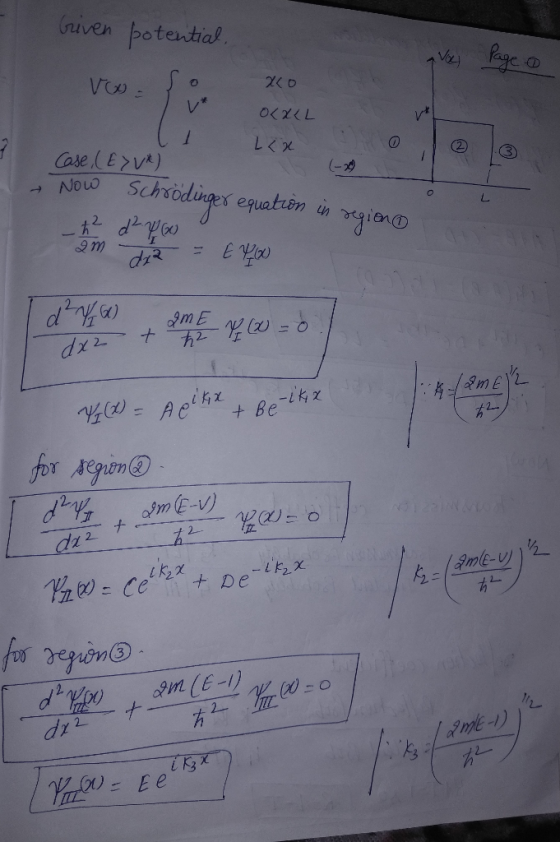
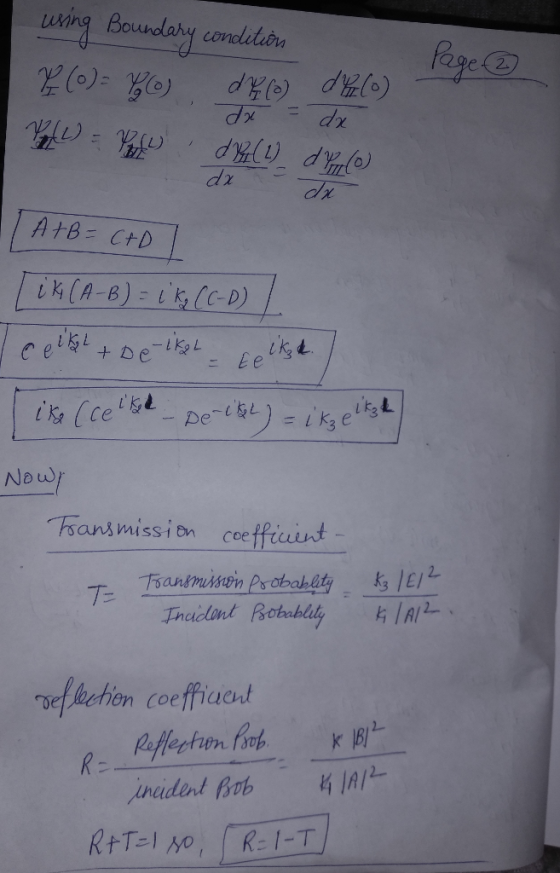
5. Consider a square potential barrier in figure below: V(x) 0 x <0 a) Assume that...
In class we considered quantum tunneling of a particle of energy Eo through a barrier of...
 In class we considered quantum tunneling of a particle of energy Eo through a barrier of potential Vofor Vo > Eo. Here we focus on two aspects of the problem we ignored in class. In order to simplify we will only consider the initial first half of the barrier as shown below RegionI xS0 Regionx 20 Il There are two cases to consider: Eo< Vo Considered in class E>Vo Not considered in class Here we will focus on the second...
0 Figure 2: The potential barrier setup for Problem 4 4. (10 points) "Burrowing a hole...
 0 Figure 2: The potential barrier setup for Problem 4 4. (10 points) "Burrowing a hole in the wall" Some particles of mass m and energy E move from the left to the potential barrier shown in Figure 2 below 0 <0 Uo 20 U(x) where Uo is some positive value (a) (5 points) Write the Time-Independent Schrödinger equations and the physically acceptable general solutions for the wave function (x) in regions I and II as labeled in Figure 2...
Consider a finite square barrier potential shown below. Figure A. For a<x<b, the space part of...
 Consider a finite square barrier potential shown below. Figure A. For a<x<b, the space part of the electron wave function has the form: k? = 2mE/h? and gu2m(V,-E)/h2 (a) Aeikx (b) Aegn (c) Ae*** + Be** (d) Ae* (e) Aelkx + Be-ika For the finite square barrier potential shown below, Figure A. For x<a, the space part of the electron wave function has the form: k = 2mE/h? and g=2m(Vo-E) /h (a) Aeikx (b) Aetex (c) Ae*EN + Bet* (d)...
Consider a particle encountering a barrier with potential U = U.>0 between x = -a and...
 Consider a particle encountering a barrier with potential U = U.>0 between x = -a and x = a with incoming energy E > U. a) Write the symbolic wave functions before and after passing through the barrier (i.e., for x<-a and x>a; regions I and III). U1 b) Write down the Schrodinger equation for the wave function in the middle (region II) where the potential is non-zero i.e., where -a<x<a; region II). c) What solution would you try for...
(III) Quantum Tunneling Consider an electron in 1D in presence of a potential barrier of width...
 (III) Quantum Tunneling Consider an electron in 1D in presence of a potential barrier of width L represented by a step function ſo I<0 or 1>L V U. r>0 and 2<L The total wavefunction is subject to the time-independent Schrödinger equation = EV (2) 2m ar2 +V where E is the energy of the quantum particle in question and m is the mass of the quantum particle. A The total wavefunction of a free particle that enters the barrier from...
Consider a particle incident from the left on the potential step. Where E = 2 eV...
 Consider a particle incident from the left on the potential step. Where E = 2 eV V(x) {5 eV lo x < 0 x > 0 1) Find the wave function of the particle in two regions 2) Find reflection and transmission coefficients R and T
Consider a traveling (electrons) wave moving in the +x direction approaching a step barrier of height 1 eV; that is V =...
 Consider a traveling (electrons) wave moving in the +x direction
approaching a step barrier of height 1 eV; that is V = 0 for x <
0, V = 1.0 eV for x ≥ 0. For x < 0, there will be both the
traveling wave in the +x direction. For x ≥ 0, only a solution
corresponding to motion in the +x direction exists. By solving the
Schrödinger wave equation in both x < 0 and x ≥ 0...
Consider a traveling (electrons) wave moving in the +x direction
approaching a step barrier of height 1 eV; that is V = 0 for x <
0, V = 1.0 eV for x ≥ 0. For x < 0, there will be both the
traveling wave in the +x direction. For x ≥ 0, only a solution
corresponding to motion in the +x direction exists. By solving the
Schrödinger wave equation in both x < 0 and x ≥ 0...
Problem # 5 ( 6 pts) Consider the potential: V(x) αδ(x) Where α is a positive...
 Problem # 5 ( 6 pts) Consider the potential: V(x) αδ(x) Where α is a positive constant, and with E>0 Calculate the reflection and transmission coefficients.
toward a Problem 4 (30 points): Consider a current of particles of energy E moving from...
 toward a Problem 4 (30 points): Consider a current of particles of energy E moving from x = - potential step as shown in the figure. x > 0 V(x) = {v. x<0 TE Where E > V a) (8 points) Derive the general solution of Schrödinger equation for x < 0 and for x > 0 b) (14 points) Apply the boundary conditions and calculate the transmission and the reflection coefficients. c) (8 points) What is the value of...
18. Consider the potential barrier as shown in the figure. Calculate the transmission coefficcient. Discuss the...
 18. Consider the potential barrier as shown in the figure. Calculate the transmission coefficcient. Discuss the depence of this coefficient. This is so called tunneling effect. Give a physical phenomenum that can be explained by this fact. E 00 0 V1 V(x) = x < 0 -V 0 < x <a V2 a< x <b 0 x <b
 In class we considered quantum tunneling of a particle of energy Eo through a barrier of potential Vofor Vo > Eo. Here we focus on two aspects of the problem we ignored in class. In order to simplify we will only consider the initial first half of the barrier as shown below RegionI xS0 Regionx 20 Il There are two cases to consider: Eo< Vo Considered in class E>Vo Not considered in class Here we will focus on the second...
 0 Figure 2: The potential barrier setup for Problem 4 4. (10 points) "Burrowing a hole in the wall" Some particles of mass m and energy E move from the left to the potential barrier shown in Figure 2 below 0 <0 Uo 20 U(x) where Uo is some positive value (a) (5 points) Write the Time-Independent Schrödinger equations and the physically acceptable general solutions for the wave function (x) in regions I and II as labeled in Figure 2...
 Consider a finite square barrier potential shown below. Figure A. For a<x<b, the space part of the electron wave function has the form: k? = 2mE/h? and gu2m(V,-E)/h2 (a) Aeikx (b) Aegn (c) Ae*** + Be** (d) Ae* (e) Aelkx + Be-ika For the finite square barrier potential shown below, Figure A. For x<a, the space part of the electron wave function has the form: k = 2mE/h? and g=2m(Vo-E) /h (a) Aeikx (b) Aetex (c) Ae*EN + Bet* (d)...
 Consider a particle encountering a barrier with potential U = U.>0 between x = -a and x = a with incoming energy E > U. a) Write the symbolic wave functions before and after passing through the barrier (i.e., for x<-a and x>a; regions I and III). U1 b) Write down the Schrodinger equation for the wave function in the middle (region II) where the potential is non-zero i.e., where -a<x<a; region II). c) What solution would you try for...
 (III) Quantum Tunneling Consider an electron in 1D in presence of a potential barrier of width L represented by a step function ſo I<0 or 1>L V U. r>0 and 2<L The total wavefunction is subject to the time-independent Schrödinger equation = EV (2) 2m ar2 +V where E is the energy of the quantum particle in question and m is the mass of the quantum particle. A The total wavefunction of a free particle that enters the barrier from...
 Consider a particle incident from the left on the potential step. Where E = 2 eV V(x) {5 eV lo x < 0 x > 0 1) Find the wave function of the particle in two regions 2) Find reflection and transmission coefficients R and T
 Consider a traveling (electrons) wave moving in the +x direction
approaching a step barrier of height 1 eV; that is V = 0 for x <
0, V = 1.0 eV for x ≥ 0. For x < 0, there will be both the
traveling wave in the +x direction. For x ≥ 0, only a solution
corresponding to motion in the +x direction exists. By solving the
Schrödinger wave equation in both x < 0 and x ≥ 0...
Consider a traveling (electrons) wave moving in the +x direction
approaching a step barrier of height 1 eV; that is V = 0 for x <
0, V = 1.0 eV for x ≥ 0. For x < 0, there will be both the
traveling wave in the +x direction. For x ≥ 0, only a solution
corresponding to motion in the +x direction exists. By solving the
Schrödinger wave equation in both x < 0 and x ≥ 0...
 Problem # 5 ( 6 pts) Consider the potential: V(x) αδ(x) Where α is a positive constant, and with E>0 Calculate the reflection and transmission coefficients.
 toward a Problem 4 (30 points): Consider a current of particles of energy E moving from x = - potential step as shown in the figure. x > 0 V(x) = {v. x<0 TE Where E > V a) (8 points) Derive the general solution of Schrödinger equation for x < 0 and for x > 0 b) (14 points) Apply the boundary conditions and calculate the transmission and the reflection coefficients. c) (8 points) What is the value of...
 18. Consider the potential barrier as shown in the figure. Calculate the transmission coefficcient. Discuss the depence of this coefficient. This is so called tunneling effect. Give a physical phenomenum that can be explained by this fact. E 00 0 V1 V(x) = x < 0 -V 0 < x <a V2 a< x <b 0 x <b
Most questions answered within 3 hours.
-
Where is the error in this code sequence?
String s1 = "Hello";
String s2 = "ello";...
asked 10 months ago -
Financial data for Joel de Paris, Inc., for last year
follow:
Joel de Paris, Inc.
Balance...
asked 10 months ago -
Consider this reaction:
Al2(SO4)3 (aq)+ BaCl3
(aq) Al2Cl6 (aq)- +
3BaSO4(s) . What is the...
asked 10 months ago -
Suppose that Savneet is considering increasing her
recent random sample from 20 car rentals to 40...
asked 10 months ago -
Trucks arrive at an unloading terminal at an average rate of 120
per hour.
Trucks arrive...
asked 10 months ago -
Why are methanol and ethanol completely soluble in water while
octanol is not very little soluble....
asked 10 months ago -
A facilities manager at a university reads in a research report
that the mean amount of...
asked 10 months ago -
When the CuSO4 is rehydrated by adding water to the anhydrous
compound, is this an endothermic...
asked 10 months ago -
A ray of sunlight is passing from diamond into crown glass; the
angle of incidence is...
asked 10 months ago -
A block of mass 0.249 kg is placed on top of a light, vertical
spring of...
asked 10 months ago -
how do the kidneys compensate in the presences of acidosis
a) trigger hyperventilate
b) reserve acid...
asked 10 months ago -
Question 501 pts
The rental rate of capital to the firm increases. Which of the
following...
asked 10 months ago