Constants | Periodic Table Calculate ΔG∘rxn and K for each of the following reactions. Part A...
Constants | Periodic Table Calculate ΔG∘rxn and K for each of the following reactions. Part A The reaction of Cr3+(aq) and Cr(s) to form Cr2+(aq). [The reduction potential of Cr2+(aq) to Cr(s) is -0.91 V.] Calculate ΔG∘rxn.
Homework Answers
 thank
you vmuch....
thank
you vmuch....Add Answer to:
Constants | Periodic Table Calculate ΔG∘rxn and K for each of
the following reactions. Part A...
For each of the following reactions, calculate ΔH∘rxn, ΔS∘rxn, and ΔG∘rxn at 25 ∘C. State whether...
For each of the following reactions, calculate ΔH∘rxn, ΔS∘rxn, and ΔG∘rxn at 25 ∘C. State whether or not the reaction is spontaneous. If the reaction is not spontaneous, would a change in temperature make it spontaneous? If so, should the temperature be raised or lowered from 25 ∘C? N2(g)+O2(g)→2NO(g) Express your answer using three significant figures. ΔH∘rxn ΔHrxn∘ = 183 kJ SubmitPrevious Answers Correct Part H Part complete Calculate ΔS∘rxn at 25 ∘C. Express your answer to one decimal place....
Calculate ΔG∘ at 298 K for the following reactions. Exercise 18.94 27 of 37 > A...
 Calculate ΔG∘ at 298 K for the
following reactions.
Exercise 18.94 27 of 37 > A Review | Constants Periodic Table Calculate AG at 298 K for the following reactions. Part A Ca(s) + CO2(g) +0(9)+CaCO3(s) Express your answer using three significant figures. % AX! * R o L ? AGⓇ = | Submit Request Answer Part B Complete previous part(s) Part CaCO3(8) + Ca(s) + CO (9) Express your answer using three significant figures. 1% AXPRO ? AGⓇ =...
Calculate ΔG∘ at 298 K for the
following reactions.
Exercise 18.94 27 of 37 > A Review | Constants Periodic Table Calculate AG at 298 K for the following reactions. Part A Ca(s) + CO2(g) +0(9)+CaCO3(s) Express your answer using three significant figures. % AX! * R o L ? AGⓇ = | Submit Request Answer Part B Complete previous part(s) Part CaCO3(8) + Ca(s) + CO (9) Express your answer using three significant figures. 1% AXPRO ? AGⓇ =...
Use tabulated half-cell potentials to calculate ΔG∘rxn for each of the following reactions at 25 ∘C....
Use tabulated half-cell potentials to calculate ΔG∘rxn for each of the following reactions at 25 ∘C. O2(g)+2H2O(l)+2Cu(s)→4OH−(aq)+2Cu2+(aq) Br2(l)+2I−(aq)→2Br−(aq)+I2(s)
For each of the following reactions, calculate ΔH∘rxn, ΔS∘rxn, and ΔG∘rxn at 25 ∘C.? 2CH4(g)→C2H6(g)+H2(g) Part...
For each of the following reactions, calculate ΔH∘rxn, ΔS∘rxn, and ΔG∘rxn at 25 ∘C.? 2CH4(g)→C2H6(g)+H2(g) Part B: Calculate ΔS∘rxn at 25 ∘C 2NH3(g)→N2H4(g)+H2(g) Part B: Calculate ΔS∘rxn at 25 ∘C.
Review I Constants I Periodic Table The equilibrium constant, K, for a redox reaction is related...
 Review I Constants I Periodic Table The equilibrium constant, K, for a redox reaction is related to the standard potential, E°, by the equation Standard reduction potentials nFE RT In K E° (V) Reduction half-reaction Agt(aq)eAg(s) Cu2+(aq)2eCu(s) 0.80 where n is the number of moles of electrons transferred, F (the Faraday constant) is equal to 96,500 C/(mol e), R (the gas constant) is equal to 8.314 J/(mol - K) , and T is the Kelvin temperature. 0.34 Sn4t (aq)4eSn(s) 0.15...
10. You want to know the standard reduction potential for the Cr* (aq)|Cr(s) half- reaction Cr3...
 10. You want to know the standard reduction potential for the Cr* (aq)|Cr(s) half- reaction Cr3 + (aq) + 3e-→ Cr(s) y, your textbook only lists the following data for chromium: Cr3+ (aq) + e-→ Cr2+ (aq) Cr2+ (aq) + 2e-→ Cr(s) E' =-0.424 V E' =-0.900 V What is the standard reduction potential for the Cr (a)Cr(s) half-reaction at 25 °C? A)-0.741 V B)-1.324 V C) 0.382V D)-0.141 V E) 0.476 V
Use the following half-reactions to write 3 spontaneous reactions, calculate E°cell for each reaction, what is...
 Use the following half-reactions to write 3 spontaneous
reactions, calculate E°cell for each reaction, what is
the n number (number of electrons transferred).
Au+ (aq) + e− → Au
(s) E° = 1.69
V
N2O (g) + 2H+ (aq) + 2 e− →
N2 (g) + H2O (l) E° =
1.77 V
Cr3+ (aq) + 3 e− → Cr
(s) E° = -0.74 V
Question 7 0.36 pts Use the following half-reactions to write 3 spontaneous reactions, calculate Eºcell for...
Use the following half-reactions to write 3 spontaneous
reactions, calculate E°cell for each reaction, what is
the n number (number of electrons transferred).
Au+ (aq) + e− → Au
(s) E° = 1.69
V
N2O (g) + 2H+ (aq) + 2 e− →
N2 (g) + H2O (l) E° =
1.77 V
Cr3+ (aq) + 3 e− → Cr
(s) E° = -0.74 V
Question 7 0.36 pts Use the following half-reactions to write 3 spontaneous reactions, calculate Eºcell for...
Given the following hypothetical reactions and ΔG°rxn's, calculate the ΔG°rxn in kilojoules per mole for the...
Given the following hypothetical reactions and ΔG°rxn's, calculate the ΔG°rxn in kilojoules per mole for the final reaction. A(g) + 12X2(g) → AX(g) ΔG°rxn = -119.2 kJ/mol ZX4(g) → Z(g) + 2X2(g) ΔG°rxn = 427.6 kJ/mol JX3(g) + 3AX(g) → JA3(g) + 3X2(g) ΔG°rxn = -472.2 kJ/mol Z(g) + 4AX(g) → ZX4(g) + 4A(g) ΔG°rxn = ??? kJ/mol
Calculate the ΔG°rxn at 298 K using the following information. 2 HNO3(aq) + NO(g) → 3...
Calculate the ΔG°rxn at 298 K using the following information. 2 HNO3(aq) + NO(g) → 3 NO2(g) + H2O(l) ΔG°rxn = ? ΔH°f (kJ/mol) -207.0 91.3 33.2 -285.8 S°(J/mol∙K 146.0 210.8 240.1 70.0
Calculate Eº and K at 25°C for ,02-(aq) +Cr2+ (aq) → Cr3+(aq) + 5,032-(aq) half reactions...
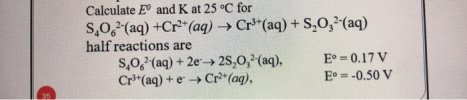 Calculate Eº and K at 25°C for ,02-(aq) +Cr2+ (aq) → Cr3+(aq) + 5,032-(aq) half reactions are 8,062-(aq) + 2e → 28,0,2-(aq), E° = 0.17 V Cr3+ (aq) + e + Cr2+(aq), E° = -0.50 V
 Calculate ΔG∘ at 298 K for the
following reactions.
Exercise 18.94 27 of 37 > A Review | Constants Periodic Table Calculate AG at 298 K for the following reactions. Part A Ca(s) + CO2(g) +0(9)+CaCO3(s) Express your answer using three significant figures. % AX! * R o L ? AGⓇ = | Submit Request Answer Part B Complete previous part(s) Part CaCO3(8) + Ca(s) + CO (9) Express your answer using three significant figures. 1% AXPRO ? AGⓇ =...
Calculate ΔG∘ at 298 K for the
following reactions.
Exercise 18.94 27 of 37 > A Review | Constants Periodic Table Calculate AG at 298 K for the following reactions. Part A Ca(s) + CO2(g) +0(9)+CaCO3(s) Express your answer using three significant figures. % AX! * R o L ? AGⓇ = | Submit Request Answer Part B Complete previous part(s) Part CaCO3(8) + Ca(s) + CO (9) Express your answer using three significant figures. 1% AXPRO ? AGⓇ =...
 Review I Constants I Periodic Table The equilibrium constant, K, for a redox reaction is related to the standard potential, E°, by the equation Standard reduction potentials nFE RT In K E° (V) Reduction half-reaction Agt(aq)eAg(s) Cu2+(aq)2eCu(s) 0.80 where n is the number of moles of electrons transferred, F (the Faraday constant) is equal to 96,500 C/(mol e), R (the gas constant) is equal to 8.314 J/(mol - K) , and T is the Kelvin temperature. 0.34 Sn4t (aq)4eSn(s) 0.15...
 10. You want to know the standard reduction potential for the Cr* (aq)|Cr(s) half- reaction Cr3 + (aq) + 3e-→ Cr(s) y, your textbook only lists the following data for chromium: Cr3+ (aq) + e-→ Cr2+ (aq) Cr2+ (aq) + 2e-→ Cr(s) E' =-0.424 V E' =-0.900 V What is the standard reduction potential for the Cr (a)Cr(s) half-reaction at 25 °C? A)-0.741 V B)-1.324 V C) 0.382V D)-0.141 V E) 0.476 V
 Use the following half-reactions to write 3 spontaneous
reactions, calculate E°cell for each reaction, what is
the n number (number of electrons transferred).
Au+ (aq) + e− → Au
(s) E° = 1.69
V
N2O (g) + 2H+ (aq) + 2 e− →
N2 (g) + H2O (l) E° =
1.77 V
Cr3+ (aq) + 3 e− → Cr
(s) E° = -0.74 V
Question 7 0.36 pts Use the following half-reactions to write 3 spontaneous reactions, calculate Eºcell for...
Use the following half-reactions to write 3 spontaneous
reactions, calculate E°cell for each reaction, what is
the n number (number of electrons transferred).
Au+ (aq) + e− → Au
(s) E° = 1.69
V
N2O (g) + 2H+ (aq) + 2 e− →
N2 (g) + H2O (l) E° =
1.77 V
Cr3+ (aq) + 3 e− → Cr
(s) E° = -0.74 V
Question 7 0.36 pts Use the following half-reactions to write 3 spontaneous reactions, calculate Eºcell for...
 Calculate Eº and K at 25°C for ,02-(aq) +Cr2+ (aq) → Cr3+(aq) + 5,032-(aq) half reactions are 8,062-(aq) + 2e → 28,0,2-(aq), E° = 0.17 V Cr3+ (aq) + e + Cr2+(aq), E° = -0.50 V
Most questions answered within 3 hours.
-
Where is the error in this code sequence?
String s1 = "Hello";
String s2 = "ello";...
asked 10 months ago -
Financial data for Joel de Paris, Inc., for last year
follow:
Joel de Paris, Inc.
Balance...
asked 10 months ago -
Consider this reaction:
Al2(SO4)3 (aq)+ BaCl3
(aq) Al2Cl6 (aq)- +
3BaSO4(s) . What is the...
asked 10 months ago -
Suppose that Savneet is considering increasing her
recent random sample from 20 car rentals to 40...
asked 10 months ago -
Trucks arrive at an unloading terminal at an average rate of 120
per hour.
Trucks arrive...
asked 10 months ago -
Why are methanol and ethanol completely soluble in water while
octanol is not very little soluble....
asked 10 months ago -
A facilities manager at a university reads in a research report
that the mean amount of...
asked 10 months ago -
When the CuSO4 is rehydrated by adding water to the anhydrous
compound, is this an endothermic...
asked 10 months ago -
A ray of sunlight is passing from diamond into crown glass; the
angle of incidence is...
asked 10 months ago -
A block of mass 0.249 kg is placed on top of a light, vertical
spring of...
asked 10 months ago -
how do the kidneys compensate in the presences of acidosis
a) trigger hyperventilate
b) reserve acid...
asked 10 months ago -
Question 501 pts
The rental rate of capital to the firm increases. Which of the
following...
asked 10 months ago