In a given CRT, electrons are accelerated horizontally by 7.4 kV . They then pass through...
In a given CRT, electrons are accelerated horizontally by 7.4 kV . They then pass through a uniform electric field E for a distance of 2.6 cm which deflects them upward so they reach the top of the screen 20 cm away, 13 cm above the center.Estimate value of E
Homework Answers
First finding the velocity of the electron from the kinetic and potential energy
v =Sqrt(2qV/m) =Sqrt(2*1.6*10-19*7.4*103/(9.11*10-31) =5.098*107m/s
now the time by the electron to cross the electric field is
t =distance /velocity =2.6*10-2m/5.098*107m/s=0.5100*10-9s =0.510ns
Now the vertical deflection of the electron in the electic field is
y =(1/2)at2
Now the force acting on the electon in an elctric field is given by
F =qE ===>ma =qE
then a =qE/m =
Now from the above equations we get electric field is E =2ym/qt2 =2*0.25*9.11*10-31/(1.6*10-19)(0.5100*10-9s)2=10.945*106V/m
Add Answer to:
In a given CRT, electrons are accelerated horizontally by 7.4 kV
. They then pass through...
In a given CRT, electrons are accelerated horizontally by 9.0 kV . They then pass through...
In a given CRT, electrons are accelerated horizontally by 9.0 kV . They then pass through a uniform electric field E for a distance of 2.5 cm , which deflects them upward so they travel 21 cm to the top of the screen, 13 cm above the center. Estimate the value of E. Neglect the upward distance that electron moves while in the electric field. kindly elaborate on the individual steps and show the calculations,thank you v
In a television picture tube (CRT), electrons are accelerated by thousands of volts through a vacuum....
In a television picture tube (CRT), electrons are accelerated by thousands of volts through a vacuum. If a television set is laid on its back, would electrons be able to move upward against the force of gravity? Find the potential difference, acting over a distance of 3.5 cm, that would be needed to balance the downward force of gravity so that an electron would remain stationary. Assume that the electric field is uniform. [Electron mass : 9.11 x 10⁻³¹ kg]
A beam of electrons is accelerated through a potential difference of 10 kV before entering a...
A beam of electrons is accelerated through a potential difference of 10 kV before entering a region having uniform electric and magnetic fields that are perpendicular to each other and perpendicular to the direction in which the electron is moving. If the magnetic field in this region has a value of 0.010 T, what magnitude of the electric field is required if the particles are to be undeflected as they pass through the region?
Part B please? A cathode ray tube (CRT) is used to accelerate electrons in some televisions,...
 Part B please?
A cathode ray tube (CRT) is used to accelerate electrons in some televisions, computer monitors, oscilloscopes, and x- ray tubes. Electrons from a heated filament pass through a hole in the cathode; they are then accelerated by an electric field between the cathode and the anode (see the figure below). + Assist Che ry View Show Guid rcal deflertion Print Ques Repa te) 1 out of 3 attempts Atter the electrons pass through the anode, they are...
Part B please?
A cathode ray tube (CRT) is used to accelerate electrons in some televisions, computer monitors, oscilloscopes, and x- ray tubes. Electrons from a heated filament pass through a hole in the cathode; they are then accelerated by an electric field between the cathode and the anode (see the figure below). + Assist Che ry View Show Guid rcal deflertion Print Ques Repa te) 1 out of 3 attempts Atter the electrons pass through the anode, they are...
In a cathode ray tube (CRT) similar to those used in older television sets, a beam...
In a cathode ray tube (CRT) similar to those used in older television sets, a beam of electrons is steered to different places on a phosphor screen, which glows at locations hit by electrons. The CRT is evacuated, so there are few gas molecules present for the electrons to run into. Electric forces are used to accelerate electrons of mass 9 × 10-31 kg to a speed 1.7 × 10⁷ m/s, after which they pass between positively and negatively charged...
A beam of electrons is accelerated through a potential difference of 11.0 kV before entering a...
A beam of electrons is accelerated through a potential difference of 11.0 kV before entering a velocity selector. If the B-field of the velocity selector is perpendicular to the velocity and has a value of 0.02 T, what value of the E-field is required (in the magnetic field region) if the particles are to be undeflected? answer in V/m
A beam of electrons is accelerated through a potential difference of 12.0 kV before entering a...
A beam of electrons is accelerated through a potential difference of 12.0 kV before entering a velocity selector. If the B-field of the velocity selector is perpendicular to the velocity and has a value of 0.02 T, what value of the E-field is required (in the magnetic field region) if the particles are to be undeflected? It's not 1.949*10^6.
4. A beam of electrons is accelerated through a potential difference of 10.0 kV before entering...
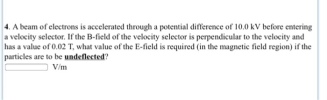 4. A beam of electrons is accelerated through a potential difference of 10.0 kV before entering a velocity selector. If the B-field of the velocity selector is perpendicular to the velocity and has a value of 0.02 T, what value of the E-field is required (in the magnetic field region) if the particles are to be undeflected? V/m
4. A beam of electrons is accelerated through a potential difference of 12.0 kV before entering...
 4. A beam of electrons is accelerated through a potential difference of 12.0 kV before entering a velocity selector. If the B-field of the velocity selector is perpendicular to the velocity and has a value of 0.03 T, what value of the E-field is required (in the magnetic field region) if the particles are to be undeflected? V/m
Electrons each with momentum 2.24539MeV/c are accelerated through an electric field of strength 4N/C over a...
Electrons each with momentum 2.24539MeV/c are accelerated through an electric field of strength 4N/C over a distance of 34nm. What is the wavelength of the electron after they pass through the electric field (electron’s speed increases)? Use non-relativistic quantities.
 Part B please?
A cathode ray tube (CRT) is used to accelerate electrons in some televisions, computer monitors, oscilloscopes, and x- ray tubes. Electrons from a heated filament pass through a hole in the cathode; they are then accelerated by an electric field between the cathode and the anode (see the figure below). + Assist Che ry View Show Guid rcal deflertion Print Ques Repa te) 1 out of 3 attempts Atter the electrons pass through the anode, they are...
Part B please?
A cathode ray tube (CRT) is used to accelerate electrons in some televisions, computer monitors, oscilloscopes, and x- ray tubes. Electrons from a heated filament pass through a hole in the cathode; they are then accelerated by an electric field between the cathode and the anode (see the figure below). + Assist Che ry View Show Guid rcal deflertion Print Ques Repa te) 1 out of 3 attempts Atter the electrons pass through the anode, they are...
 4. A beam of electrons is accelerated through a potential difference of 10.0 kV before entering a velocity selector. If the B-field of the velocity selector is perpendicular to the velocity and has a value of 0.02 T, what value of the E-field is required (in the magnetic field region) if the particles are to be undeflected? V/m
 4. A beam of electrons is accelerated through a potential difference of 12.0 kV before entering a velocity selector. If the B-field of the velocity selector is perpendicular to the velocity and has a value of 0.03 T, what value of the E-field is required (in the magnetic field region) if the particles are to be undeflected? V/m
Most questions answered within 3 hours.
-
Where is the error in this code sequence?
String s1 = "Hello";
String s2 = "ello";...
asked 10 months ago -
Financial data for Joel de Paris, Inc., for last year
follow:
Joel de Paris, Inc.
Balance...
asked 10 months ago -
Consider this reaction:
Al2(SO4)3 (aq)+ BaCl3
(aq) Al2Cl6 (aq)- +
3BaSO4(s) . What is the...
asked 10 months ago -
Suppose that Savneet is considering increasing her
recent random sample from 20 car rentals to 40...
asked 10 months ago -
Trucks arrive at an unloading terminal at an average rate of 120
per hour.
Trucks arrive...
asked 10 months ago -
Why are methanol and ethanol completely soluble in water while
octanol is not very little soluble....
asked 10 months ago -
A facilities manager at a university reads in a research report
that the mean amount of...
asked 10 months ago -
When the CuSO4 is rehydrated by adding water to the anhydrous
compound, is this an endothermic...
asked 10 months ago -
A ray of sunlight is passing from diamond into crown glass; the
angle of incidence is...
asked 10 months ago -
A block of mass 0.249 kg is placed on top of a light, vertical
spring of...
asked 10 months ago -
how do the kidneys compensate in the presences of acidosis
a) trigger hyperventilate
b) reserve acid...
asked 10 months ago -
Question 501 pts
The rental rate of capital to the firm increases. Which of the
following...
asked 10 months ago