
Homework Answers
Identify all the forces acting on piston and draw free body
diagram of piston and apply force balance on the piston


Add Answer to:
3. A gas is contained in a vertical, frictionless piston-cylinder device (figure 3) above. The piston...
A gas is contained in a vertical, frictionless piston-cylinder device. The piston has a mass of...
 A gas is contained in a vertical, frictionless piston-cylinder device. The piston has a mass of 3.2 kg and a cross-sectional area of 35 cm2. A compressed spring above the piston exerts a force of 110 N on the piston. If the atmospheric pressure is 95 kPa, determine the pressure inside the cylinder. The pressure inside the cylinder is _______ kPa.
Question 5. (20 points) A gas is contained in a vertical frictionless piston-cylinder device. The piston...
 Question 5. (20 points) A gas is contained in a vertical frictionless piston-cylinder device. The piston has a mass of 2.9 kg and cross-sectional area of 40 cm2. A compressed spring above the piston exerts a force of 170 N on the piston. If the atmospheric pressure is 97 kPa, determine the pressure inside the cylinder
* A gas is contained in a vertical, frictionless piston-cylinder device. The piston has a mass...
* A gas is contained in a vertical, frictionless piston-cylinder device. The piston has a mass of 2 kg and a cross-sectional area of 30 cm2. A spring above the piston is compressed by 2.5 mm and has a spring constant, k, of 38 kN/m. a. If the atmospheric pressure is 1 atm, determine the initial pressure (P1) inside the cylinder. Heat is added to the system until the piston moves an additional 10 mm. b. How much did the...
thermodynamics question
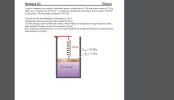 A gas is contained in a vertical, frictionless piston–cylinder device. The piston has a mass of 3.2 kg
and a cross sectional area of 35 cm2
. A compressed spring above the piston exerts a force of 150 N
on the piston. The atmospheric pressure is 95 kPa.
A gas is contained in a vertical, frictionless piston–cylinder device. The piston has a mass of 3.2 kg
and a cross sectional area of 35 cm2
. A compressed spring above the piston exerts a force of 150 N
on the piston. The atmospheric pressure is 95 kPa.
An ideal gas is contained in a cylinder equipped with a frictionless, nonleaking piston of area...
An ideal gas is contained in a cylinder equipped with a frictionless, nonleaking piston of area A. When the pressure is atmospheric P0, the piston face is at a distance l from from the closed end. The gas is compressed by moving the piston a distance x. Calculate the spring constant, or force constant, F/x, under (a) isothermal conditions and (b) under adiabatic conditions. (c) In what respect is a gas cushion superior to a steel spring?
A gas is confined within a piston-cylinder device. The piston rests, stationary atop the gas and...
A gas is confined within a piston-cylinder device. The piston rests, stationary atop the gas and has a mass of 6.3 kg and a cross sectional area of 550 mm^2. If atmospheric pressure is 104 kPa, determine the gage pressure of the gas in the cylinder and the absolute pressure of the gas in the cylinder.
5-18E Hydrogen is contained in a piston-cylinder device at 14.7 psia and 15 ft'. At this...
 5-18E Hydrogen is contained in a piston-cylinder device at 14.7 psia and 15 ft'. At this state, a linear spring (F « x) with a spring constant of 15,000 lbf/ft is touching the piston but exerts no force on it. The cross-sectional area of the piston is 3 f?. Heat is transferred to the hydrogen, causing it to expand until its vol- ume doubles. Determine (a) the final pressure, (b) the total work done by the hydrogen, and (c) the...
QUESTION 6 A 56.6 kg piston sits above a gas contained in a vertical piston-cylinder assembly....
 QUESTION 6 A 56.6 kg piston sits above a gas contained in a vertical piston-cylinder assembly. The area of the piston face is 0.1 m2. The gas undergoes a process from state 1 to state 2 defined by the following diagram and given properties. Determine the work (kl) done by the gas. Note that the piston is free floating (no friction). 8 - 9.81 m/s2 Patm - 100 kPa V1 = 1.8 m V2 = 2.5 m2 Gas
Air is contained in a vertical piston-cylinder assembly such that the piston is in static...
 Air is contained in a vertical piston-cylinder assembly such that the piston is in static equilibrium The atmosphere exerts a pressure of 101 kPa on top of the 0.8 meter-diameter piston. The gage pressure of the air inside the cylinder is 1.2 kPa. Subsequently, a weight is placed on top of the piston, as shown below, causing the piston to descend until reaching a new static equilibrium position. At this position, the gage pressure of the air inside the cylinder is...
A gas is contained in a vertical piston–cylinder assembly by a piston with a face area...
A gas is contained in a vertical piston–cylinder assembly by a piston with a face area of 40 in.2 and weight of 100 lbf. The atmosphere exerts a pressure of 14.7 lbf/in.2on top of the piston. A paddle wheel transfers 3 Btu of energy to the gas during a process in which the elevation of the piston increases by 1 ft. The change in internal energy of the gas is 2.12 Btu. The piston and cylinder are poor thermal conductors,...
 Question 5. (20 points) A gas is contained in a vertical frictionless piston-cylinder device. The piston has a mass of 2.9 kg and cross-sectional area of 40 cm2. A compressed spring above the piston exerts a force of 170 N on the piston. If the atmospheric pressure is 97 kPa, determine the pressure inside the cylinder
 5-18E Hydrogen is contained in a piston-cylinder device at 14.7 psia and 15 ft'. At this state, a linear spring (F « x) with a spring constant of 15,000 lbf/ft is touching the piston but exerts no force on it. The cross-sectional area of the piston is 3 f?. Heat is transferred to the hydrogen, causing it to expand until its vol- ume doubles. Determine (a) the final pressure, (b) the total work done by the hydrogen, and (c) the...
 QUESTION 6 A 56.6 kg piston sits above a gas contained in a vertical piston-cylinder assembly. The area of the piston face is 0.1 m2. The gas undergoes a process from state 1 to state 2 defined by the following diagram and given properties. Determine the work (kl) done by the gas. Note that the piston is free floating (no friction). 8 - 9.81 m/s2 Patm - 100 kPa V1 = 1.8 m V2 = 2.5 m2 Gas
Most questions answered within 3 hours.
-
Where is the error in this code sequence?
String s1 = "Hello";
String s2 = "ello";...
asked 10 months ago -
Financial data for Joel de Paris, Inc., for last year
follow:
Joel de Paris, Inc.
Balance...
asked 10 months ago -
Consider this reaction:
Al2(SO4)3 (aq)+ BaCl3
(aq) Al2Cl6 (aq)- +
3BaSO4(s) . What is the...
asked 10 months ago -
Suppose that Savneet is considering increasing her
recent random sample from 20 car rentals to 40...
asked 10 months ago -
Trucks arrive at an unloading terminal at an average rate of 120
per hour.
Trucks arrive...
asked 10 months ago -
Why are methanol and ethanol completely soluble in water while
octanol is not very little soluble....
asked 10 months ago -
A facilities manager at a university reads in a research report
that the mean amount of...
asked 10 months ago -
When the CuSO4 is rehydrated by adding water to the anhydrous
compound, is this an endothermic...
asked 10 months ago -
A ray of sunlight is passing from diamond into crown glass; the
angle of incidence is...
asked 10 months ago -
A block of mass 0.249 kg is placed on top of a light, vertical
spring of...
asked 10 months ago -
how do the kidneys compensate in the presences of acidosis
a) trigger hyperventilate
b) reserve acid...
asked 10 months ago -
Question 501 pts
The rental rate of capital to the firm increases. Which of the
following...
asked 10 months ago