
Homework Answers
![hPaie3500047 144 168-2 PSIa (b) isk done Ge 14.9 PSia 4. P 1s8-2144 Ib 7A Aota o tape 20ida! :.wak dane AC434168-24) (30-15]](http://img.homeworklib.com/questions/6733aba0-cd84-11eb-9c8d-e7d6cd9ea069.png?x-oss-process=image/resize,w_560)
Add Answer to:
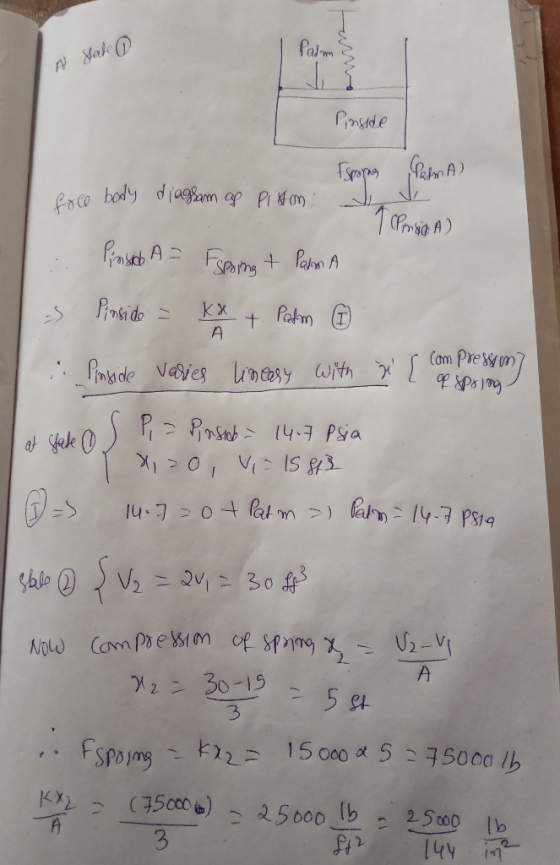
5-18E Hydrogen is contained in a piston-cylinder device at 14.7 psia and 15 ft'. At this...
2. A piston-cylinder device maintain a constant pressure of 800 kPa while containing 20 kg of...
 2. A piston-cylinder device maintain a constant pressure of 800 kPa while containing 20 kg of saturated water vapor. The system is heated with a resistance heater for 10 min at a current of 8 A at the standard wall voltage of 120 V. In that time, 3.2 kJ of heat is lost through the walls. What is the temperature at the heated state? 3 5-18E Hydrogen is contained in a piston-cylinder device at 14.7 psia and 15 ft. At...
Question 5. (20 points) A gas is contained in a vertical frictionless piston-cylinder device. The piston...
 Question 5. (20 points) A gas is contained in a vertical frictionless piston-cylinder device. The piston has a mass of 2.9 kg and cross-sectional area of 40 cm2. A compressed spring above the piston exerts a force of 170 N on the piston. If the atmospheric pressure is 97 kPa, determine the pressure inside the cylinder
A gas is contained in a vertical, frictionless piston-cylinder device. The piston has a mass of...
 A gas is contained in a vertical, frictionless piston-cylinder device. The piston has a mass of 3.2 kg and a cross-sectional area of 35 cm2. A compressed spring above the piston exerts a force of 110 N on the piston. If the atmospheric pressure is 95 kPa, determine the pressure inside the cylinder. The pressure inside the cylinder is _______ kPa.
3. A gas is contained in a vertical, frictionless piston-cylinder device (figure 3) above. The piston...
 3. A gas is contained in a vertical, frictionless piston-cylinder device (figure 3) above. The piston has a mass of 38 kg and a cross-sectional area of 35 cm2. A compressed spring above the piston exerts a force of 60 N on the piston. Determine the pressure inside the cylinder. (12 marks) a. 138.4 kPa b 147 kPa e. 127.8 kPa d. 131.2 kPae. 125 kPa
A piston-cylinder device initially contains steam at 200 kPa, 250°C, and 0.4 m3. At this state,...
A piston-cylinder device initially contains steam at 200 kPa, 250°C, and 0.4 m3. At this state, a linear spring is touching the piston, but exerts no force on it. Heat is now slowly transferred to the steam, causing the pressure and the volume to rise to 300 kPa and 0.7 m3, respectively. Show the process on a P-v diagram with respect to saturation lines and determine the following: a. The final temperature b. The work done by the steam c....
QUESTION 24 A piston-cylinder device contains 50 kg of water at 250 kPa and 25 degree...
 QUESTION 24
A piston-cylinder device contains 50 kg of water at 250 kPa and 25 degree C. The cross-sectional area of the piston is 0.1 m2. Heat is now transferred to the water, causing part of it to evaporate and expand. When the volume reaches 0.2 m3 the piston reaches a linear spring whose spring constant is 100 kN/m. More heat is transferred to the water until the piston rises 20 cm more. Determine (a) the final pressure and temperature...
QUESTION 24
A piston-cylinder device contains 50 kg of water at 250 kPa and 25 degree C. The cross-sectional area of the piston is 0.1 m2. Heat is now transferred to the water, causing part of it to evaporate and expand. When the volume reaches 0.2 m3 the piston reaches a linear spring whose spring constant is 100 kN/m. More heat is transferred to the water until the piston rises 20 cm more. Determine (a) the final pressure and temperature...
* A gas is contained in a vertical, frictionless piston-cylinder device. The piston has a mass...
* A gas is contained in a vertical, frictionless piston-cylinder device. The piston has a mass of 2 kg and a cross-sectional area of 30 cm2. A spring above the piston is compressed by 2.5 mm and has a spring constant, k, of 38 kN/m. a. If the atmospheric pressure is 1 atm, determine the initial pressure (P1) inside the cylinder. Heat is added to the system until the piston moves an additional 10 mm. b. How much did the...
A gas is contained in a vertical piston–cylinder assembly by a piston with a face area...
A gas is contained in a vertical piston–cylinder assembly by a piston with a face area of 40 in.2 and weight of 100 lbf. The atmosphere exerts a pressure of 14.7 lbf/in.2on top of the piston. A paddle wheel transfers 3 Btu of energy to the gas during a process in which the elevation of the piston increases by 1 ft. The change in internal energy of the gas is 2.12 Btu. The piston and cylinder are poor thermal conductors,...
Please show all working so I can learn the material. Partial answers I have are W1-2...
 Please show all working so I can learn the material.
Partial answers I have are W1-2 =117KJ, Wspring/W12 = 0.641
Hopefully that helps you verify your answer a bit. Thank you in
advance!
SP7: (20 points) Hydrogen gas is contained in a vertical piston-cylinder device at 140 kPa and 0.3 mº. At this state, a linear spring with a spring constant of k=150,000 N/m touches the top of the piston but exerts no force on it because the spring is...
Please show all working so I can learn the material.
Partial answers I have are W1-2 =117KJ, Wspring/W12 = 0.641
Hopefully that helps you verify your answer a bit. Thank you in
advance!
SP7: (20 points) Hydrogen gas is contained in a vertical piston-cylinder device at 140 kPa and 0.3 mº. At this state, a linear spring with a spring constant of k=150,000 N/m touches the top of the piston but exerts no force on it because the spring is...
Water is being heated in a frictionless piston cylinder device. During the process, 8 Btu of...
Water is being heated in a frictionless piston cylinder device. During the process, 8 Btu of heat is lost to the surroundings, 50,000 lbf-ft of heat is transferred to the container from a burner, and 7 Btu of work is done by the expansion of the vapor. Determine the change in the internal energy for this process.
 2. A piston-cylinder device maintain a constant pressure of 800 kPa while containing 20 kg of saturated water vapor. The system is heated with a resistance heater for 10 min at a current of 8 A at the standard wall voltage of 120 V. In that time, 3.2 kJ of heat is lost through the walls. What is the temperature at the heated state? 3 5-18E Hydrogen is contained in a piston-cylinder device at 14.7 psia and 15 ft. At...
 Question 5. (20 points) A gas is contained in a vertical frictionless piston-cylinder device. The piston has a mass of 2.9 kg and cross-sectional area of 40 cm2. A compressed spring above the piston exerts a force of 170 N on the piston. If the atmospheric pressure is 97 kPa, determine the pressure inside the cylinder
 3. A gas is contained in a vertical, frictionless piston-cylinder device (figure 3) above. The piston has a mass of 38 kg and a cross-sectional area of 35 cm2. A compressed spring above the piston exerts a force of 60 N on the piston. Determine the pressure inside the cylinder. (12 marks) a. 138.4 kPa b 147 kPa e. 127.8 kPa d. 131.2 kPae. 125 kPa
 QUESTION 24
A piston-cylinder device contains 50 kg of water at 250 kPa and 25 degree C. The cross-sectional area of the piston is 0.1 m2. Heat is now transferred to the water, causing part of it to evaporate and expand. When the volume reaches 0.2 m3 the piston reaches a linear spring whose spring constant is 100 kN/m. More heat is transferred to the water until the piston rises 20 cm more. Determine (a) the final pressure and temperature...
QUESTION 24
A piston-cylinder device contains 50 kg of water at 250 kPa and 25 degree C. The cross-sectional area of the piston is 0.1 m2. Heat is now transferred to the water, causing part of it to evaporate and expand. When the volume reaches 0.2 m3 the piston reaches a linear spring whose spring constant is 100 kN/m. More heat is transferred to the water until the piston rises 20 cm more. Determine (a) the final pressure and temperature...
 Please show all working so I can learn the material.
Partial answers I have are W1-2 =117KJ, Wspring/W12 = 0.641
Hopefully that helps you verify your answer a bit. Thank you in
advance!
SP7: (20 points) Hydrogen gas is contained in a vertical piston-cylinder device at 140 kPa and 0.3 mº. At this state, a linear spring with a spring constant of k=150,000 N/m touches the top of the piston but exerts no force on it because the spring is...
Please show all working so I can learn the material.
Partial answers I have are W1-2 =117KJ, Wspring/W12 = 0.641
Hopefully that helps you verify your answer a bit. Thank you in
advance!
SP7: (20 points) Hydrogen gas is contained in a vertical piston-cylinder device at 140 kPa and 0.3 mº. At this state, a linear spring with a spring constant of k=150,000 N/m touches the top of the piston but exerts no force on it because the spring is...
Most questions answered within 3 hours.
-
Where is the error in this code sequence?
String s1 = "Hello";
String s2 = "ello";...
asked 10 months ago -
Financial data for Joel de Paris, Inc., for last year
follow:
Joel de Paris, Inc.
Balance...
asked 10 months ago -
Consider this reaction:
Al2(SO4)3 (aq)+ BaCl3
(aq) Al2Cl6 (aq)- +
3BaSO4(s) . What is the...
asked 10 months ago -
Suppose that Savneet is considering increasing her
recent random sample from 20 car rentals to 40...
asked 10 months ago -
Trucks arrive at an unloading terminal at an average rate of 120
per hour.
Trucks arrive...
asked 10 months ago -
Why are methanol and ethanol completely soluble in water while
octanol is not very little soluble....
asked 10 months ago -
A facilities manager at a university reads in a research report
that the mean amount of...
asked 10 months ago -
When the CuSO4 is rehydrated by adding water to the anhydrous
compound, is this an endothermic...
asked 10 months ago -
A ray of sunlight is passing from diamond into crown glass; the
angle of incidence is...
asked 10 months ago -
A block of mass 0.249 kg is placed on top of a light, vertical
spring of...
asked 10 months ago -
how do the kidneys compensate in the presences of acidosis
a) trigger hyperventilate
b) reserve acid...
asked 10 months ago -
Question 501 pts
The rental rate of capital to the firm increases. Which of the
following...
asked 10 months ago