A composite refrigerator wall is composed of 2 in of cork board sandwiched between a 1/2...
Homework Answers
Step 1: convert units.
2 in = 0.17 ft
1/2 in = 0.042 ft
1/32 in = 0.0026 ft
Step 2: Draw the problem
Remember, heat comes from the external wall to the inner wall, as follows:

Step 3: Draw the thermal circuit. So, you'll have different temperatures in points 4 to 1. Every change in temperature is a node and what happens in between are resistences. Resistence is given by the thick (delta x) of the layer divide by the k coefficient and the area. When doing your calculation remember that the area is not what your seeing in front, but it is the larger part of the wall. For example, if the wall is 10 ft high, 5 ft width and has a thick of 2 ft (delta x), the area is: 10 ft * 5 ft.

Hope this helps!
Add Answer to:
A
composite refrigerator wall is composed of 2 in of cork board
sandwiched between a 1/2...
1) 1.5 A composite refrigerator wall is composed of zin. of corkboard sandwiched between a ²...
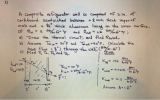 1) 1.5 A composite refrigerator wall is composed of zin. of corkboard sandwiched between a ² inch thick layer of oak and a #" thick aluminum lining on the inner surface. If hin 2 Btu/hr fe of and hout Bte/urff of; a) Draw the thermal circuit, and find total. b) Assume Too in = 20°F and Too out 90°r. Calculate the heat flux (9") through the walls (Btu/hr. ft) () Find Ti, To, To, and T4 KAR- 136 hout 15...
1. A house has a composite wall of wood, fiberglass insulation, and plaster board, as indicated...
 1. A house has a composite wall of wood, fiberglass insulation, and
plaster board, as indicated below. On a cold winter day the
convection heat transfer coefficients are ho
=
60 W/m2K
and hi
=
30 W/m2K.
The total wall surface area is 350 m2.
(a) Determine the heat transfer rate through the wall in
Watts.
(b) If the wind were blowing violently, raising ho
to 300 W/m2K,
determine the percentage
increase in the heat transfer rate.
(c) What is...
1. A house has a composite wall of wood, fiberglass insulation, and
plaster board, as indicated below. On a cold winter day the
convection heat transfer coefficients are ho
=
60 W/m2K
and hi
=
30 W/m2K.
The total wall surface area is 350 m2.
(a) Determine the heat transfer rate through the wall in
Watts.
(b) If the wind were blowing violently, raising ho
to 300 W/m2K,
determine the percentage
increase in the heat transfer rate.
(c) What is...
QUESTION 1 The wall of a refrigerator is constructed of fiberglass insulation (k - 0.035 W/m...
QUESTION 1 The wall of a refrigerator is constructed of fiberglass insulation (k - 0.035 W/m "C) sandwiched between two layers of 1-mm-thick sheet metal (k-15.1 W/m. "C). The refrigerated space is maintained at 3°C, and the average heat transfer coefficients at the inner and outer surfaces of the wall are 4 W/m2. "C and 9 W/m2. C, respectively. The kitchen temperature averages 25°C. It is observed that condensation occurs on the outer surfaces of the refrigerator when the temperature...
Problem 1: (10 points) The composite wall of an oven consists of three materials, two of...
 Problem 1: (10 points) The composite wall of an oven consists of three materials, two of which are of known thermal conductivity, k 20 W/mK and ke-50 W/m.K, and known thickness, La 0.30 m and 0.15 m. The third material, B, which is sandwiched between materials A and C is of known thickness, 0.15 m, but unknown thermal conductivity ks. Under steady-state operating conditions, measurements reveal an outer surface temperature of 20°C, an inner surface temperature of T 600°C, and...
A house has a composite wall of wood, fiberglass insulation, and plaster board, as indicated in...
 A house has a composite wall of wood, fiberglass insulation, and
plaster board, as indicated in the sketch. On a cold day, the
temperature and the convection heat transfer coefficients are T∞,i
=20°C, hi =30 W/m2K and T∞,o=−15°C, ho =60 W/m2K. The wall surface
area is 350 m2. Determine the total heat loss through the wall.
Conductivities are given as b k =0.038 W/m.K, s k =0.012 W/m.K, p k
=0.17 W/m.K
Glass fiber blanket (28 kg/m3), kn Plaster board,...
A house has a composite wall of wood, fiberglass insulation, and
plaster board, as indicated in the sketch. On a cold day, the
temperature and the convection heat transfer coefficients are T∞,i
=20°C, hi =30 W/m2K and T∞,o=−15°C, ho =60 W/m2K. The wall surface
area is 350 m2. Determine the total heat loss through the wall.
Conductivities are given as b k =0.038 W/m.K, s k =0.012 W/m.K, p k
=0.17 W/m.K
Glass fiber blanket (28 kg/m3), kn Plaster board,...
Consider the following composite wall of a building. It is made out of plaster board (Lp...
 Consider the following composite wall of a building. It is made out of plaster board (Lp 0.85 W/mK), glass fibre insulation (Lb-160 mm, k = 0.050 W/mK) and plywood (1,-40 m m, k = 0.70 W/mK) as shown below. On a certain day, the convective heat transfer coefficients inside and outside of the building are 35 W/m2K and 65 W/m2 K respectively. The inside and outside temperatures are 24°C and 36°C respectively. The wall has a total surface area of...
1. one wall is formed by two materials, the first one is 15cm thick and has...
 1. one wall is formed by two materials, the first one is 15cm thick and has a thermal conductivity of 1W/mk and the second one is cork with an unknown thick. If the temperature of the inner wall is 22°C and the temperature of the outer surface is -10°C find: a) the necessary thick of the cork to maintain a heat loss of 8W. Consider an area of 1m2! b) the interface temperature. Note: use a scheme that represents the...
A house has a composite wall of wood (exterior) (k = 0.12 W m-1 K -1...
A house has a composite wall of wood (exterior) (k = 0.12 W m-1 K -1 , 20 mm thick), fibreglass insulation (k = 0.045 W m-1 K -1 , 70 mm thick) and plasterboard (interior) (k = 0.25 W m-1 K -1 , 10 mm thick). Determine the total heat loss through the wall when the inside temperature is 20 °C, the outside temperature is -10 °C, the inside heat transfer coefficient is 15 W m-2 K -1, and...
A planar wall is composed of two materials, wall 1 has a uniform heat generation of...
 A planar wall is composed of two materials, wall 1 has a uniform heat generation of 1.5 x 10⁶ W/m3 and a thermal conductivity of 60 Wm.Κ. Wall 2 has no heat generation and thermal resistance of 150 W/m.K. The inner surface of Wall 1 is well insulated, while the outer surface of Wall 2 is exposed to 30°C fluld. The temperature of the wall surface exposed to the fluid is most nearly 00 heat flow fluid at 30°C h...
Le Lw Figure 2: Composite wall with contact resistance Figure 1: Water-proof deck 2. A tube...
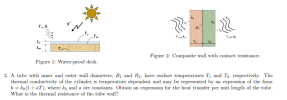 Le Lw Figure 2: Composite wall with contact resistance Figure 1: Water-proof deck 2. A tube with inner and outer wall diameters, R and R2, have surface temperatures Ti and T2, respectively. The thermal conductivity of the cylinder is temperature dependent and may be represented by an expression of the form k-ko(1 aT), where ko and a are constants. Obtain an expression for the heat transfer per unit length of the tube. What is the thermal resistance of the tube...
 1) 1.5 A composite refrigerator wall is composed of zin. of corkboard sandwiched between a ² inch thick layer of oak and a #" thick aluminum lining on the inner surface. If hin 2 Btu/hr fe of and hout Bte/urff of; a) Draw the thermal circuit, and find total. b) Assume Too in = 20°F and Too out 90°r. Calculate the heat flux (9") through the walls (Btu/hr. ft) () Find Ti, To, To, and T4 KAR- 136 hout 15...
 1. A house has a composite wall of wood, fiberglass insulation, and
plaster board, as indicated below. On a cold winter day the
convection heat transfer coefficients are ho
=
60 W/m2K
and hi
=
30 W/m2K.
The total wall surface area is 350 m2.
(a) Determine the heat transfer rate through the wall in
Watts.
(b) If the wind were blowing violently, raising ho
to 300 W/m2K,
determine the percentage
increase in the heat transfer rate.
(c) What is...
1. A house has a composite wall of wood, fiberglass insulation, and
plaster board, as indicated below. On a cold winter day the
convection heat transfer coefficients are ho
=
60 W/m2K
and hi
=
30 W/m2K.
The total wall surface area is 350 m2.
(a) Determine the heat transfer rate through the wall in
Watts.
(b) If the wind were blowing violently, raising ho
to 300 W/m2K,
determine the percentage
increase in the heat transfer rate.
(c) What is...
 Problem 1: (10 points) The composite wall of an oven consists of three materials, two of which are of known thermal conductivity, k 20 W/mK and ke-50 W/m.K, and known thickness, La 0.30 m and 0.15 m. The third material, B, which is sandwiched between materials A and C is of known thickness, 0.15 m, but unknown thermal conductivity ks. Under steady-state operating conditions, measurements reveal an outer surface temperature of 20°C, an inner surface temperature of T 600°C, and...
 A house has a composite wall of wood, fiberglass insulation, and
plaster board, as indicated in the sketch. On a cold day, the
temperature and the convection heat transfer coefficients are T∞,i
=20°C, hi =30 W/m2K and T∞,o=−15°C, ho =60 W/m2K. The wall surface
area is 350 m2. Determine the total heat loss through the wall.
Conductivities are given as b k =0.038 W/m.K, s k =0.012 W/m.K, p k
=0.17 W/m.K
Glass fiber blanket (28 kg/m3), kn Plaster board,...
A house has a composite wall of wood, fiberglass insulation, and
plaster board, as indicated in the sketch. On a cold day, the
temperature and the convection heat transfer coefficients are T∞,i
=20°C, hi =30 W/m2K and T∞,o=−15°C, ho =60 W/m2K. The wall surface
area is 350 m2. Determine the total heat loss through the wall.
Conductivities are given as b k =0.038 W/m.K, s k =0.012 W/m.K, p k
=0.17 W/m.K
Glass fiber blanket (28 kg/m3), kn Plaster board,...
 Consider the following composite wall of a building. It is made out of plaster board (Lp 0.85 W/mK), glass fibre insulation (Lb-160 mm, k = 0.050 W/mK) and plywood (1,-40 m m, k = 0.70 W/mK) as shown below. On a certain day, the convective heat transfer coefficients inside and outside of the building are 35 W/m2K and 65 W/m2 K respectively. The inside and outside temperatures are 24°C and 36°C respectively. The wall has a total surface area of...
 1. one wall is formed by two materials, the first one is 15cm thick and has a thermal conductivity of 1W/mk and the second one is cork with an unknown thick. If the temperature of the inner wall is 22°C and the temperature of the outer surface is -10°C find: a) the necessary thick of the cork to maintain a heat loss of 8W. Consider an area of 1m2! b) the interface temperature. Note: use a scheme that represents the...
 A planar wall is composed of two materials, wall 1 has a uniform heat generation of 1.5 x 10⁶ W/m3 and a thermal conductivity of 60 Wm.Κ. Wall 2 has no heat generation and thermal resistance of 150 W/m.K. The inner surface of Wall 1 is well insulated, while the outer surface of Wall 2 is exposed to 30°C fluld. The temperature of the wall surface exposed to the fluid is most nearly 00 heat flow fluid at 30°C h...
 Le Lw Figure 2: Composite wall with contact resistance Figure 1: Water-proof deck 2. A tube with inner and outer wall diameters, R and R2, have surface temperatures Ti and T2, respectively. The thermal conductivity of the cylinder is temperature dependent and may be represented by an expression of the form k-ko(1 aT), where ko and a are constants. Obtain an expression for the heat transfer per unit length of the tube. What is the thermal resistance of the tube...
Most questions answered within 3 hours.
-
Where is the error in this code sequence?
String s1 = "Hello";
String s2 = "ello";...
asked 10 months ago -
Financial data for Joel de Paris, Inc., for last year
follow:
Joel de Paris, Inc.
Balance...
asked 10 months ago -
Consider this reaction:
Al2(SO4)3 (aq)+ BaCl3
(aq) Al2Cl6 (aq)- +
3BaSO4(s) . What is the...
asked 10 months ago -
Suppose that Savneet is considering increasing her
recent random sample from 20 car rentals to 40...
asked 10 months ago -
Trucks arrive at an unloading terminal at an average rate of 120
per hour.
Trucks arrive...
asked 10 months ago -
Why are methanol and ethanol completely soluble in water while
octanol is not very little soluble....
asked 10 months ago -
A facilities manager at a university reads in a research report
that the mean amount of...
asked 10 months ago -
When the CuSO4 is rehydrated by adding water to the anhydrous
compound, is this an endothermic...
asked 10 months ago -
A ray of sunlight is passing from diamond into crown glass; the
angle of incidence is...
asked 10 months ago -
A block of mass 0.249 kg is placed on top of a light, vertical
spring of...
asked 10 months ago -
how do the kidneys compensate in the presences of acidosis
a) trigger hyperventilate
b) reserve acid...
asked 10 months ago -
Question 501 pts
The rental rate of capital to the firm increases. Which of the
following...
asked 10 months ago