
Homework Answers
Add Answer to:
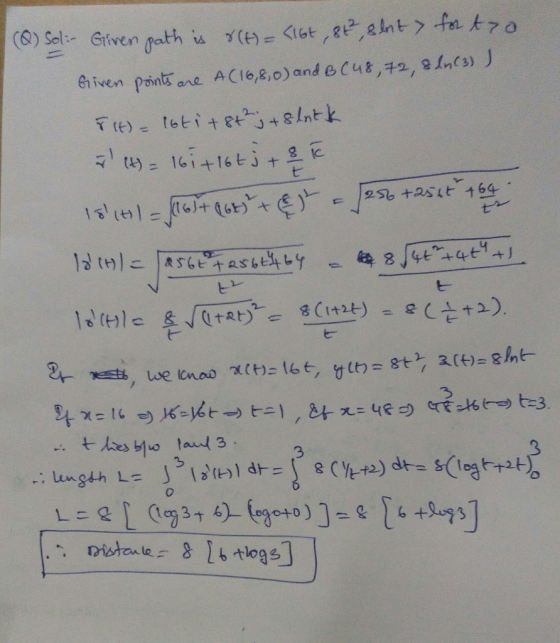
(1 point) Consider the path r(t) (16t, 812, 8 Int) defined for t> 0. Find the...
1 point) Find the arclength of the curve r(t)=(2t2,2y2t,int), for 1-t-6. 1 point) Find the arclength of the curve r(t)=(2t2,2y2t,int), for 1-t-6.
 1 point) Find the arclength of the curve r(t)=(2t2,2y2t,int), for 1-t-6.
1 point) Find the arclength of the curve r(t)=(2t2,2y2t,int), for 1-t-6.
1 point) Find the arclength of the curve r(t)=(2t2,2y2t,int), for 1-t-6.
Find the length od the curve C defined by х = t2/2 - Int, y =...
 Find the length od the curve C defined by х = t2/2 - Int, y = 2t for 1 <t <2.
Problem 3 The curve C is given by the parameterization r(t) = (t?,t) for 0 <t<...
 Problem 3 The curve C is given by the parameterization r(t) = (t?,t) for 0 <t< 1. Find the midpoint of this curve.
3. (12 points) Consider the curve C defined by r(t) = (4 sint, -4 cost,0) with...
 3. (12 points) Consider the curve C defined by r(t) = (4 sint, -4 cost,0) with t€ (0,2) (a) Compute the length of the curve C. (b) Parametrize fit) with respect to are length measured from t = 0. (c) Determine the curvature of C.
3. (12 points) Consider the curve C defined by r(t) = (4 sint, -4 cost,0) with...
 3. (12 points) Consider the curve C defined by r(t) = (4 sint, -4 cost,0) with t € (0,2) (a) Compute the length of the curve C. (b) Parametrize f(t) with respect to arc length measured from t=0. (c) Determine the curvature of C.
(1 point) Find the length of the curver r(t) = i +3t'j + tºk, 0<t</96 L
 (1 point) Find the length of the curver r(t) = i +3t'j + tºk, 0<t</96 L
(1 point) Find a vector equation for the tangent line to the curve r(t) = (2/)...
 (1 point) Find a vector equation for the tangent line to the curve r(t) = (2/) 7+ (31-8)+ (21) k at t = 9. !!! with -o0 <1 < 0
The answer above is NOT correct. (1 point) Find the length of the curve r(t) =...
 The answer above is NOT correct. (1 point) Find the length of the curve r(t) = i +3t'j + t'k, 0 <t</45 L Preview My Answers Submit Answers Your score was recorded. You have attempted this problem 9 times. You received a score of 0% for this attempt. Your overall recorded score is 0%. You have unlimited attempts remaining. Email WebWork TA WebWork 1996-20
1. a. Consider the curve defined by the following parametric equations: r(t) = et-e-t, y(t) = et ...
 1. a. Consider the curve defined by the following parametric equations: r(t) = et-e-t, y(t) = et + e-t where t can be any number. Determine where the particle describing the curve is when tIn(3) In(2). 0, ln(2) and In(3). Split up the work among your group Onex, vou l'ave found i lose live polnia, try to n"惱; wbai ille wlu le curve "u"ht lex k like. b. Verify that every point on the curve from the previous problem solves...
Int The velocity of a particle along a path is given by v(t)= fort > 0.6...
 Int The velocity of a particle along a path is given by v(t)= fort > 0.6 points each) a. Find the acceleration function of the particle along this path. t b. Find the position function of the particle given that its position at t=1 is 5.
 1 point) Find the arclength of the curve r(t)=(2t2,2y2t,int), for 1-t-6.
1 point) Find the arclength of the curve r(t)=(2t2,2y2t,int), for 1-t-6.
1 point) Find the arclength of the curve r(t)=(2t2,2y2t,int), for 1-t-6.
 Find the length od the curve C defined by х = t2/2 - Int, y = 2t for 1 <t <2.
 Problem 3 The curve C is given by the parameterization r(t) = (t?,t) for 0 <t< 1. Find the midpoint of this curve.
 3. (12 points) Consider the curve C defined by r(t) = (4 sint, -4 cost,0) with t€ (0,2) (a) Compute the length of the curve C. (b) Parametrize fit) with respect to are length measured from t = 0. (c) Determine the curvature of C.
 3. (12 points) Consider the curve C defined by r(t) = (4 sint, -4 cost,0) with t € (0,2) (a) Compute the length of the curve C. (b) Parametrize f(t) with respect to arc length measured from t=0. (c) Determine the curvature of C.
 (1 point) Find the length of the curver r(t) = i +3t'j + tºk, 0<t</96 L
 (1 point) Find a vector equation for the tangent line to the curve r(t) = (2/) 7+ (31-8)+ (21) k at t = 9. !!! with -o0 <1 < 0
 The answer above is NOT correct. (1 point) Find the length of the curve r(t) = i +3t'j + t'k, 0 <t</45 L Preview My Answers Submit Answers Your score was recorded. You have attempted this problem 9 times. You received a score of 0% for this attempt. Your overall recorded score is 0%. You have unlimited attempts remaining. Email WebWork TA WebWork 1996-20
 1. a. Consider the curve defined by the following parametric equations: r(t) = et-e-t, y(t) = et + e-t where t can be any number. Determine where the particle describing the curve is when tIn(3) In(2). 0, ln(2) and In(3). Split up the work among your group Onex, vou l'ave found i lose live polnia, try to n"惱; wbai ille wlu le curve "u"ht lex k like. b. Verify that every point on the curve from the previous problem solves...
 Int The velocity of a particle along a path is given by v(t)= fort > 0.6 points each) a. Find the acceleration function of the particle along this path. t b. Find the position function of the particle given that its position at t=1 is 5.
Most questions answered within 3 hours.
-
Where is the error in this code sequence?
String s1 = "Hello";
String s2 = "ello";...
asked 10 months ago -
Financial data for Joel de Paris, Inc., for last year
follow:
Joel de Paris, Inc.
Balance...
asked 10 months ago -
Consider this reaction:
Al2(SO4)3 (aq)+ BaCl3
(aq) Al2Cl6 (aq)- +
3BaSO4(s) . What is the...
asked 10 months ago -
Suppose that Savneet is considering increasing her
recent random sample from 20 car rentals to 40...
asked 10 months ago -
Trucks arrive at an unloading terminal at an average rate of 120
per hour.
Trucks arrive...
asked 10 months ago -
Why are methanol and ethanol completely soluble in water while
octanol is not very little soluble....
asked 10 months ago -
A facilities manager at a university reads in a research report
that the mean amount of...
asked 10 months ago -
When the CuSO4 is rehydrated by adding water to the anhydrous
compound, is this an endothermic...
asked 10 months ago -
A ray of sunlight is passing from diamond into crown glass; the
angle of incidence is...
asked 10 months ago -
A block of mass 0.249 kg is placed on top of a light, vertical
spring of...
asked 10 months ago -
how do the kidneys compensate in the presences of acidosis
a) trigger hyperventilate
b) reserve acid...
asked 10 months ago -
Question 501 pts
The rental rate of capital to the firm increases. Which of the
following...
asked 10 months ago