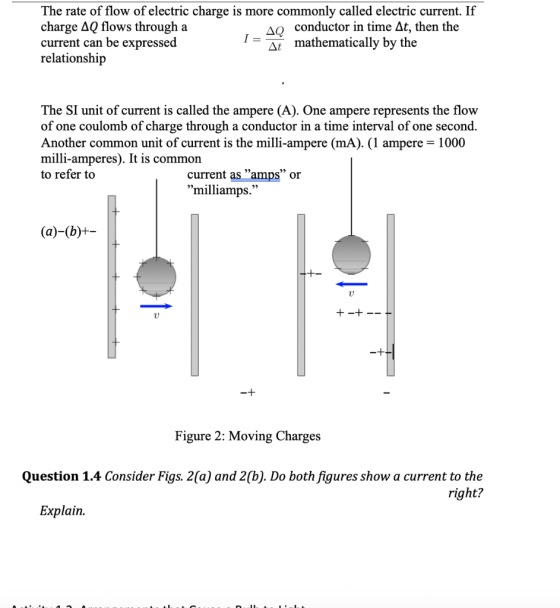
Consider Figs. 2(a) and 2(b). Do both figures show a current to the right?
Explain.
Homework Answers
As for convention - current flow in the direction where the positive chagre will flow or current flow oppsite to the direction of flow of negative charge.
In figure ( a) sphere has positive charge and it is moving to the right so current will also flow in right direction.
In Figure (b) sphere has negative charge and it is moving to the left , due to neagtive charge current will flow in opposite direction.
so in both figure current will flow in right direction.
Add Answer to:
Consider Figs. 2(a) and 2(b). Do
both figures show a current to the right?
Explain.
The...
Part A and B Please show all of the steps Analysis of Electroplating When electricity (the flow of electrons) is...
 Part A and B
Please show all of the steps
Analysis of Electroplating When electricity (the flow of electrons) is passed through a solution, it causes an oxidation-reduction (redox) reaction to occur. If the solution contains a metal cation such as Ag+, the flow of electrons will reduce the silver ion, causing solid silver to plate onto the electrode. The amount of metal plated depends on the number of electrons passed. The total charge of a mole of electrons is...
Part A and B
Please show all of the steps
Analysis of Electroplating When electricity (the flow of electrons) is passed through a solution, it causes an oxidation-reduction (redox) reaction to occur. If the solution contains a metal cation such as Ag+, the flow of electrons will reduce the silver ion, causing solid silver to plate onto the electrode. The amount of metal plated depends on the number of electrons passed. The total charge of a mole of electrons is...
A = 33, B = 3, C = 3 Consider two positive charges separated by a...
 A = 33, B = 3, C = 3
Consider two positive charges separated by a distance ((A+20)/100) meters. One charge hasa value of (B+5) mC (milli-coulombs) and is located to the right of the other (C+ 5) mC charge. Assume the left charge is the origin and the other charge is located with a positive horizontal position. How large and in what direction is the electrostatic field at the mid-point, directly between the two charges? Use i-notation for the...
A = 33, B = 3, C = 3
Consider two positive charges separated by a distance ((A+20)/100) meters. One charge hasa value of (B+5) mC (milli-coulombs) and is located to the right of the other (C+ 5) mC charge. Assume the left charge is the origin and the other charge is located with a positive horizontal position. How large and in what direction is the electrostatic field at the mid-point, directly between the two charges? Use i-notation for the...
A 33, B 3, C3 Consider two positive charges separated by a distance (A+20)/100) meters. One...
 A 33, B 3, C3 Consider two positive charges separated by a distance (A+20)/100) meters. One charge has a value of (B +5) mC (milli-coulombs) and is located to the right of the other (C+ 5) mC charge. Assume the left charge is the origin and the other charge is located with a positive horizontal position. How large and in what direction is the electrostatic field at the mid-point, directly between the two charges? Use i-notation for the direction. Calculate...
Please provide diagrams and explain very clearly. E14M.2 Consider a conductor with excess charge on its...
 Please provide diagrams and explain very clearly.
E14M.2 Consider a conductor with excess charge on its surface, and consider a patch of that conductor's surface that is small enough so that we can approximate it as being flat (a) Argue using the results of chapter E3 the conductor's surface must be perpendicular to that surface Use Gauss's law in integral form to prove that l E-σ eo Just outside the conductor, where σ is the local charge per unit area....
Please provide diagrams and explain very clearly.
E14M.2 Consider a conductor with excess charge on its surface, and consider a patch of that conductor's surface that is small enough so that we can approximate it as being flat (a) Argue using the results of chapter E3 the conductor's surface must be perpendicular to that surface Use Gauss's law in integral form to prove that l E-σ eo Just outside the conductor, where σ is the local charge per unit area....
Really need help with both please!! Question 17 2 pts Given the electric filed E =...
 Really need help with both please!!
Question 17 2 pts Given the electric filed E = 5xi – 13y2j, find the potential difference between the points (2, 3) and (4, 6). Please round your answer to the nearest whole number (integer). Equation: AV = – 5 5 S « dx + 13 So y dy Question 25 2 pts R The current density across a cylindrical conductor of radius R varies according to the equation J = 7.2 J. +...
Really need help with both please!!
Question 17 2 pts Given the electric filed E = 5xi – 13y2j, find the potential difference between the points (2, 3) and (4, 6). Please round your answer to the nearest whole number (integer). Equation: AV = – 5 5 S « dx + 13 So y dy Question 25 2 pts R The current density across a cylindrical conductor of radius R varies according to the equation J = 7.2 J. +...
Is 1 correct? Can someone explain #2? QUESTION 1 Which of the following statements about conductive...
 Is 1 correct? Can someone explain #2?
QUESTION 1 Which of the following statements about conductive materials is incorrect? 1. Charges in a conductor move in response to an electric field. Examples of conductive materials include iron, aluminum, and gold. 3. Increasing the voltage applied across a conductor will cause the conductor temperature to increase 4 Current flow in a conductive material is due to the movement of positive and/or negative charges QUESTION2 Which of the following statements about voltage...
Is 1 correct? Can someone explain #2?
QUESTION 1 Which of the following statements about conductive materials is incorrect? 1. Charges in a conductor move in response to an electric field. Examples of conductive materials include iron, aluminum, and gold. 3. Increasing the voltage applied across a conductor will cause the conductor temperature to increase 4 Current flow in a conductive material is due to the movement of positive and/or negative charges QUESTION2 Which of the following statements about voltage...
Right side (- Keep each reaction as a reduction (as in Table), and use this for both sides: E-E- ...
 right side (- Keep each reaction as a reduction (as in Table), and use this for both sides: E-E- (RT/n F) In Q Then use: Ecl E, (on the right side) - E. (on left side) 5) Consider the following electrochemical cell. Ni (s) I NİSO, (aq) (NiSO4-0.0020 M) Il (Cu2+-: 0.0030 M) | Cu (s) CuCl2 (aq) a) Write out the Nernst equation for both of the half reactions. Calculate the potential (voltage) for the system (E cell and...
P 2. (12.5 points) The figures show cross-sections of spherical (A.C.D) or cubical (B.E) Gaussian surfaces...
 P 2. (12.5 points) The figures show cross-sections of spherical (A.C.D) or cubical (B.E) Gaussian surfaces that intersect solid charged spheres of radius R. The situations on the left and right are independent. The centre each of sphere is at the origin of Insulator separate coordinate systems with axes going through the centre of both spheres. The total charge + is the same for the conducting sphere on the left and the uniformly charged dielectric sphere on the right. The...
Part B and D Please show all of the steps. Learning Goal: To relate current, time,...
 Part B and D
Please show all of the steps.
Learning Goal: To relate current, time, charge, and mass for electroplating calculations. Electroplating is a form of electrolysis in which a metal is deposited on the surface of another metal. To quantify electrolysis, use the following relationships. Electric current is measured in amperes (A), which expresses the amount of charge, in coulombs (C), that flows per second (s): 1 A 1 C/s Another unit of charge is the faraday (F),...
Part B and D
Please show all of the steps.
Learning Goal: To relate current, time, charge, and mass for electroplating calculations. Electroplating is a form of electrolysis in which a metal is deposited on the surface of another metal. To quantify electrolysis, use the following relationships. Electric current is measured in amperes (A), which expresses the amount of charge, in coulombs (C), that flows per second (s): 1 A 1 C/s Another unit of charge is the faraday (F),...
1) Which of these scientists pioneered the study of electricity? A) Isaac Newton B) Galileo C)...
 1) Which of these scientists pioneered the study of electricity? A) Isaac Newton B) Galileo C) Benjamin Franklin D) all of the above 2) The nucleus of an atom is charged A) positively B) negatively C) both of these D) none of the above 3) The electric charge of all electrons A) vary from atom to atom. B) vary from ion to ion. C) are identical. 4) Compared to the mass of a proton, the mass of an electron is...
 Part A and B
Please show all of the steps
Analysis of Electroplating When electricity (the flow of electrons) is passed through a solution, it causes an oxidation-reduction (redox) reaction to occur. If the solution contains a metal cation such as Ag+, the flow of electrons will reduce the silver ion, causing solid silver to plate onto the electrode. The amount of metal plated depends on the number of electrons passed. The total charge of a mole of electrons is...
Part A and B
Please show all of the steps
Analysis of Electroplating When electricity (the flow of electrons) is passed through a solution, it causes an oxidation-reduction (redox) reaction to occur. If the solution contains a metal cation such as Ag+, the flow of electrons will reduce the silver ion, causing solid silver to plate onto the electrode. The amount of metal plated depends on the number of electrons passed. The total charge of a mole of electrons is...
 A = 33, B = 3, C = 3
Consider two positive charges separated by a distance ((A+20)/100) meters. One charge hasa value of (B+5) mC (milli-coulombs) and is located to the right of the other (C+ 5) mC charge. Assume the left charge is the origin and the other charge is located with a positive horizontal position. How large and in what direction is the electrostatic field at the mid-point, directly between the two charges? Use i-notation for the...
A = 33, B = 3, C = 3
Consider two positive charges separated by a distance ((A+20)/100) meters. One charge hasa value of (B+5) mC (milli-coulombs) and is located to the right of the other (C+ 5) mC charge. Assume the left charge is the origin and the other charge is located with a positive horizontal position. How large and in what direction is the electrostatic field at the mid-point, directly between the two charges? Use i-notation for the...
 A 33, B 3, C3 Consider two positive charges separated by a distance (A+20)/100) meters. One charge has a value of (B +5) mC (milli-coulombs) and is located to the right of the other (C+ 5) mC charge. Assume the left charge is the origin and the other charge is located with a positive horizontal position. How large and in what direction is the electrostatic field at the mid-point, directly between the two charges? Use i-notation for the direction. Calculate...
 Please provide diagrams and explain very clearly.
E14M.2 Consider a conductor with excess charge on its surface, and consider a patch of that conductor's surface that is small enough so that we can approximate it as being flat (a) Argue using the results of chapter E3 the conductor's surface must be perpendicular to that surface Use Gauss's law in integral form to prove that l E-σ eo Just outside the conductor, where σ is the local charge per unit area....
Please provide diagrams and explain very clearly.
E14M.2 Consider a conductor with excess charge on its surface, and consider a patch of that conductor's surface that is small enough so that we can approximate it as being flat (a) Argue using the results of chapter E3 the conductor's surface must be perpendicular to that surface Use Gauss's law in integral form to prove that l E-σ eo Just outside the conductor, where σ is the local charge per unit area....
 Really need help with both please!!
Question 17 2 pts Given the electric filed E = 5xi – 13y2j, find the potential difference between the points (2, 3) and (4, 6). Please round your answer to the nearest whole number (integer). Equation: AV = – 5 5 S « dx + 13 So y dy Question 25 2 pts R The current density across a cylindrical conductor of radius R varies according to the equation J = 7.2 J. +...
Really need help with both please!!
Question 17 2 pts Given the electric filed E = 5xi – 13y2j, find the potential difference between the points (2, 3) and (4, 6). Please round your answer to the nearest whole number (integer). Equation: AV = – 5 5 S « dx + 13 So y dy Question 25 2 pts R The current density across a cylindrical conductor of radius R varies according to the equation J = 7.2 J. +...
 Is 1 correct? Can someone explain #2?
QUESTION 1 Which of the following statements about conductive materials is incorrect? 1. Charges in a conductor move in response to an electric field. Examples of conductive materials include iron, aluminum, and gold. 3. Increasing the voltage applied across a conductor will cause the conductor temperature to increase 4 Current flow in a conductive material is due to the movement of positive and/or negative charges QUESTION2 Which of the following statements about voltage...
Is 1 correct? Can someone explain #2?
QUESTION 1 Which of the following statements about conductive materials is incorrect? 1. Charges in a conductor move in response to an electric field. Examples of conductive materials include iron, aluminum, and gold. 3. Increasing the voltage applied across a conductor will cause the conductor temperature to increase 4 Current flow in a conductive material is due to the movement of positive and/or negative charges QUESTION2 Which of the following statements about voltage...
 right side (- Keep each reaction as a reduction (as in Table), and use this for both sides: E-E- (RT/n F) In Q Then use: Ecl E, (on the right side) - E. (on left side) 5) Consider the following electrochemical cell. Ni (s) I NİSO, (aq) (NiSO4-0.0020 M) Il (Cu2+-: 0.0030 M) | Cu (s) CuCl2 (aq) a) Write out the Nernst equation for both of the half reactions. Calculate the potential (voltage) for the system (E cell and...
 P 2. (12.5 points) The figures show cross-sections of spherical (A.C.D) or cubical (B.E) Gaussian surfaces that intersect solid charged spheres of radius R. The situations on the left and right are independent. The centre each of sphere is at the origin of Insulator separate coordinate systems with axes going through the centre of both spheres. The total charge + is the same for the conducting sphere on the left and the uniformly charged dielectric sphere on the right. The...
 Part B and D
Please show all of the steps.
Learning Goal: To relate current, time, charge, and mass for electroplating calculations. Electroplating is a form of electrolysis in which a metal is deposited on the surface of another metal. To quantify electrolysis, use the following relationships. Electric current is measured in amperes (A), which expresses the amount of charge, in coulombs (C), that flows per second (s): 1 A 1 C/s Another unit of charge is the faraday (F),...
Part B and D
Please show all of the steps.
Learning Goal: To relate current, time, charge, and mass for electroplating calculations. Electroplating is a form of electrolysis in which a metal is deposited on the surface of another metal. To quantify electrolysis, use the following relationships. Electric current is measured in amperes (A), which expresses the amount of charge, in coulombs (C), that flows per second (s): 1 A 1 C/s Another unit of charge is the faraday (F),...
 1) Which of these scientists pioneered the study of electricity? A) Isaac Newton B) Galileo C) Benjamin Franklin D) all of the above 2) The nucleus of an atom is charged A) positively B) negatively C) both of these D) none of the above 3) The electric charge of all electrons A) vary from atom to atom. B) vary from ion to ion. C) are identical. 4) Compared to the mass of a proton, the mass of an electron is...
Most questions answered within 3 hours.
-
Where is the error in this code sequence?
String s1 = "Hello";
String s2 = "ello";...
asked 10 months ago -
Financial data for Joel de Paris, Inc., for last year
follow:
Joel de Paris, Inc.
Balance...
asked 10 months ago -
Consider this reaction:
Al2(SO4)3 (aq)+ BaCl3
(aq) Al2Cl6 (aq)- +
3BaSO4(s) . What is the...
asked 10 months ago -
Suppose that Savneet is considering increasing her
recent random sample from 20 car rentals to 40...
asked 10 months ago -
Trucks arrive at an unloading terminal at an average rate of 120
per hour.
Trucks arrive...
asked 10 months ago -
Why are methanol and ethanol completely soluble in water while
octanol is not very little soluble....
asked 10 months ago -
A facilities manager at a university reads in a research report
that the mean amount of...
asked 10 months ago -
When the CuSO4 is rehydrated by adding water to the anhydrous
compound, is this an endothermic...
asked 10 months ago -
A ray of sunlight is passing from diamond into crown glass; the
angle of incidence is...
asked 10 months ago -
A block of mass 0.249 kg is placed on top of a light, vertical
spring of...
asked 10 months ago -
how do the kidneys compensate in the presences of acidosis
a) trigger hyperventilate
b) reserve acid...
asked 10 months ago -
Question 501 pts
The rental rate of capital to the firm increases. Which of the
following...
asked 10 months ago