
Homework Answers

Add Answer to:
Right side (- Keep each reaction as a reduction (as in Table), and use this for both sides: E-E- ...
Constants The following values may be useful when solving this tutorial. Constant Value E∘Cu 0.337 V...
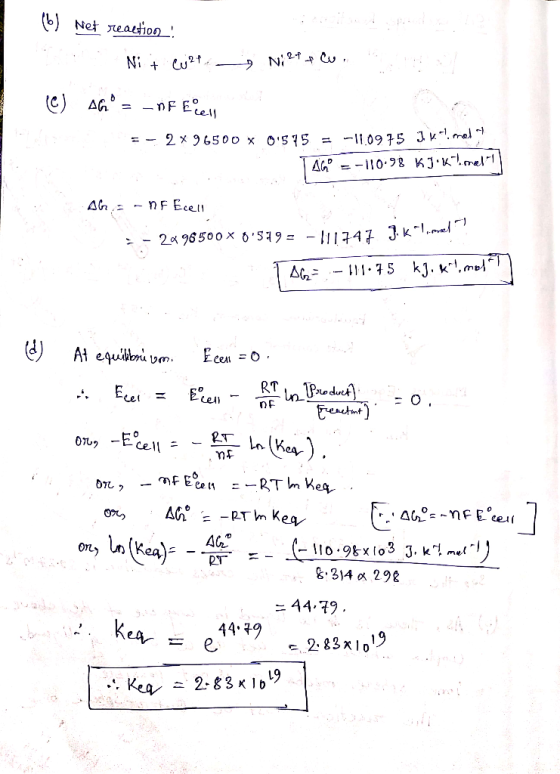
Constants The following values may be useful when solving this tutorial. Constant Value E∘Cu 0.337 V E∘Ni -0.257 V R 8.314 J⋅mol−1⋅K−1 F 96,485 C/mol T 298 K Part A In the activity, click on the E∘cell and Keq quantities to observe how they are related. Use this relation to calculate Keq for the following redox reaction that occurs in an electrochemical cell having two electrodes: a cathode and an anode. The two half-reactions that occur in the cell are...
Please help, thanks. Use the table below to answer the questions that follow. Half Reaction &
Please help, thanks. Use the table below to answer the questions that follow. Half Reaction E°(V) Ag+ + e- → Ag (s) +0.80 Cu2+ + 2e- → Cu (s) +0.34 Pb2+ + 2e- → Pb (s) -0.13 Ni2+ + 2e- → Ni (s) -0.28 (A) Calculate E°cell for a voltaic cell made with Ni, Ni2+and Ag, and Ag+. (B) Which substance is Oxidized? (be sure to include the state of the oxidized substance in your answer) Zn(s) + CuSO4(aq) -->...
electro Calculate the E°cell for the following reaction: Cu2+ (aq) + Ni (s) → Cu (s)...
electro Calculate the E°cell for the following reaction: Cu2+ (aq) + Ni (s) → Cu (s) + Ni2+ (aq)
Cell Potential and Equilibrium Standard reduction potentials The equilibrium constant, K, for a redox reaction is...
 Cell Potential and Equilibrium Standard reduction potentials The equilibrium constant, K, for a redox reaction is related to the standard cell potential, Ecel, by the equation Reduction half-reaction (V) Ag+ (aq) + e-→Ag(s) Cu2+ (aq) + 2e-→Cu(s) 0.34 Sn (a) 4e-Sn(s 0.15 2H' (aq) + 2e-→H2 (g) Ni2+ (aq) + 2e-→Ni(s)-0.26 Fe2+ (aq) + 2e-→Fe(s)-0.45 Zn2+ (aq) + 2e-→Zn(s)-0.76 Al3+ (aq) +3e-→Al(s) -1.66 Mg2+ (aq) + 2e-→Mg(s) -2.37 0.80 n FEcell where n is the number of moles of electrons...
QUESTION 4 Using the table below and the Nearnst Equation E-E° (0.0592/n)logQ Find the voltage of...
 QUESTION 4 Using the table below and the Nearnst Equation E-E° (0.0592/n)logQ Find the voltage of the cell: Cu2+(aq) + Ni(s) ? Cu(s) + Ni2+(aq) at 25° C if the concentrations of the soluble species are [Cu2+1-0.050 M and [Ni]- 1.40 M Reduction Reaction Sn2++ 2e-? Sn Cu2+ + 2e- ?Cu" Reduction Potential, Ecell 0.14 Volts 0.34 Volts 0.25 Volts +0.77 Volts Fe3+ + e-? Fe2+ 0.50 V 0.54 V 0.62 V 0.66 V
Given the following reaction, Cu2+(aq) + Zn(s) → Cu(s) + Zn2+(aq) E° = 1.10 V Use...
Given the following reaction, Cu2+(aq) + Zn(s) → Cu(s) + Zn2+(aq) E° = 1.10 V Use the Nernst equation to calculate the cell potential for the cell described with standard line notation below. Zn|Zn2+(0.5038 M)||Cu2+(0.3981 M)|Cu Units are not required. Report answer to three decimal places.
Constants The following values may be useful when solving this tutorial. Constant Value Eco 0.337 V...
 Constants The following values may be useful when solving this tutorial. Constant Value Eco 0.337 V -0.257 V R 8.314 J. mol-1. K-1 96,485 C/mol 298 K F T Part A In the activity, click on the Ecell and Keq quantities to observe how they are related. Use this relation to calculate Keq for the following redox reaction that occurs in an electrochemical cell having two electrodes: a cathode and an anode. The two half- reactions that occur in the...
use e.) to answer #4 1. Classify each of the following reactions as OR (oxidation-reduction), SR...
 use e.) to answer #4
1. Classify each of the following reactions as OR (oxidation-reduction), SR (single replacement), DR (double replacement), C (combination), D (decomposition) reactions. If a reaction falls into more than one classification, you need to indicate them all. Classification Reaction: a) 4 HNO3 (aq)+ Cu (s) Cu(NO3)2 (aq)+2 NO2 (g) +2 H20 (1) b) Cu(NO3)2 (aq) + 2 NaOH (aq) Cu(OH)2 (s) + 2 NaNO3 (aq) c) Cu(OH)2 (s) + heat > CuO (s)+ H20 1) d)...
use e.) to answer #4
1. Classify each of the following reactions as OR (oxidation-reduction), SR (single replacement), DR (double replacement), C (combination), D (decomposition) reactions. If a reaction falls into more than one classification, you need to indicate them all. Classification Reaction: a) 4 HNO3 (aq)+ Cu (s) Cu(NO3)2 (aq)+2 NO2 (g) +2 H20 (1) b) Cu(NO3)2 (aq) + 2 NaOH (aq) Cu(OH)2 (s) + 2 NaNO3 (aq) c) Cu(OH)2 (s) + heat > CuO (s)+ H20 1) d)...
Calculate the E°cell for the following reaction: Cu2+ (aq) + Ni (s) → Cu (s)...
Calculate the E°cell for the following reaction: Cu2+ (aq) + Ni (s) → Cu (s) + Ni2+ (aq) A) (-0.59 ± 0.01) V B) (-0.09 ± 0.01) V C) (0.59 ± 0.01) V D) (0.09 ± 0.01) V --------------------------------------------------------------------------------------------------------- What is the proper line notation for the following reaction? Cu (s) + 2Ag+ (aq) → Cu2+ (aq) + 2Ag (s) A) Cu2+ | Cu || Ag | Ag+ B) Ag+ | Ag || Cu | Cu2+ C) Cu |...
The equilibrium constant, K, for a redox reaction is related to the standard potential, Eº, by...
 The equilibrium constant, K, for a redox reaction is related to the standard potential, Eº, by the equation In K = nFE° RT where n is the number of moles of electrons transferred, F (the Faraday constant) is equal to 96,500 C/(mol e), R (the gas constant) is equal to 8.314 J/(mol · K), and T is the Kelvin temperature. Standard reduction potentials Reduction half-reaction E° (V) Ag+ (aq) + e +Ag(s) 0.80 Cu²+ (aq) + 2e + Cu(s) 0.34...
 Cell Potential and Equilibrium Standard reduction potentials The equilibrium constant, K, for a redox reaction is related to the standard cell potential, Ecel, by the equation Reduction half-reaction (V) Ag+ (aq) + e-→Ag(s) Cu2+ (aq) + 2e-→Cu(s) 0.34 Sn (a) 4e-Sn(s 0.15 2H' (aq) + 2e-→H2 (g) Ni2+ (aq) + 2e-→Ni(s)-0.26 Fe2+ (aq) + 2e-→Fe(s)-0.45 Zn2+ (aq) + 2e-→Zn(s)-0.76 Al3+ (aq) +3e-→Al(s) -1.66 Mg2+ (aq) + 2e-→Mg(s) -2.37 0.80 n FEcell where n is the number of moles of electrons...
 QUESTION 4 Using the table below and the Nearnst Equation E-E° (0.0592/n)logQ Find the voltage of the cell: Cu2+(aq) + Ni(s) ? Cu(s) + Ni2+(aq) at 25° C if the concentrations of the soluble species are [Cu2+1-0.050 M and [Ni]- 1.40 M Reduction Reaction Sn2++ 2e-? Sn Cu2+ + 2e- ?Cu" Reduction Potential, Ecell 0.14 Volts 0.34 Volts 0.25 Volts +0.77 Volts Fe3+ + e-? Fe2+ 0.50 V 0.54 V 0.62 V 0.66 V
 Constants The following values may be useful when solving this tutorial. Constant Value Eco 0.337 V -0.257 V R 8.314 J. mol-1. K-1 96,485 C/mol 298 K F T Part A In the activity, click on the Ecell and Keq quantities to observe how they are related. Use this relation to calculate Keq for the following redox reaction that occurs in an electrochemical cell having two electrodes: a cathode and an anode. The two half- reactions that occur in the...
 use e.) to answer #4
1. Classify each of the following reactions as OR (oxidation-reduction), SR (single replacement), DR (double replacement), C (combination), D (decomposition) reactions. If a reaction falls into more than one classification, you need to indicate them all. Classification Reaction: a) 4 HNO3 (aq)+ Cu (s) Cu(NO3)2 (aq)+2 NO2 (g) +2 H20 (1) b) Cu(NO3)2 (aq) + 2 NaOH (aq) Cu(OH)2 (s) + 2 NaNO3 (aq) c) Cu(OH)2 (s) + heat > CuO (s)+ H20 1) d)...
use e.) to answer #4
1. Classify each of the following reactions as OR (oxidation-reduction), SR (single replacement), DR (double replacement), C (combination), D (decomposition) reactions. If a reaction falls into more than one classification, you need to indicate them all. Classification Reaction: a) 4 HNO3 (aq)+ Cu (s) Cu(NO3)2 (aq)+2 NO2 (g) +2 H20 (1) b) Cu(NO3)2 (aq) + 2 NaOH (aq) Cu(OH)2 (s) + 2 NaNO3 (aq) c) Cu(OH)2 (s) + heat > CuO (s)+ H20 1) d)...
 The equilibrium constant, K, for a redox reaction is related to the standard potential, Eº, by the equation In K = nFE° RT where n is the number of moles of electrons transferred, F (the Faraday constant) is equal to 96,500 C/(mol e), R (the gas constant) is equal to 8.314 J/(mol · K), and T is the Kelvin temperature. Standard reduction potentials Reduction half-reaction E° (V) Ag+ (aq) + e +Ag(s) 0.80 Cu²+ (aq) + 2e + Cu(s) 0.34...
Most questions answered within 3 hours.
-
Where is the error in this code sequence?
String s1 = "Hello";
String s2 = "ello";...
asked 11 months ago -
Financial data for Joel de Paris, Inc., for last year
follow:
Joel de Paris, Inc.
Balance...
asked 11 months ago -
Consider this reaction:
Al2(SO4)3 (aq)+ BaCl3
(aq) Al2Cl6 (aq)- +
3BaSO4(s) . What is the...
asked 11 months ago -
Suppose that Savneet is considering increasing her
recent random sample from 20 car rentals to 40...
asked 11 months ago -
Trucks arrive at an unloading terminal at an average rate of 120
per hour.
Trucks arrive...
asked 11 months ago -
Why are methanol and ethanol completely soluble in water while
octanol is not very little soluble....
asked 11 months ago -
A facilities manager at a university reads in a research report
that the mean amount of...
asked 11 months ago -
When the CuSO4 is rehydrated by adding water to the anhydrous
compound, is this an endothermic...
asked 11 months ago -
A ray of sunlight is passing from diamond into crown glass; the
angle of incidence is...
asked 11 months ago -
A block of mass 0.249 kg is placed on top of a light, vertical
spring of...
asked 11 months ago -
how do the kidneys compensate in the presences of acidosis
a) trigger hyperventilate
b) reserve acid...
asked 11 months ago -
Question 501 pts
The rental rate of capital to the firm increases. Which of the
following...
asked 11 months ago