For the analysis of a sample , 3 beakers containing 25 mL of the sample ,...
For the analysis of a sample , 3 beakers containing 25 mL of the sample , each added with 5 mL phosphoric acid and then treated differently (some added with KIO4 while one was added with 5 mL of 2 mM Mn standard) before being transferred into a 50-mL volumetric flask and then added with water to the 50 mL mark. The absorbance reading after zeroing with the blank is 0.850 for the sample with added standard and 0.500 for just the sample. Determine the concentration of the Mn in the original sample
Homework Answers
Absorbance is directly proportional to concentration.
Let's say x mM of original sample in dilute.
5 mL of 2 mM standard diluted to 50 mL.concentration of standard in beaker= 5×2/50=0.2 mM
A1/A2 = x/x+0.2=0.5/0.85
0.85x=0.5x + 0.1
0.35x=0.1
x=0.286 mM.
25 mL of sample diluted to 50 mL or 50/25=2 times diluted.
Original Mn sample concentration=0.286×2= 0.572 mM.
Add Answer to:
For the analysis of a sample , 3 beakers containing 25 mL of the
sample ,...
A 11.17 mg ore sample containing copper is digested with acid, filtered and transferred to a...
A 11.17 mg ore sample containing copper is digested with acid, filtered and transferred to a volumetric flask and diluted to exactly 200.00 mL. A 10.00 mL aliquot is transferred to a 100.00 mL volumetric flask containing zincon reagent and a quantity of a pH 9 buffer solution. It is then diluted to the mark and mixed thoroughly. The measured absorbance of the resulting blue solution at 600 nm was 0.326 which corresponded to a Cu(II) concentration of 0.498 ppm...
Question 5: A set of values for known concentrations of Mn ions were first obtained and...
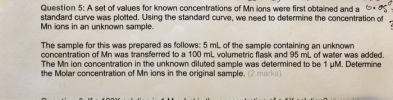 Question 5: A set of values for known concentrations of Mn ions were first obtained and a .os standard curve was plotted. Using the standard curve, we need to determine the concentration of Mn ions in an unknown sample. The sample for this was prepared as follows: 5 mL of the sample containing an unknown concentration of Mn was transferred to a 100 mL volumetric flask and 95 mL of water was added. The Mn ion concentration in the unknown...
Pure solid NaH2PO4 is dissolved in distilled water, making 100.00 ml of solution. 10.00ml of this...
Pure solid NaH2PO4 is dissolved in distilled water, making 100.00 ml of solution. 10.00ml of this solution is diluted to 100.00 ml to prepare the original phosphate standard solution. Three working standard solutions are made from this by pipetting 0.8ml, 1.5ml and 3.0 ml of the original standard solution into 100.00 ml volumetric flasks. Acid and molybdate reagent are added and the solutions are diluted to 100.00 ml. You may assume that all these absorbance measurements have already been corrected...
The following five beakers, each containing a solution of sodium chloride (NaCl, also known as table...
The following five beakers, each containing a solution of sodium chloride (NaCl, also known as table salt), were found on a lab shelf: Beaker Contents 1 200 mL. of 1.50 M NaCl solution 2 100 mL. of 3.00 M NaCl solution 3 150 mL. of solution containing 22.5 g of NaCl 4 100 mL. of solution containing 22.5 g of NaCl 5 300 mL. of solution containing 0.450 mol NaCl Arrange the solutions in order of decreasing concentration. Rank from...
You weighed out 0.3267 g of steel and completely dissolved it in 6 M nitric acid...
You weighed out 0.3267 g of steel and completely dissolved it in 6 M nitric acid upon heating in the fume hood for an hour. The entire contents were transferred to a 250 mL volumetric flask, which was diluted to the mark with DI water. 10 mL aliquots were transferred to six different 250 mL Erlenmeyer flasks. To each Erlenmeyer flask, 5 mL of 85 % H3PO4 were added along with 0.4 g of KIO4. Increasing volumes, Vs of 0,...
A student obtains 500.0 mL of a solution containing an unknown concentration of calcium iodide, CaI...
A student obtains 500.0 mL of a solution containing an unknown concentration of calcium iodide, CaI 2. She pipets 25 mL of this solution into a 100 mL volumetric flask and dilutes to the mark. She then pipets 10 mL of this diluted solution into a 50 mL volumetric flask and dilutes to the mark. She analyzes some of the solution from the final volumetric flask and finds that the iodide ion concentration is 0.0000064 M. Determine the molar concentration...
To analyze the chromium in an unknown sample 1.5623 f of the sample was pretreated and...
 To analyze the chromium in an unknown sample 1.5623 f of the sample was pretreated and diluted to the exact 100 mL mark in a volumetric flask. Two 20.0 mL samples of this solution were taken. In the first sample, a Cr-EDTA complex is developed and sufficient water is added to give a total volume of 100.0 mL. In the second sample, 10.0 mL of Cr(III) standard solution at to concentration of 15 mM was added before developing the Cr-EDTA...
5. Caffeine in Mountain Due is determined by standard addition method. Five mL of the soft...
 5. Caffeine in Mountain Due is determined by standard addition method. Five mL of the soft drink is placed in each of five 100-mL volumetric flask. Then, increasing volumes: 0, 5, 10, 15, 20 mL of a standard solution of 0.300 mM caffeine are added to each flask. All 5 flasks are filled with distilled water to the 100-mL mark and mixed well. Absorbance of - the solution in each flask is obtained. Plotting absorbance vs added volume (as mL)...
b) In this experiment an aspirin ta and dissolved in 10 mL of 1.0M Na mark...
 b) In this experiment an aspirin ta and dissolved in 10 mL of 1.0M Na mark with deionized water. Using a into a 100-mL volumetric flask and make a diluted aspirin solution'. ent an aspirin tablet was placed in a 250-ml volumetric flask 10 mL of 1.OM NaOH solution, the flask was then filled to the zed water. Using a pipette, 5.0 mL of this solution was added IL Volumetric flask and diluted to the mark with FeCl solution to...
The urine sample containing phosphate was treated with molybdenum blue reagent to produce a species absorbing...
The urine sample containing phosphate was treated with molybdenum blue reagent to produce a species absorbing at 820 nm with an absorbance of 0.428. Then 1.00 mL of a 5.00 g/L phosphate standard was added to 104.0 mL of the urine sample. The spiked urine sample gave an absorbance of 0.517. Find the original concentration of phosphate in g/L in the urine sample. Correct sigfigs!
 Question 5: A set of values for known concentrations of Mn ions were first obtained and a .os standard curve was plotted. Using the standard curve, we need to determine the concentration of Mn ions in an unknown sample. The sample for this was prepared as follows: 5 mL of the sample containing an unknown concentration of Mn was transferred to a 100 mL volumetric flask and 95 mL of water was added. The Mn ion concentration in the unknown...
 To analyze the chromium in an unknown sample 1.5623 f of the sample was pretreated and diluted to the exact 100 mL mark in a volumetric flask. Two 20.0 mL samples of this solution were taken. In the first sample, a Cr-EDTA complex is developed and sufficient water is added to give a total volume of 100.0 mL. In the second sample, 10.0 mL of Cr(III) standard solution at to concentration of 15 mM was added before developing the Cr-EDTA...
 5. Caffeine in Mountain Due is determined by standard addition method. Five mL of the soft drink is placed in each of five 100-mL volumetric flask. Then, increasing volumes: 0, 5, 10, 15, 20 mL of a standard solution of 0.300 mM caffeine are added to each flask. All 5 flasks are filled with distilled water to the 100-mL mark and mixed well. Absorbance of - the solution in each flask is obtained. Plotting absorbance vs added volume (as mL)...
 b) In this experiment an aspirin ta and dissolved in 10 mL of 1.0M Na mark with deionized water. Using a into a 100-mL volumetric flask and make a diluted aspirin solution'. ent an aspirin tablet was placed in a 250-ml volumetric flask 10 mL of 1.OM NaOH solution, the flask was then filled to the zed water. Using a pipette, 5.0 mL of this solution was added IL Volumetric flask and diluted to the mark with FeCl solution to...
Most questions answered within 3 hours.
-
Where is the error in this code sequence?
String s1 = "Hello";
String s2 = "ello";...
asked 10 months ago -
Financial data for Joel de Paris, Inc., for last year
follow:
Joel de Paris, Inc.
Balance...
asked 10 months ago -
Consider this reaction:
Al2(SO4)3 (aq)+ BaCl3
(aq) Al2Cl6 (aq)- +
3BaSO4(s) . What is the...
asked 10 months ago -
Suppose that Savneet is considering increasing her
recent random sample from 20 car rentals to 40...
asked 10 months ago -
Trucks arrive at an unloading terminal at an average rate of 120
per hour.
Trucks arrive...
asked 10 months ago -
Why are methanol and ethanol completely soluble in water while
octanol is not very little soluble....
asked 10 months ago -
A facilities manager at a university reads in a research report
that the mean amount of...
asked 10 months ago -
When the CuSO4 is rehydrated by adding water to the anhydrous
compound, is this an endothermic...
asked 10 months ago -
A ray of sunlight is passing from diamond into crown glass; the
angle of incidence is...
asked 10 months ago -
A block of mass 0.249 kg is placed on top of a light, vertical
spring of...
asked 10 months ago -
how do the kidneys compensate in the presences of acidosis
a) trigger hyperventilate
b) reserve acid...
asked 10 months ago -
Question 501 pts
The rental rate of capital to the firm increases. Which of the
following...
asked 10 months ago