
Homework Answers
7. Gas pressure is caused by
E) gas molecules colliding with surfaces. Greater the collisions greater will be the pressure of the gas.
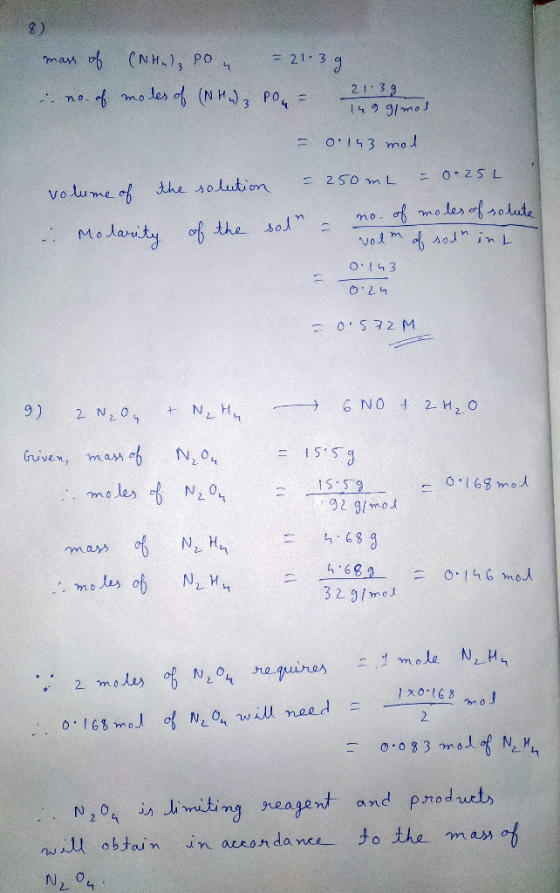
8. A) 0.572 M
9. C) 15.2 g
10. The name of the compound Mg(NO3)2 is
D) Magnesium nitrate
11. A) 87.7

Add Answer to:
Gas pressure is caused by: A) barometers B) temperature C) gas molecules condensing into a liquid...
1. Gas turning to liquid is A) Increase in entropy B) Decrease in entropy C) Endothermic...
1. Gas turning to liquid is A) Increase in entropy B) Decrease in entropy C) Endothermic 2. Breaking of bonds is always A) Endothermic B) Exothermic C) No net change of energy 3. Forming bonds is A) Exothermic B) Endothermic C) No change in energy 4. Which of the following is standard state function? A) density B) heat C) rate of reaction 5. Which of the following is a decrease in entropy? A) solid becomes a liquid B) liquid becomes...
Hi there I need help please. 26. Which of the following does not have eight valence...
 Hi there I need help please.
26. Which of the following does not have eight valence electrons? A) Ca+ B) Rb+ C) Xe D) Br E) All of the above have eight valence electrons. as the magnitude of the ion 27. In ionic bond formation, the lattice energy of ions charges A) decrease, decrease, decrease B) increases, increase, increase C) decreases, increase, increase D) increases, increase, decrease E) increases, decrease, decrease and the radii 28. Which formula/name pair is incorrect?...
Hi there I need help please.
26. Which of the following does not have eight valence electrons? A) Ca+ B) Rb+ C) Xe D) Br E) All of the above have eight valence electrons. as the magnitude of the ion 27. In ionic bond formation, the lattice energy of ions charges A) decrease, decrease, decrease B) increases, increase, increase C) decreases, increase, increase D) increases, increase, decrease E) increases, decrease, decrease and the radii 28. Which formula/name pair is incorrect?...
At High Temperature the red color is strong. At Low Temperature the gas has less color....
 At High Temperature the red color is strong. At Low Temperature the gas has less color. If we represent the equilibrium as: N204() 2 2 NO2(g) We can conclude that: 1. This reaction is: A. Exothermic B. Endothermic C. Neutral D. More information is needed to answer this question. 2. When the temperature is decreased the equilibrium constant, K: A. Increases B. Decreases C. Remains the same D. More information is needed to answer this question. 3. When the temperature...
Dinitrogen tetraoxide and nitrogen dioxide are two gases that cxist in cquilibrium at brown gas while N204 is colorless...
 Dinitrogen tetraoxide and nitrogen dioxide are two gases that cxist in cquilibrium at brown gas while N204 is colorless range of tempcratures. NO2 is a reddish At High Temperature the red color is strong. At Low Temperature the gas has less color. If we represent the equilibrium as: 2 NO2(g) E N204(g) We can conclude that: A 1. This reaction is: A. Exothermic B. Endothermic C. Neutral D. More information is needed to answer this question. B 2. When the...
If the temperature of a sealed glass flask containing 1 mole of nitrogen gas at 101.3...
If the temperature of a sealed glass flask containing 1 mole of nitrogen gas at 101.3 kPa is raised from 273.2 K to 546.4 K a. The moles of gas will decrease by a factor of 2. b. The moles of gas will increase by a factor of 2. c. The pressure will decrease by a factor of 2. d. The pressure will increase by a factor of 2. e. The volume of gas will decrease by a factor of...
If the temperature of a sealed glass flask containing 1 mole of nitrogen gas at 101.3 kPa is raised from 273.2 K to 546....
If the temperature of a sealed glass flask containing 1 mole of nitrogen gas at 101.3 kPa is raised from 273.2 K to 546.4 K a. The moles of gas will decrease by a factor of 2. b. The moles of gas will increase by a factor of 2. c. The pressure will decrease by a factor of 2. d. The pressure will increase by a factor of 2. e. The volume of gas will decrease by a factor of...
A.) Classify reaction as exothermic or endothermic. Gas burning in a Bunsen burner: C3H8(g)+5O2(g)→3CO2(g)+4H2O(g)+2044kJ B.) Give...
A.) Classify reaction as exothermic or endothermic. Gas burning in a Bunsen burner: C3H8(g)+5O2(g)→3CO2(g)+4H2O(g)+2044kJ B.) Give ΔH for reaction above. C.) Classify reaction as exothermic or endothermic. Dehydratation hydroxide: Co(OH)2(s)+16kJ→CoO(s)+H2O(l) D.) Give ΔH for reaction above. E.) Classify reaction as exothermic or endothermic. Formation of aluminum oxide and chromium from aluminum and chromium (III) oxide: 2Al(s)+Cr2O3(s)→Al2O3(s)+2Cr(s)+536kJ F.) Give ΔH for reaction above.
please answer all questions (14) If you mix two solutions and the temperature of the mixture...
 please answer all questions
(14) If you mix two solutions and the temperature of the mixture decrease, which is true in such case? (a) The reaction is endgyermic, AH >O (b) The reaction is exothermic, AH< 0 O(C) The reaction is endothermic, AH< 0 (d) The reaction is exothermic, AH>0 (12) One liter of Nigas and one liter of O2 gas will have the same at 25°C and 1 atm. (a) molarity (b) density (c) molar mass (d) mass (20)...
please answer all questions
(14) If you mix two solutions and the temperature of the mixture decrease, which is true in such case? (a) The reaction is endgyermic, AH >O (b) The reaction is exothermic, AH< 0 O(C) The reaction is endothermic, AH< 0 (d) The reaction is exothermic, AH>0 (12) One liter of Nigas and one liter of O2 gas will have the same at 25°C and 1 atm. (a) molarity (b) density (c) molar mass (d) mass (20)...
If the temperature of a sealed glass flask containing 1 mole of nitrogen gas at 101.3 kPa is raised from 273.2 K to 546....
If the temperature of a sealed glass flask containing 1 mole of nitrogen gas at 101.3 kPa is raised from 273.2 K to 546.4 K a. The moles of gas will decrease by a factor of 2. b. The moles of gas will increase by a factor of 2. c. The pressure will decrease by a factor of 2. d. The pressure will increase by a factor of 2. e. The volume of gas will decrease by a factor of...
32) The reaction of one mole of nitrogen gas with three moles of hydrogen gas releases 92 ) thermal energy to the s...
 32) The reaction of one mole of nitrogen gas with three moles of hydrogen gas releases 92 ) thermal energy to the surroundings. Which of the following is TRUE? A) This reaction has a negative enthalpy of reaction. B) Complete reaction of two moles of nitrogen gas would release 184 kl of thermal energy this reaction. C) This reaction is exothermic. D) All of the above are true. E) None of the above are true. 33) How many grams of...
 Hi there I need help please.
26. Which of the following does not have eight valence electrons? A) Ca+ B) Rb+ C) Xe D) Br E) All of the above have eight valence electrons. as the magnitude of the ion 27. In ionic bond formation, the lattice energy of ions charges A) decrease, decrease, decrease B) increases, increase, increase C) decreases, increase, increase D) increases, increase, decrease E) increases, decrease, decrease and the radii 28. Which formula/name pair is incorrect?...
Hi there I need help please.
26. Which of the following does not have eight valence electrons? A) Ca+ B) Rb+ C) Xe D) Br E) All of the above have eight valence electrons. as the magnitude of the ion 27. In ionic bond formation, the lattice energy of ions charges A) decrease, decrease, decrease B) increases, increase, increase C) decreases, increase, increase D) increases, increase, decrease E) increases, decrease, decrease and the radii 28. Which formula/name pair is incorrect?...
 At High Temperature the red color is strong. At Low Temperature the gas has less color. If we represent the equilibrium as: N204() 2 2 NO2(g) We can conclude that: 1. This reaction is: A. Exothermic B. Endothermic C. Neutral D. More information is needed to answer this question. 2. When the temperature is decreased the equilibrium constant, K: A. Increases B. Decreases C. Remains the same D. More information is needed to answer this question. 3. When the temperature...
 Dinitrogen tetraoxide and nitrogen dioxide are two gases that cxist in cquilibrium at brown gas while N204 is colorless range of tempcratures. NO2 is a reddish At High Temperature the red color is strong. At Low Temperature the gas has less color. If we represent the equilibrium as: 2 NO2(g) E N204(g) We can conclude that: A 1. This reaction is: A. Exothermic B. Endothermic C. Neutral D. More information is needed to answer this question. B 2. When the...
 please answer all questions
(14) If you mix two solutions and the temperature of the mixture decrease, which is true in such case? (a) The reaction is endgyermic, AH >O (b) The reaction is exothermic, AH< 0 O(C) The reaction is endothermic, AH< 0 (d) The reaction is exothermic, AH>0 (12) One liter of Nigas and one liter of O2 gas will have the same at 25°C and 1 atm. (a) molarity (b) density (c) molar mass (d) mass (20)...
please answer all questions
(14) If you mix two solutions and the temperature of the mixture decrease, which is true in such case? (a) The reaction is endgyermic, AH >O (b) The reaction is exothermic, AH< 0 O(C) The reaction is endothermic, AH< 0 (d) The reaction is exothermic, AH>0 (12) One liter of Nigas and one liter of O2 gas will have the same at 25°C and 1 atm. (a) molarity (b) density (c) molar mass (d) mass (20)...
 32) The reaction of one mole of nitrogen gas with three moles of hydrogen gas releases 92 ) thermal energy to the surroundings. Which of the following is TRUE? A) This reaction has a negative enthalpy of reaction. B) Complete reaction of two moles of nitrogen gas would release 184 kl of thermal energy this reaction. C) This reaction is exothermic. D) All of the above are true. E) None of the above are true. 33) How many grams of...
Most questions answered within 3 hours.
-
Where is the error in this code sequence?
String s1 = "Hello";
String s2 = "ello";...
asked 10 months ago -
Financial data for Joel de Paris, Inc., for last year
follow:
Joel de Paris, Inc.
Balance...
asked 10 months ago -
Consider this reaction:
Al2(SO4)3 (aq)+ BaCl3
(aq) Al2Cl6 (aq)- +
3BaSO4(s) . What is the...
asked 10 months ago -
Suppose that Savneet is considering increasing her
recent random sample from 20 car rentals to 40...
asked 10 months ago -
Trucks arrive at an unloading terminal at an average rate of 120
per hour.
Trucks arrive...
asked 10 months ago -
Why are methanol and ethanol completely soluble in water while
octanol is not very little soluble....
asked 10 months ago -
A facilities manager at a university reads in a research report
that the mean amount of...
asked 10 months ago -
When the CuSO4 is rehydrated by adding water to the anhydrous
compound, is this an endothermic...
asked 10 months ago -
A ray of sunlight is passing from diamond into crown glass; the
angle of incidence is...
asked 10 months ago -
A block of mass 0.249 kg is placed on top of a light, vertical
spring of...
asked 10 months ago -
how do the kidneys compensate in the presences of acidosis
a) trigger hyperventilate
b) reserve acid...
asked 10 months ago -
Question 501 pts
The rental rate of capital to the firm increases. Which of the
following...
asked 10 months ago