
Homework Answers
Add Answer to:
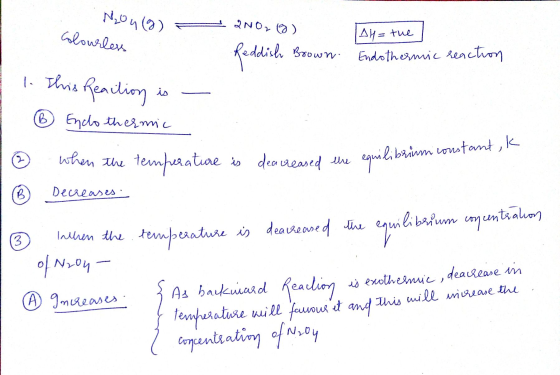
At High Temperature the red color is strong. At Low Temperature the gas has less color....
Dinitrogen tetraoxide and nitrogen dioxide are two gases that exist in equilibrium at a range of...
 Dinitrogen tetraoxide and nitrogen dioxide are two gases that exist in equilibrium at a range of temperatures. NO2 is a reddish brown gas while N204 is colorless. At High Temperature the red color is strong. || At Low Temperature the gas has less color. If we represent the equilibrium as: 2 NO2(g) = N204(9) We can conclude that: 1. This reaction is: A. Exothermic B. Endothermic C. Neutral D. More information is needed to answer this question. 2. When the...
Dinitrogen tetraoxide and nitrogen dioxide are two gases that cxist in cquilibrium at brown gas while N204 is colorless...
 Dinitrogen tetraoxide and nitrogen dioxide are two gases that cxist in cquilibrium at brown gas while N204 is colorless range of tempcratures. NO2 is a reddish At High Temperature the red color is strong. At Low Temperature the gas has less color. If we represent the equilibrium as: 2 NO2(g) E N204(g) We can conclude that: A 1. This reaction is: A. Exothermic B. Endothermic C. Neutral D. More information is needed to answer this question. B 2. When the...
age but References Review Dies ws VU - ww PA Leo tots M 1 pts 2rea...
 age but References Review Dies ws VU - ww PA Leo tots M 1 pts 2rea ipts 2ree At Low Temperature the pink color predominates. At High Temperature the blue color is strong. Tots 2rea 1 pts req K 1 pts M If we represent the equilibrium as: CoC1, (aq)= Co2+ (aq) + 4Cl (aq) We can conclude that: 1. This reaction is: A. Exothermic B. Endothermic C. Neutral D. More information is needed to answer this question. 1 pts...
The equilibrium constant for a given reaction a. always increases with temperature. b. increases with temperature...
 The equilibrium constant for a given reaction a. always increases with temperature. b. increases with temperature for endothermic reactions only. c. increases with temperature for exothermic reactions only. d. does not change with temperature. e. always decreases with temperature.
Gas pressure is caused by: A) barometers B) temperature C) gas molecules condensing into a liquid...
 Gas pressure is caused by: A) barometers B) temperature C) gas molecules condensing into a liquid D) gas molecules hitting other gas molecules E) gas molecules colliding with surfaces 7) 8) What is the molarity of a solution that results when 21.3 g of (NH4)3PO4 (MM- 149 g/mol) is dissolved C) 0.357 M E) 1.61 x 10- water and brought to a total volume of 250.0 mL? D) 85.2 M B) 2.28 M A) 0.572 M 9) What is the...
2. The reaction Fe3+ (aq) + SCN (aq) → FeSCN2+ (aq) produces a dark red color...
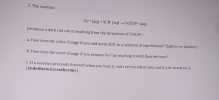 2. The reaction Fe3+ (aq) + SCN (aq) → FeSCN2+ (aq) produces a dark red color resulting from the formation of FeSCN2+. a. How does the color change if you add more SCN to a solution at equilibrium? (lighter or darker) b. How does the color change if you remove Fe3+ by reacting it with fluoride ions? c. If a reaction proceeds forward when you heat it, and reverse when you cool it, the reaction is [endothermic exothermic).
uestion Completion Status: N204(8) <...> 2 NO 2(8) At 25°C, 0.11 mole of N204 reacts to form 0.10 mol of N204...
 uestion Completion Status: N204(8) <...> 2 NO 2(8) At 25°C, 0.11 mole of N204 reacts to form 0.10 mol of N204 and 0.02 mole of NO 2. At 90'C, 0.11 mole of N204 forms 0.050 moles of N204 and 0.12 mole of NO2. From this data, we can conclude The reaction is exothermic the equilibrium constant for the reaction above increases with an increase in temperature. N204 molecules react faster at 25°C than at 90°C. O None of these are...
Q1)Reactions tend to form the most products when a) the disorder increases and the energy content...
Q1)Reactions tend to form the most products when a) the disorder increases and the energy content increases. b) the disorder increases and the energy content decreases. c) the disorder decreases and the energy content increases. d) the disorder decreases and the energy content decreases. e) None of the above are correct. Q2)Assuming all following gases can be considered as ideal, which chemical system shifts to the right when pressure is increased? a) CO2(g) + H2(g) <----> CO(g) + H2O(g) b)...
Number five temperature increases and entropy increases temperature is unchanged and entropy increases temperature increases and...
 Number five
temperature increases and entropy increases
temperature is unchanged and entropy increases
temperature increases and entropy us unchanged
temperature increases and entropy decreases
number 6
none
temperature increases and entropy increases
temperature is unchanged and entropy increases
temperature increases and entropy us unchanged
temperature increases and entropy decreases
Number seven
spontaneous at all temperatures
Non-spontaneous at all temperatures
not enough information
spontaneous at low temperature only
spontaneous at high temperature only
5. Choose best answer from drop-down menu: 3...
Number five
temperature increases and entropy increases
temperature is unchanged and entropy increases
temperature increases and entropy us unchanged
temperature increases and entropy decreases
number 6
none
temperature increases and entropy increases
temperature is unchanged and entropy increases
temperature increases and entropy us unchanged
temperature increases and entropy decreases
Number seven
spontaneous at all temperatures
Non-spontaneous at all temperatures
not enough information
spontaneous at low temperature only
spontaneous at high temperature only
5. Choose best answer from drop-down menu: 3...
Why does the pressure of a gas sample increase when the temperature is increased? Assume the...
 Why does the pressure of a gas sample increase when the
temperature is increased? Assume the volume remains constant.
Select all that apply.
Why does the pressure of a gas sample increase when the temperature is increased? Assume the volume remains constant. Select all that apply. Choose one or more: O A. The average kinetic energy of the gas increases as the temperature increases, causing more energetic collisions with the walls. O B. As the temperature of the gas increases,...
Why does the pressure of a gas sample increase when the
temperature is increased? Assume the volume remains constant.
Select all that apply.
Why does the pressure of a gas sample increase when the temperature is increased? Assume the volume remains constant. Select all that apply. Choose one or more: O A. The average kinetic energy of the gas increases as the temperature increases, causing more energetic collisions with the walls. O B. As the temperature of the gas increases,...
 Dinitrogen tetraoxide and nitrogen dioxide are two gases that exist in equilibrium at a range of temperatures. NO2 is a reddish brown gas while N204 is colorless. At High Temperature the red color is strong. || At Low Temperature the gas has less color. If we represent the equilibrium as: 2 NO2(g) = N204(9) We can conclude that: 1. This reaction is: A. Exothermic B. Endothermic C. Neutral D. More information is needed to answer this question. 2. When the...
 Dinitrogen tetraoxide and nitrogen dioxide are two gases that cxist in cquilibrium at brown gas while N204 is colorless range of tempcratures. NO2 is a reddish At High Temperature the red color is strong. At Low Temperature the gas has less color. If we represent the equilibrium as: 2 NO2(g) E N204(g) We can conclude that: A 1. This reaction is: A. Exothermic B. Endothermic C. Neutral D. More information is needed to answer this question. B 2. When the...
 age but References Review Dies ws VU - ww PA Leo tots M 1 pts 2rea ipts 2ree At Low Temperature the pink color predominates. At High Temperature the blue color is strong. Tots 2rea 1 pts req K 1 pts M If we represent the equilibrium as: CoC1, (aq)= Co2+ (aq) + 4Cl (aq) We can conclude that: 1. This reaction is: A. Exothermic B. Endothermic C. Neutral D. More information is needed to answer this question. 1 pts...
 The equilibrium constant for a given reaction a. always increases with temperature. b. increases with temperature for endothermic reactions only. c. increases with temperature for exothermic reactions only. d. does not change with temperature. e. always decreases with temperature.
 Gas pressure is caused by: A) barometers B) temperature C) gas molecules condensing into a liquid D) gas molecules hitting other gas molecules E) gas molecules colliding with surfaces 7) 8) What is the molarity of a solution that results when 21.3 g of (NH4)3PO4 (MM- 149 g/mol) is dissolved C) 0.357 M E) 1.61 x 10- water and brought to a total volume of 250.0 mL? D) 85.2 M B) 2.28 M A) 0.572 M 9) What is the...
 2. The reaction Fe3+ (aq) + SCN (aq) → FeSCN2+ (aq) produces a dark red color resulting from the formation of FeSCN2+. a. How does the color change if you add more SCN to a solution at equilibrium? (lighter or darker) b. How does the color change if you remove Fe3+ by reacting it with fluoride ions? c. If a reaction proceeds forward when you heat it, and reverse when you cool it, the reaction is [endothermic exothermic).
 uestion Completion Status: N204(8) <...> 2 NO 2(8) At 25°C, 0.11 mole of N204 reacts to form 0.10 mol of N204 and 0.02 mole of NO 2. At 90'C, 0.11 mole of N204 forms 0.050 moles of N204 and 0.12 mole of NO2. From this data, we can conclude The reaction is exothermic the equilibrium constant for the reaction above increases with an increase in temperature. N204 molecules react faster at 25°C than at 90°C. O None of these are...
 Number five
temperature increases and entropy increases
temperature is unchanged and entropy increases
temperature increases and entropy us unchanged
temperature increases and entropy decreases
number 6
none
temperature increases and entropy increases
temperature is unchanged and entropy increases
temperature increases and entropy us unchanged
temperature increases and entropy decreases
Number seven
spontaneous at all temperatures
Non-spontaneous at all temperatures
not enough information
spontaneous at low temperature only
spontaneous at high temperature only
5. Choose best answer from drop-down menu: 3...
Number five
temperature increases and entropy increases
temperature is unchanged and entropy increases
temperature increases and entropy us unchanged
temperature increases and entropy decreases
number 6
none
temperature increases and entropy increases
temperature is unchanged and entropy increases
temperature increases and entropy us unchanged
temperature increases and entropy decreases
Number seven
spontaneous at all temperatures
Non-spontaneous at all temperatures
not enough information
spontaneous at low temperature only
spontaneous at high temperature only
5. Choose best answer from drop-down menu: 3...
 Why does the pressure of a gas sample increase when the
temperature is increased? Assume the volume remains constant.
Select all that apply.
Why does the pressure of a gas sample increase when the temperature is increased? Assume the volume remains constant. Select all that apply. Choose one or more: O A. The average kinetic energy of the gas increases as the temperature increases, causing more energetic collisions with the walls. O B. As the temperature of the gas increases,...
Why does the pressure of a gas sample increase when the
temperature is increased? Assume the volume remains constant.
Select all that apply.
Why does the pressure of a gas sample increase when the temperature is increased? Assume the volume remains constant. Select all that apply. Choose one or more: O A. The average kinetic energy of the gas increases as the temperature increases, causing more energetic collisions with the walls. O B. As the temperature of the gas increases,...
Most questions answered within 3 hours.
-
Where is the error in this code sequence?
String s1 = "Hello";
String s2 = "ello";...
asked 10 months ago -
Financial data for Joel de Paris, Inc., for last year
follow:
Joel de Paris, Inc.
Balance...
asked 10 months ago -
Consider this reaction:
Al2(SO4)3 (aq)+ BaCl3
(aq) Al2Cl6 (aq)- +
3BaSO4(s) . What is the...
asked 10 months ago -
Suppose that Savneet is considering increasing her
recent random sample from 20 car rentals to 40...
asked 10 months ago -
Trucks arrive at an unloading terminal at an average rate of 120
per hour.
Trucks arrive...
asked 10 months ago -
Why are methanol and ethanol completely soluble in water while
octanol is not very little soluble....
asked 10 months ago -
A facilities manager at a university reads in a research report
that the mean amount of...
asked 10 months ago -
When the CuSO4 is rehydrated by adding water to the anhydrous
compound, is this an endothermic...
asked 10 months ago -
A ray of sunlight is passing from diamond into crown glass; the
angle of incidence is...
asked 10 months ago -
A block of mass 0.249 kg is placed on top of a light, vertical
spring of...
asked 10 months ago -
how do the kidneys compensate in the presences of acidosis
a) trigger hyperventilate
b) reserve acid...
asked 10 months ago -
Question 501 pts
The rental rate of capital to the firm increases. Which of the
following...
asked 10 months ago