
Homework Answers

Add Answer to:
1. (4 points) Four forces are acting on a disk as shown in the Figure 1....
Two dlsks are located on an axle as shown In the figure below. The lower disk...
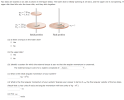 Two dlsks are located on an axle as shown In the figure below. The lower disk Is Initlally spinning at 24 rad/s, and the upper one Is not spinning. T upper dlsk then falls onto the lower dlsk, and they stlck together. m2 7.0 kg R1.0 m m 20 kg R1 2.0 m Initial position Final position (a) Is there a torque on the lower disk? Yes No On the upper disk? Yes No (b) Identify a system for which...
24 4 points Conservation of angular momentum: A disk with moment of inertia I1 = 3kgm...
 24 4 points Conservation of angular momentum: A disk with moment of inertia I1 = 3kgm rotates about a frictionless, vertical axle with angular speed wi = 8Rad/s. A second disk, this one having moment of inertia 12 = 1kgm and initially not rotating, drops onto the first disk. Because of friction between the surfaces, the two eventually reach the same angular speed W2 . What is w2? 13 Before After 24 Rad/s 12 Rad/s 6 Rad/s 16 Rad/s 4...
A metal disk of radius 5.0 cm is mounted on a frictionless axle. Current can flow...
 A metal disk of radius 5.0 cm is mounted on a frictionless axle. Current can flow through the axle out along the disk, to a sliding contact on the rim of the disk. A forte at thegone iGetween the station ary electrical c onta ct and the rotating the surrent i5 3.0 A, the disk rotätes with constant angular velocity. What's the frictiona 825 N This problem focuses on two concepts. One is the Faraday Law, the other is the...
Disk A, with n mass of 2. 0 kg and a radius of 90 cm, rotates...
 Disk A, with n mass of 2. 0 kg and a radius of 90 cm, rotates clockwise about a frictionless vertical axle at 20 rev/g. Disk B, also 2.0 kg but with a radius of 20 cm, rotates counterclockwise about that same axle, but at a greater height than disk A, at 20 rev/s. Disk B slides down the axle until it lands on top of disk A, after which they rotate together. After the collision what is magnitude of...
Adisk slides toward a motionless stick on a frictionless surface (figure below). The disk strikes and...
 Adisk slides toward a motionless stick on a frictionless surface (figure below). The disk strikes and adheres to the stick and they rotate together pivoting around the rail. Angular momentum is conserved for this inelastic collision because the surface is frictionless and the unbalanced external force at the tail exerts no torque Before M Nal (plot 0.100 m from the il Consideratuation where the disk as a masof 515 (a) What is the angula velocity in rad/s) of the two...
A disk with moment of inertia 9.15 × 10⁻³ kg∙m^2 initially rotates about its center at...
A disk with moment of inertia 9.15 × 10⁻³ kg∙m^2 initially rotates about its center at angular velocity 5.32 rad/s. A non-rotating ring with moment of inertia 4.86 × 10⁻³ kg∙m^2 right above the disk’s center is suddenly dropped onto the disk. Finally, the two objects rotate at the same angular velocity ?? about the same axis. There is no external torque acting on the system during the collision. Please compute the system’s quantities below. 1. Initial angular momentum ??...
(3) A disk with moment of inertia 9.15 × 10⁻³ kg∙m 2 initially rotates about its...
(3) A disk with moment of inertia 9.15 × 10⁻³ kg∙m 2 initially rotates about its center at angular velocity 5.32 rad/s. A non-rotating ring with moment of inertia 4.86 × 10⁻³ kg∙m 2 right above the disk’s center is suddenly dropped onto the disk. Finally, the two objects rotate at the same angular velocity ?? about the same axis. There is no external torque acting on the system during the collision. Please compute the system’s quantities below. 1. Initial...
unable to find the x and y values.. A thin disk of mass m = 4...
 unable to find the x and y values..
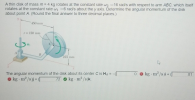
A thin disk of mass m = 4 kg rotates at the constant rate W2 =16 rad/s with respect to arm ABC, which itself rotates at the constant rate wi=6 rad/s about the y axis. Determine the angular momentum of the disk about point A. (Round the final answer to three decimal places.) 450 mm T = 150 mm The angular momentum of the disk about its center C is Ha=- kg.mº/s)j...
unable to find the x and y values..
A thin disk of mass m = 4 kg rotates at the constant rate W2 =16 rad/s with respect to arm ABC, which itself rotates at the constant rate wi=6 rad/s about the y axis. Determine the angular momentum of the disk about point A. (Round the final answer to three decimal places.) 450 mm T = 150 mm The angular momentum of the disk about its center C is Ha=- kg.mº/s)j...
The 1.9 kg , 4.6-cm-diameter disk is rotating as shown in (Figure 1). What is the...
The 1.9 kg , 4.6-cm-diameter disk is rotating as shown in (Figure 1). What is the angular momentum of the disk about the axle?
The disk ntating with a constant angular accelerstion Assurse the axle is frictionkess Ca) Calcud...
 please answer 5 and 6
im sorry thats the closest pic i can get to
it
the disk ntating with a constant angular accelerstion Assurse the axle is frictionkess Ca) Calcudlate the magnituke and direction of the net torpsue prodhuced by the twe lorces b) Determine the magnitude of the angular acceleration of the disk rad/s Cakulate the angular momentum, in kg mP/s, of an ice skater spinning at 6.00 rew/s given is moment of inertia is 0 rew/s given...
please answer 5 and 6
im sorry thats the closest pic i can get to
it
the disk ntating with a constant angular accelerstion Assurse the axle is frictionkess Ca) Calcudlate the magnituke and direction of the net torpsue prodhuced by the twe lorces b) Determine the magnitude of the angular acceleration of the disk rad/s Cakulate the angular momentum, in kg mP/s, of an ice skater spinning at 6.00 rew/s given is moment of inertia is 0 rew/s given...
 Two dlsks are located on an axle as shown In the figure below. The lower disk Is Initlally spinning at 24 rad/s, and the upper one Is not spinning. T upper dlsk then falls onto the lower dlsk, and they stlck together. m2 7.0 kg R1.0 m m 20 kg R1 2.0 m Initial position Final position (a) Is there a torque on the lower disk? Yes No On the upper disk? Yes No (b) Identify a system for which...
 24 4 points Conservation of angular momentum: A disk with moment of inertia I1 = 3kgm rotates about a frictionless, vertical axle with angular speed wi = 8Rad/s. A second disk, this one having moment of inertia 12 = 1kgm and initially not rotating, drops onto the first disk. Because of friction between the surfaces, the two eventually reach the same angular speed W2 . What is w2? 13 Before After 24 Rad/s 12 Rad/s 6 Rad/s 16 Rad/s 4...
 A metal disk of radius 5.0 cm is mounted on a frictionless axle. Current can flow through the axle out along the disk, to a sliding contact on the rim of the disk. A forte at thegone iGetween the station ary electrical c onta ct and the rotating the surrent i5 3.0 A, the disk rotätes with constant angular velocity. What's the frictiona 825 N This problem focuses on two concepts. One is the Faraday Law, the other is the...
 Disk A, with n mass of 2. 0 kg and a radius of 90 cm, rotates clockwise about a frictionless vertical axle at 20 rev/g. Disk B, also 2.0 kg but with a radius of 20 cm, rotates counterclockwise about that same axle, but at a greater height than disk A, at 20 rev/s. Disk B slides down the axle until it lands on top of disk A, after which they rotate together. After the collision what is magnitude of...
 Adisk slides toward a motionless stick on a frictionless surface (figure below). The disk strikes and adheres to the stick and they rotate together pivoting around the rail. Angular momentum is conserved for this inelastic collision because the surface is frictionless and the unbalanced external force at the tail exerts no torque Before M Nal (plot 0.100 m from the il Consideratuation where the disk as a masof 515 (a) What is the angula velocity in rad/s) of the two...
 unable to find the x and y values..
A thin disk of mass m = 4 kg rotates at the constant rate W2 =16 rad/s with respect to arm ABC, which itself rotates at the constant rate wi=6 rad/s about the y axis. Determine the angular momentum of the disk about point A. (Round the final answer to three decimal places.) 450 mm T = 150 mm The angular momentum of the disk about its center C is Ha=- kg.mº/s)j...
unable to find the x and y values..
A thin disk of mass m = 4 kg rotates at the constant rate W2 =16 rad/s with respect to arm ABC, which itself rotates at the constant rate wi=6 rad/s about the y axis. Determine the angular momentum of the disk about point A. (Round the final answer to three decimal places.) 450 mm T = 150 mm The angular momentum of the disk about its center C is Ha=- kg.mº/s)j...
 please answer 5 and 6
im sorry thats the closest pic i can get to
it
the disk ntating with a constant angular accelerstion Assurse the axle is frictionkess Ca) Calcudlate the magnituke and direction of the net torpsue prodhuced by the twe lorces b) Determine the magnitude of the angular acceleration of the disk rad/s Cakulate the angular momentum, in kg mP/s, of an ice skater spinning at 6.00 rew/s given is moment of inertia is 0 rew/s given...
please answer 5 and 6
im sorry thats the closest pic i can get to
it
the disk ntating with a constant angular accelerstion Assurse the axle is frictionkess Ca) Calcudlate the magnituke and direction of the net torpsue prodhuced by the twe lorces b) Determine the magnitude of the angular acceleration of the disk rad/s Cakulate the angular momentum, in kg mP/s, of an ice skater spinning at 6.00 rew/s given is moment of inertia is 0 rew/s given...
Most questions answered within 3 hours.
-
Where is the error in this code sequence?
String s1 = "Hello";
String s2 = "ello";...
asked 10 months ago -
Financial data for Joel de Paris, Inc., for last year
follow:
Joel de Paris, Inc.
Balance...
asked 10 months ago -
Consider this reaction:
Al2(SO4)3 (aq)+ BaCl3
(aq) Al2Cl6 (aq)- +
3BaSO4(s) . What is the...
asked 10 months ago -
Suppose that Savneet is considering increasing her
recent random sample from 20 car rentals to 40...
asked 10 months ago -
Trucks arrive at an unloading terminal at an average rate of 120
per hour.
Trucks arrive...
asked 10 months ago -
Why are methanol and ethanol completely soluble in water while
octanol is not very little soluble....
asked 10 months ago -
A facilities manager at a university reads in a research report
that the mean amount of...
asked 10 months ago -
When the CuSO4 is rehydrated by adding water to the anhydrous
compound, is this an endothermic...
asked 10 months ago -
A ray of sunlight is passing from diamond into crown glass; the
angle of incidence is...
asked 10 months ago -
A block of mass 0.249 kg is placed on top of a light, vertical
spring of...
asked 10 months ago -
how do the kidneys compensate in the presences of acidosis
a) trigger hyperventilate
b) reserve acid...
asked 10 months ago -
Question 501 pts
The rental rate of capital to the firm increases. Which of the
following...
asked 10 months ago